
The Pentagon Is Eating Silicon Valley
An influx of military spending has been moving tech companies away from serving consumers and back toward chasing government contracts.
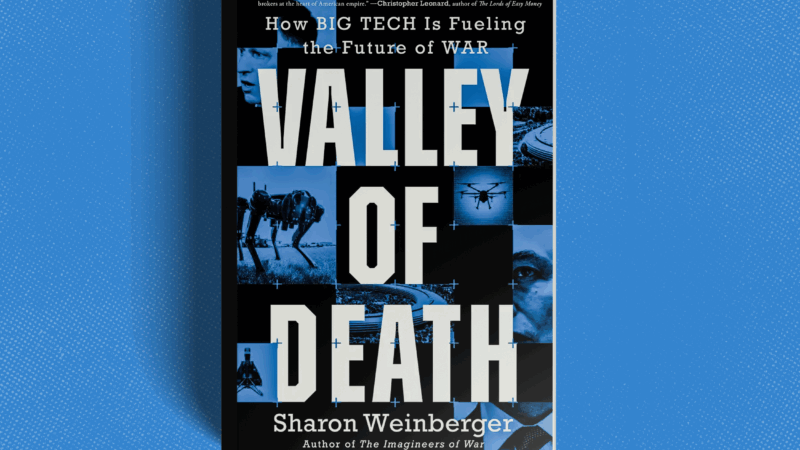
Valley of Death: How Big Tech Is Fueling the Future of War, by Sharon Weinberger, Little, Brown and Company, 320 pages, $32
Donald Trump reportedly consulted a chatbot before attacking Venezuela. After an artificial intelligence told him Venezuelans would celebrate the overthrow of their regime, the president came away from the operation "thinking Grok was ingenious," Time reports, based on conversations with Trump and his advisers.
A few months later, another AI nearly started another war. With the help of a chatbot, someone at U.S. Special Operations Command wrote a report about a Chinese ship bringing nuclear weapons parts to Iran. The U.S. military nearly attacked the vessel before realizing that the chatbot had steered the official wrong, according to CNN.
Killer robots have long been a part of the popular imagination, but fewer people predicted automated yes-men whispering in the ears of military leaders. Weirder yet, these yes-men are a consumer product that anyone can use. Grok had 117 million monthly users as of March 2026, according to SpaceX corporate filings, and what U.S. Special Operations Command has is "mostly just copies of the commercial stuff wearing lipstick," an official told CNN. Last year, the U.S. military signed $200 million deals with OpenAI, Anthropic, Google, and xAI (owned by SpaceX) to integrate their systems with military databases.
"The most likely application of AI models" by the military is "identifying potential targets that could then be destroyed by weapons. In other words, the models, which are in some cases trained and refined on data from people seeking information on everything from medical problems to marital issues, could now be applied to warfare," Sharon Weinberger writes in her new book, Valley of Death. It's akin to the dilemma Weinberger notes about Amazon providing cloud computing for the U.S. government: "A company that has years of data on your purchases of everything from books to medications also provides remote servers for intelligence agencies."
Weinberger, a journalist who has been covering the weapons industry for more than two decades, argues that commercial tech companies and the military-industrial complex have fundamentally transformed each other. Rather than publicly traded corporations specializing in weapons, Pentagon contracts now go to billionaires "straddling the commercial and federal marketplaces." Tech entrepreneurs shape their strategies around locking in taxpayer-funded contracts and state-enforced monopolies. Investors call themselves providers of "patriotic capital." Government agencies rush to invest in promising technologies. The products we use in everyday life are being shaped around military needs.
"Every drone company I had five years ago was a drone delivery company trying to sell to Walmart, and today they're military-first, and 90 percent of their revenue is from the military," venture capitalist Clayton Williams tells Weinberger. Anduril founder Palmer Luckey, who made virtual reality headsets for video games before moving into weapons development, predicts to Weinberger that "you are going to see augmented reality on every soldier's head before you see it on every consumer's head."
Silicon Valley has never been completely disconnected from state violence. The semiconductor manufacturers that put San Francisco at the frontier of electronics were largely providing parts for military equipment. Larry Ellison, the Oracle owner who recently refashioned himself as a media mogul, got into the I.T. business building a database for the CIA in the 1970s. And if there was a gap between the hippie hackers and the buttoned-down national security state, the CIA helped bridge it by bailing out Apple founder Steve Jobs. He advertised himself as fighting Big Brother and once stubbornly refused to "do business for the fucking federal government," but Jobs' company NeXT would have gone out of business in 1989 if the agency hadn't bought thousands of his computers, which private industry found expensive and not very useful.
The CIA used those computers for analyzing satellite imagery, using graphics technology developed by Pixar. Ten years later, the agency created a venture capital firm called In-Q-Tel to fund promising technological startups.
One of In-Q-Tel's earliest ventures was Palantir, a data processing company. Like Jobs, its founder Peter Thiel had a libertarian streak early on. Thiel told Wired in 2001 that his best-known company, PayPal, would foster "the ability to move money fluidly" and "the erosion of the nation-state." Less than two weeks after that magazine issue appeared, Al Qaeda attacked America and Thiel reinvented himself. "The secret coordination of the world's intelligence services," he wrote in 2007, would be "the decisive path to a truly global pax Americana."
A few years later, future OpenAI founder Sam Altman invited Thiel to give a guest lecture at a class Altman was teaching. "Competition is for losers," Thiel preached, telling the class that "you always want to aim for monopoly."
Although Thiel is aligned with the Republican Party, it was a Democratic administration that helped his vision take off. President Barack Obama began surging troops to Afghanistan in 2009, and Palantir promised to help stop the Afghan insurgency by integrating many different sources of surveillance data. (The technology was based on PayPal's fraud-detection techniques.) The company gave U.S. troops free access to its database software and even sent its engineers into the country in hopes of making Palantir indispensable to the war. Obama's surge failed to pacify Afghanistan, but Thiel's gambit succeeded at bringing him business.
Afghanistan also birthed an important part of the AI revolution: image recognition. The U.S. military began deploying Gorgon Stare, a drone-based camera system that could surveil an entire city at once, over Afghan territory. (According to Weinberger, Gorgon Stare was inspired by the 1998 movie Enemy of the State, about a rogue surveillance apparatus.) The system was simply capturing too much footage for human beings to watch, so the military began Project Maven, hiring civilian AI companies to develop better image recognition technology. When Google employees objected to participating, Palantir swooped in to take the contract. Project Maven became a comprehensive battlefield surveillance system, helping watch over the last U.S. troops leaving Afghanistan and contributing to the 2026 aerial massacre of schoolchildren in Minab, Iran.
The leading AI labs, OpenAI and Anthropic, originally promised not to get into the business of killing people. Weinberger calls this "a distinction without a difference," because they don't exclude helping to draw lists of targets. In 2024, OpenAI announced a partnership with Anduril on target detection and Anthropic announced a partnership with Palantir on "classified environments." As Weinberger points out, these could turn people's innocent queries into training data for killer robots.
Valley of Death hints at a big contradiction between how tech moguls speak and what they actually do. It's almost a dogma in the tech industry that the U.S. needs to be ready for war with China by 2027. Yet Silicon Valley's comfort zone is clearly with counterinsurgencies, not conflicts between great powers. Its technologies are better suited to imposing control from above than fighting a peer on equal ground.
The Russian invasion of Ukraine was a dry run for great power conflict. Although American military tech executives tried to make a big show of their contribution to the Ukrainian war effort, products from Palantir and Anduril proved mediocre compared to homegrown Ukrainian systems. "It's almost impossible to develop something that works without the contact with the problem space," Ukrainian technologist Andrey Liscovich told Weinberger, arguing that American technology companies lose their nimbleness in his country. And the challenge facing Ukraine is not really about making weapons smarter; it's about producing them cheaply at scale. In other words, great power conflict is an issue of physical bottlenecks, not intelligence.
The industry's enthusiastic engagement with Israel after October 7, 2023, which Weinberger portrays as a deviation from its otherwise China-focused strategy, makes more sense as a reversion to the mean. The U.S. focus turned back to fighting low-tech guerrillas and managing unruly populations. That was Silicon Valley's comfort zone. While insisting that China is still his No. 1 priority, Anduril's Luckey pitches Weinberger on a technology for dealing with tunnels in Gaza. He slips in the possibility that competition with China tomorrow will involve proxy wars like those of today. Of course.
In the war with Iran, "there is still little to show of startup technologies being used" by the U.S. military, Weinberger notes. (The two notable exceptions are Palantir's Maven database and SpaceX's satellite communications.) And that may serve Silicon Valley just fine. With so much military spending focused on capturing tomorrow's technologies, startup aerospace contractors can still "get to billions of dollars of revenue without an aircraft that flies," a venture capitalist brags to Weinberger. "Silicon Valley's 'fake it till you make it' works until people die," former CIA officer James Acuna tells her. That isn't a problem for most of the industry, yet.
Weinberger wonders whether putting power in the hands of private businessmen is dangerous for democracy. A better question may be whether it's good for the private marketplace. Increasingly insulated from the need to make money from customers, Silicon Valley has moved from technologies that enhance life and freedom to technologies that seek to destroy both.