
The FDA Promises To Streamline the Dauntingly Complex Rules for Approving Nicotine Products
The planned reforms could promote harm reduction by addressing a huge backlog that has resulted in routine violations of a statutory deadline.
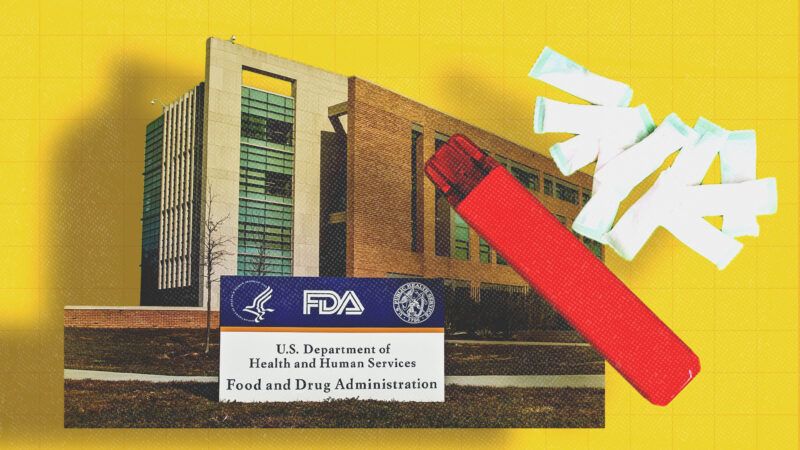
The Food and Drug Administration (FDA) this week announced that it is reevaluating its approach to approving nicotine products such as vapes and pouches. The Wall Street Journal reports that FDA officials want to "smooth the way for more tobacco products such as flavored vapes to legally enter the market by changing the rules to speed up the authorization process."
That is good news for manufacturers of nicotine products, who for years have struggled with regulatory bottlenecks, burdensome requirements that do not apply to cigarettes, and long delays in processing their applications for "premarket" approval. It is also good news for current and former cigarette smokers, promising to preserve their access to a wide variety of alternatives that are far less hazardous than combusted tobacco.
The planned reforms would build on progress that the FDA has made during the last couple of years, including its approval of nicotine pouches and vapes in flavors that former smokers demonstrably prefer. Those decisions recognize that concerns about underage use should not override the interests of adults who might want to dramatically reduce their health risks by switching to nicotine habits that do not involve lighting vegetable matter on fire and inhaling the smoke. But if the FDA is serious about tobacco harm reduction, it needs to overhaul a dauntingly complex, expensive, time-consuming, and frustrating system that makes it extremely difficult to legally market such alternatives.
"The Trump administration is committed to keeping nicotine out of the hands of kids, getting counterfeit vaping products off the streets, and providing safer alternatives for adults who want to quit smoking cigarettes," a Department of Health and Human Services (HHS) spokeswoman told the Journal. Regulate Smarter, a trade group chaired by former U.S. Sen. Richard Burr (R–N.C.), welcomed the FDA's announcement in an emailed press release, calling it "an encouraging and long-overdue course correction."
The need for that correction is clear from a lawsuit that Helix Innovations, an Altria subsidiary that makes nicotine pouches, and NJOY, the company's vape business, filed this month in the U.S. District Court for the Northern District of Texas. The complaint, which was also joined by two Texas retailers and the Texas Food & Fuel Association, argues that the FDA has failed to "comply with its obligations" under the Family Smoking Prevention and Tobacco Control Act (TCA), the 2009 law that gave the agency regulatory authority over tobacco products.
That law "expressly requires the FDA to authorize the marketing of new tobacco products (including alternatives to cigarettes) as 'appropriate for the protection of the public health,'" Helix et al. note. "To facilitate such authorizations, the statute requires the FDA to grant or deny new product applications as promptly as possible, and 'in no event later than 180 days after the receipt of an application.'" But the FDA "has never complied with this deadline."
The problem was exacerbated in 2016, when the FDA issued a "deeming" rule requiring premarket approval for myriad nicotine products, including vapes. In response to the resulting backlog, the FDA repeatedly extended application deadlines. But in May 2019, a federal judge in Maryland nixed those extensions, saying applications would have to be submitted by September 9, 2020, with enforcement against unapproved products delayed for another year.
In September 2019, the FDA proposed a rule that "set forth requirements related to the content and format" of premarket applications and "the procedure by which FDA would review" them. According to the lawsuit, that rule, which the FDA finalized in October 2021, "disregarded comments, evidence, and obvious alternatives that would have facilitated" the processing of applications.
Under the TCA, a premarket application is supposed to include product samples, proposed labeling, a "full description" of manufacturing and packaging, a "full statement" of the product's ingredients and operation, a "full report" of available information on the product's "health risks," and an "identifying reference" to any relevant FDA standard, along with "adequate information" about the product's compliance with it. The TCA also says applicants must submit "such other information relevant to the subject matter" that HHS "may require."
The FDA's 2021 rule "made it impossible for the FDA to issue orders on the vast majority of [applications] within 180 days," Helix et al. argue. It "did not set forth a viable way for the FDA to timely apply the statutory-authorization criteria to the vast number of new product applications the Deeming Rule required. Instead of trying to dig out of the application backlog the FDA had created for itself," the agency "required vast amounts of additional information from applicants—well beyond the TCA's requirements."
The FDA's demands included "granular descriptions of 'product formulation' that had little to do with any conceivable public health concern," the lawsuit says. The agency also required "extensive supporting materials," including "all studies concerning" the product's "pharmacological profile" and behavioral data indicating how the product might "affect the tobacco use behavior of both users and nonusers of tobacco products."
The process mandated by the FDA, critics complained, was "significantly more" demanding than the requirements for approving a new prescription drug or medical device, setting an "impossibly high" bar for manufacturers. And the FDA's procedures guaranteed that processing time would exceed the TCA's 180-day limit. Among other things, the agency said the clock would not start on that limit until it received the "last piece of information necessary to complete the submission."
The FDA also broke its process into three components: "acceptance" of an application, a "filing phase," and substantive review. The agency "would often refuse to accept [an] application on non-substantive grounds," such as "failure to 'comply with the applicable format requirements,'" Helix et al. note. The FDA's forms "sometimes lack the requisite fields for all products," they say, which causes the FDA to refuse acceptance for "purely administrative reasons."
By itself, the "acceptance" phase "often takes longer than the agency's 180-day statutory deadline," the lawsuit says. "For example, under the 2021 Final Rule, Helix's [applications] for certain of its [flavored nicotine pouches] were submitted on September 25, 2024, but not 'accepted' until August 12, 2025—321 days later."
Once an application is accepted, the FDA conducts a "filing review" to determine whether it contains "sufficient information to permit a full substantive review." That phase, Helix et al. say, "typically takes even longer than 'acceptance' review." And even after "an application had been accepted and filed," the FDA "would sometimes require further information from the applicant—including product samples that applicants offered with their initial submissions" but the FDA refused to accept at that point.
The FDA, in short, asserted the power to "unilaterally determine when Congress's 180-day review period started." And that, the plaintiffs argue, plainly violates the TCA.
After the FDA proposed the nicotine product regulations but before they were finalized, the court-set deadline for applications resulted in thousands of submissions covering 4.8 million products, mainly nicotine vapes. Although "this flood of reports and applications was entirely predictable," the lawsuit says, "the FDA was totally unprepared" for it.
As of January 2021, the FDA had managed to look at just 0.6 percent of the applications. The following month, it noted "the unprecedented number of applications" and said it was unlikely to review them by September 9, 2021. That was when the protection against enforcement for companies with pending applications was set to expire, and it was six months after the TCA's 180-day limit.
"Given the unprecedented number of applications," the FDA conceded in June 2021, "the likelihood of FDA reviewing all of the applications" in compliance with the statutory and judicial time limits was "extremely low." It said that the "number of applications exceeds anything that we've ever seen by orders of magnitude" and that reviewing them had been "very challenging due to the size, complexity and diversity of these submissions."
Thanks to the FDA's onerous demands, Helix et al. argue, that challenge was inevitable. Critics of the agency's regulations predicted exactly this sort of backlog.
As of October 2022, the HHS Office of the Inspector General reported, the FDA still had a backlog of more than 53,000 vape applications that it had received two years earlier, and it was routinely missing the TCA's 180-day deadline. A 2022 analysis by the Reagan-Udall Foundation noted that the FDA had "struggled to function as a regulator in part due to some of its policy choices," including the "scope of the product review regulations," which "have been difficult for both stakeholders and [the FDA] to apply in practice." As of last March, according to the lawsuit, the FDA "still faced a massive backlog" of about 130,000 premarket applications.
In September 2025, the FDA launched a pilot project aimed at facilitating approval of nicotine pouches. That initiative "got off to a promising start," resulting in the December 2025 approval of six Helix products, the plaintiffs say. "But the pilot program's limited progress only confirmed the need for permanent, structural regulatory changes to fix the problems" that the 2021 rule "codified and exacerbated."
Last May, the FDA "again recognized the statutory and other problems with the backlog of applications" by issuing "guidance for de-prioritizing enforcement action against products in certain categories," the lawsuit says. "But the FDA's discretionary enforcement moratoria on certain (thus far unidentified) products is no substitute for the decisions that the TCA requires the FDA to make within 180 days."
The FDA is now contemplating reforms aimed at addressing the problems described in the lawsuit. "The agency is looking to add more flexibility for companies to get more products authorized," the Journal reports. "One potential way to do that is by simplifying requirements for scientific studies and speeding review times….The administration hopes to see products it considers less harmful for smokers, such as flavored vapes, enter the market more easily."
In a recent interview with Nicotine Insider, Azim Chowdhury, a tobacco and nicotine specialist at the law firm Keller and Heckman, notes that "there is a tremendous amount of potential redundancy" in premarket applications. He questions the need to reiterate the same basic information in applications for every product variation.
"There are a lot of companies in this industry—including many small businesses—that want to comply," Chowdhury says. "They are asking FDA to tell them, in a clear and predictable way, what they need to do." The current process can cost businesses "millions or even tens of millions of dollars," he notes. "That creates a system that, in practice, can be navigated much more easily by the largest tobacco companies and multinational corporations than by smaller manufacturers."
Chowdhury emphasizes the harm-reducing potential of alternative nicotine products, which the FDA has repeatedly recognized. "If the goal is a regulated marketplace, then there has to be a realistic pathway from the marketplace we have today to the marketplace FDA wants," he says. "If we create a regulated market so narrow that it doesn't reflect what adult consumers actually want, we're going to miss opportunities to move people away from combustible cigarettes."