
Free Speech Groups Say the FCC's Disney/ABC Investigation 'Reeks of Political Pretext'
FIRE, Cato, PEN America, and others take on the broadcasting police.
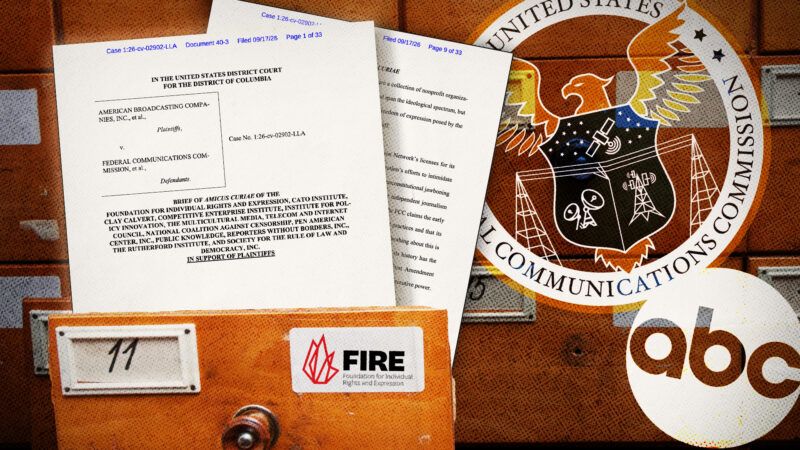
It's no surprise that President Donald Trump is no fan of the media—just days ago, he banned three outlets from the White House, a move that is very likely unconstitutional. And since his first term in office, he has called for the Federal Communications Commission (FCC) to pull critical networks' broadcast licenses—even those that often don't have licenses.
Earlier this year, the FCC announced it would review the broadcast licenses of eight ABC affiliates—in particular, those owned by ABC's parent company, Disney. Under the review, Disney must apply to renew its broadcast licenses years ahead of schedule.
The FCC said its action stemmed from concerns that Disney had engaged in "unlawful discrimination," but Trump and FCC Chairman Brendan Carr have each publicly criticized and threatened ABC for its editorial decisions.
Last month, Disney sued the FCC, seeking an end to the investigation. Multiple free speech and civil liberties groups are taking Disney's side.
"The FCC's initiation of early renewal for the ABC Television Network's licenses for its owned and operated stations is a serious escalation of this Administration's efforts to intimidate the media," opens an amicus brief filed last week in the U.S. District Court for the District of Columbia. "These began with informal actions that crossed the line into unconstitutional jawboning and now have ripened into official actions designed to punish ABC for independent journalism and entertainment programs the current Administration finds offensive."
The brief was filed on behalf of several free speech advocacy organizations, including the Foundation for Individual Rights and Expression (FIRE), the Cato Institute, the Competitive Enterprise Institute, Reporters Without Borders, and PEN America.
"Coming as it does after years of demands by Donald Trump to revoke network 'licenses,' and in the wake of nineteen months of jawboning by the President and Chairman Carr targeting ABC programming and personalities, the unprecedented proceeding calling for early review of ABC's television station licenses reeks of political pretext and should be enjoined," the brief adds.
FIRE, et al. aren't the only ones to notice that this FCC is more aggressive than most.
"The FCC's proceedings against ABC are a gross denial of procedural and substantive due process for ABC," Mark S. Fowler, who spearheaded a deregulatory effort as FCC chairman under President Ronald Reagan, wrote last month in a filing on Disney's behalf. "The FCC's investigative demands of Disney/ABC are more intrusive, burdensome and extreme than anything I observed as a chairman; indeed, the early license renewal process has not been invoked in more than 50 years."
"The blatant interplay between presidential complaints respecting ABC's broadcast content and subsequent FCC Chairman Carr's punitive actions regarding broadcast content…define the Chairman as a biased political operative with a personal stake and bias in this case's outcome," Fowler continued. "Never in its history has the agency ever acted so corruptly and unlawfully to intrude on broadcasters' First Amendment rights."
According to the FIRE brief, the FCC's case is extremely weak. The claim of "unlawful discrimination," for example, stems from the accusation that Disney took part in diversity, equity, and inclusion (DEI) initiatives.
DEI has been a target of Trump's second term: Within his first two days back in office, the president signed two executive orders seeking to end its use.
Even though Disney had already ended its DEI programs, "significant concerns remain" that the company may still be "promoting invidious forms of DEI discrimination," Carr wrote in a March 2025 letter. In particular, Carr cited ABC's previous pledge to draw more of the "regular and recurring characters" on its TV shows from "underrepresented groups."
But "the letter did not specify how Disney and ABC's practices might have violated any FCC rule, let alone provide a basis for non-renewal (or early renewal) of licenses," according to the brief. Instead, Carr cited Trump's executive orders, neither of which "offered a definition of DEI" but simply "seemed to assume DEI, however defined, is a per se violation of existing civil rights laws."
That's not necessarily true. "Courts have rejected the assumption that DEI initiatives necessarily violate antidiscrimination laws," the filing continues. "Courts have also found the government's references to 'DEI' are undefined to the point of being unintelligible and unadministrable."
Ultimately, they conclude, the only remedy is for the court to intervene.
"Broadcasters' decisions about what stories to tell, what their editorial positions will be, and who they should hire to convey those messages are all protected by the First Amendment," the amicus brief concludes. "This proceeding is a shameful chapter in the history of the FCC. This Court must intervene to halt the Commission's retaliatory proceeding and continued abuse of executive power."