
The National Debt Has Crossed $40 Trillion. Both Parties Are Responsible.
And both are hiding behind a lie of omission.
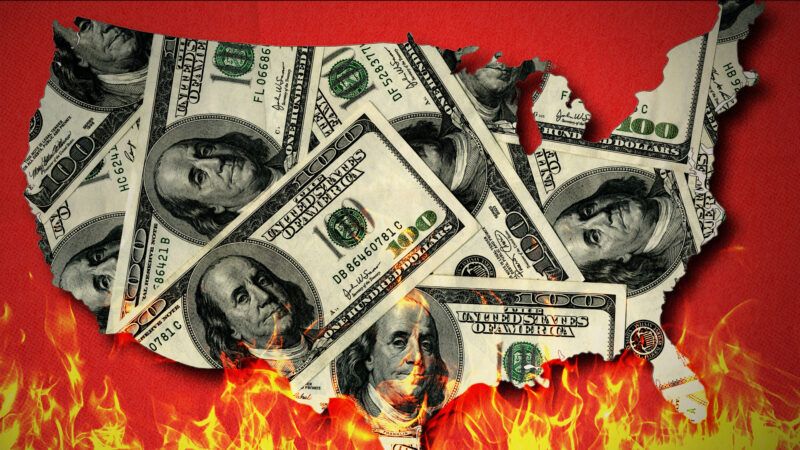
The U.S. national debt just crossed the $40 trillion threshold, doubling in less than a decade. Washington politicians have responded with their favorite fiscal game: blaming the other party. Democrats say Republican tax cuts are the culprit. Republicans say Democratic spending is the root cause. But both parties are responsible, with both hiding behind a lie of omission. And if we let them, they'll keep driving us into the same wall together.
Sen. Patty Murray (D–Wash.) recently called Republican tax cuts "the single biggest driver" of the debt across the last 25 years. The number uses an unrealistic 2001 baseline that projected endless surpluses, as if the late-1990s revenue windfall would last forever. The Brookings Institution's Jessica Riedl makes a more honest comparison by lining up the actual budget in 2000 against 2026. Tax cuts have reduced revenue by roughly 2 percent of gross domestic product. Spending rose by 5.7 percent, nearly three times as much.
Its a common and effective talking point, but not true. Below is a comparison of the 2000 vs. 2026 federal budget. Tax cuts have totalled 2% of GDP (unrelated economic factors also reduced revenues). But spending has jumped 5.7% of GDP since 2000. Lots of blame to go around. https://t.co/JZUBKyYDS7 pic.twitter.com/8AkqGMps9B
— Jessica Riedl 🧀 🇺🇦 (@JessicaBRiedl) August 22, 2026
Tax cuts can be great, especially when structured to move us toward a better overall tax code. But they are not free and often do not pay for themselves, largely because they come with lots of nonproductive handouts to special interests.
Yet the fact of the matter is that despite every tax cut since 2001, revenue today sits near its long-run average as a share of the gross domestic product (GDP). With spending climbing nearly six points, we know exactly where the problem lies.
The Congressional Budget Office projects federal spending to rise further, from 23.3 percent of GDP this year to 24.4 percent in 2036. For those paying attention, the drivers won't come as a surprise: entitlement programs and interest payments. Discretionary spending, defense included, is poised to shrink relative to GDP. Revenue holds near its average.
But while Republicans blame Democrats for expanding spending, they have joyfully participated. As David Stockman documented in his 1986 book, The Triumph of Politics, the Reagan Revolution failed to truly reform welfare and entitlement spending because Republicans were active in their expansion in the decades before.
More recently, Republicans who spent years complaining about Obamacare have failed to abolish it, let alone reform its finances. Today, you don't hear a peep out of Republicans about reforming Social Security and Medicare, though they have made some cosmetic adjustments to Medicaid and the Supplemental Nutrition Assistance Program (SNAP), as they were cutting taxes.
This is not new. About 26 years ago, Social Security's trustees were already projecting the trust funds to run dry in 2037, after which payroll taxes would cover only 72 percent of benefits. Today, the trustees expect the old-age fund to be depleted by around 2032, covering about 77 percent of benefits thereafter. And we have always known why: longer lives, lower birth rates, fewer workers per retiree. Maintaining these benefits without crushing taxes was always going to mean a lot of debt.
Medicare's Hospital Insurance fund is estimated to run dry around the same time. But as the Hoover Institution's Tom Church notes, Medicare's real fiscal problem is that we now rely on general revenue to cover more than half of its outlays. This amounts to roughly $10 trillion over 2026-2035, mostly from Part B (a medical insurance program for outpatient and doctors' visits). That's huge, but it's not news, either.
All of this has frustrated me for years. Those of us warning about debt have been dismissed as primitives. When interest rates were low, debt was cheap. We were assured that if growth beat the borrowing rate, we could roll it over almost for free. The reality is that even low rates on explosive debt aren't cheap, and there was little chance that rates would stay low forever.
Here's what the low-rate crowd never understood, and what this decade's inflation should have taught everyone: Government debt is a promise to run future surpluses. The market expects no less, and thus, the debt's real value depends on whether investors believe that promise.
When Washington dropped roughly $5 trillion in pandemic dollars into the economy with no plan to pay for any of it, investors reappraised this promise and the price level adjusted. The inflation of 2021 and 2022 was not an unlucky storm. It was the market's response to a government taking on debt it didn't have fiscal backing for. Higher interest rates followed, and we are still living with them.
That's the risk Washington is not pricing into its complacency. The danger of an unreformed entitlement state is about more than interest payments crowding out the rest of the budget. It's that bondholders will stop believing future surpluses will materialize, and the adjustment comes through the price level again. Unfunded Social Security and Medicare promises are, in effect, a standing commitment to more debt and future inflation.
So, the question is whether the politicians who claim to be alarmed by the crossing of this threshold will stand up and turn the tide of red ink heading our way.
COPYRIGHT 2026 CREATORS.COM