
Will Tucker Carlson Run for President? Don't Bet on It.
Third-party bids are much more fun to talk about than do. Plus, there's reason to suspect it's all a bid to boost J.D. Vance.
Third party/independent trial balloon season started three months early last Wednesday when the popular conspiratorial podcaster Tucker Carlson released his 10 principles for saving America, right after having been urged by a group of MAGA exiles—including Rep. Thomas Massie (R—Ky.) and former Rep. Marjorie Taylor Greene (R–Ga.)—to run for president.
"Both parties have colluded against the population to make their lives better and our lives worse," Carlson said, sounding very much like the guy who told the Columbia Journalism Review last month that "there's going to be a third party, and I'm going to do everything I can to bring that about."
But will he? News articles abound with anonymous Carlson confidants throwing cold water on the idea. Politico's Playbook newsletter on Monday quoted a "source close to Carlson" as saying, "He won't run against JD Vance. He will very likely run if [Donald] Trump endorses [Marco] Rubio."
As the Ohio-based political observer and critic of postliberalism Jason Hart never tires of pointing out, Tucker Carlson and Vice President J.D. Vance have an intense and productive political relationship, anchoring one major side of the Trump-succession fights that have roiled the conservative coalition since the assassination of Charlie Kirk.
Carlson was one of a dozen attendees at a foundational 2019 meeting in Rockbridge, Ohio, convened by Vance and his longtime mentor Peter Thiel, that soon blossomed into "one of the most influential forces in GOP politics," according to a November 2025 Washington Post article about the collection of Silicon Valley investors, economic populists, and media entrepreneurs. "Political strategists," the Post asserted, "credit the close-knit network of businessmen-cum-donors with helping fuel the president's reelection last year and propelling one of its own—Vance—into the vice presidency."
It was also good for Carlson: 1789 Capital, a "patriotic" and "anti-woke" venture capital firm founded by some of the Rockbridge attendees in 2022, chose as its first investment Last Country Inc., the digital media company Carlson founded after being fired by Fox News. (Beginning in the momentous month of November 2024, the venture fund brought on Donald Trump Jr. as a partner.)
The vice president and the podcaster have had each other's backs ever since that first meeting, in service of Rockbridge's aim to (in the Post's characterization) "equip MAGA to outlive Trump." In March 2025, Carlson called Vance "the only person in the entire Republican Party…who's capable of carrying on the Trump legacy and expanding it, making it what it should fully be." At a Heritage Foundation event the following month, he said "J.D. Vance is the future, period."
Things got squirrely after the September 2025 assassination of Charlie Kirk, which sent some in the conservative mediasphere down conspiratorial and antisemitic rabbit holes, leading both to widespread condemnation and strategic fence-sitting. Amid a season of reporting about racist and antisemitic trolling among professional young conservatives in Washington, D.C., Carlson chose this moment to interview Nazi Groyper Nick Fuentes, a decision that would soon lead to convulsions at the Carlson-supporting Heritage Foundation.
Vance's first response to all that was to post on X that "The infighting is stupid." Then, in a December 2025 interview with Unherd's Sohrab Ahmari, the veep expanded.
"Tucker's a friend of mine. And do I have disagreements with Tucker Carlson? Sure. I have disagreements with most of my friends, especially those who work in politics," he said. "I find the idea that Tucker Carlson…that his views are somehow completely anathema to conservatism, that he has no place in the conservative movement, is frankly absurd. And I don't think anybody actually believes it. I think that there's a certain amount of gatekeeping where people are trying to settle their own ideological scores, and that's what's really going on here."
At the time, Vance's big-tent approach toward Carlson was shared by his boss. But no more. After Trump's fateful decision to launch what would become an open-ended war with Iran this February, the president's former campaign hype man became one of his fiercest critics, accusing the commander in chief of being hoodwinked by Israel to betray American First. Trump responded by telling the New York Post that "Tucker's a low IQ person that has absolutely no idea what's going on," then following that up with a Truth Social broadside against Carlson, Megyn Kelly, Candace Owens, and the resigned director of the National Counterterrorism Center, Joe Kent.
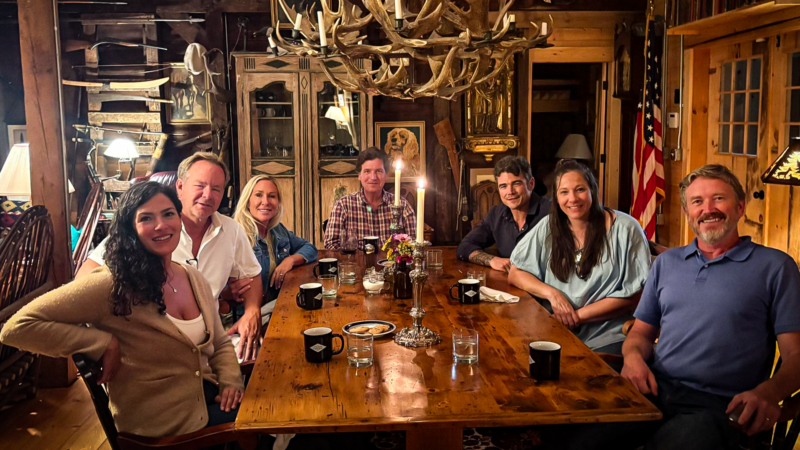
Kent was around the dinner table earlier this month with Massie, Greene, and other anti-war voices trying to convince Carlson to run. "We said no more foreign wars and we meant it and supported Donald Trump because he made that promise," Greene wrote on X. "But he's betrayed us all. Our commitment is America First for all Americans, right, left, and center. The movement has begun."
If that movement is contingent on whether Donald Trump tabs Vance over Rubio in the succession sweepstakes, then it's not likely to attract much of the left and center, let alone the more Rubio-sympathetic right. Vance's approval ratings, while not as disastrous as Trump's, still hover in the low 40s and high 30s.
Carlson's gambit also puts Vance in the awkward spot of being championed by the very people Trump has run out of his own movement. As we have seen for nearly a decade now, conservatives who dare to publicly oppose the two-time president do not last very long in national Republican politics. If Vance is seen as the exiles' champion, neither will he.
So if Trump called Carlson's bluff by anointing Rubio, would that trigger the threatened third-party run? Don't bet on it.
The last two decades have seen an almost impressive list of trial-ballooned new-third-party or independent presidential campaigns that mostly never got off the ground: Howard Schultz, Mark Cuban, Larry Hogan, Kanye West, Mike Bloomberg, John Kasich, Evan McMullin, David French, No Labels, Americans Elect, American Renewal, the Forward Party, ad infinitum. One of the only start-from-scratch presidential efforts to achieve ballot access in even half the country over that span was the 2024 run by Robert F. Kennedy Jr., who happily exchanged what would have been a distant third-place showing for a plum Cabinet spot.
The work of overcoming major-party-devised ballot-access laws in 50 states is a bewilderingly tedious slog, much more strenuous and unsexy than hosting a daily podcast with millions of subscribers, or attending small meetings with the billionaires and populists who might make the next king or at least finance your next venture.
Indeed, the Carlson juggernaut may be over even before it's begun. "Tucker, he's not running for president," Greene told Politico. "Our argument is the two-party system is a complete and total failure.…I am 100% totally completely disgusted with both parties."
This will not be the last time you hear that statement before November 7, 2028. Nor will it be the last time you hear about a presidential candidate who will not, in fact, run for president.