
Don't Let AOC Retcon Her Starring Role in 'Woke 1'
Would President AOC eschew wokeness? I doubt it.
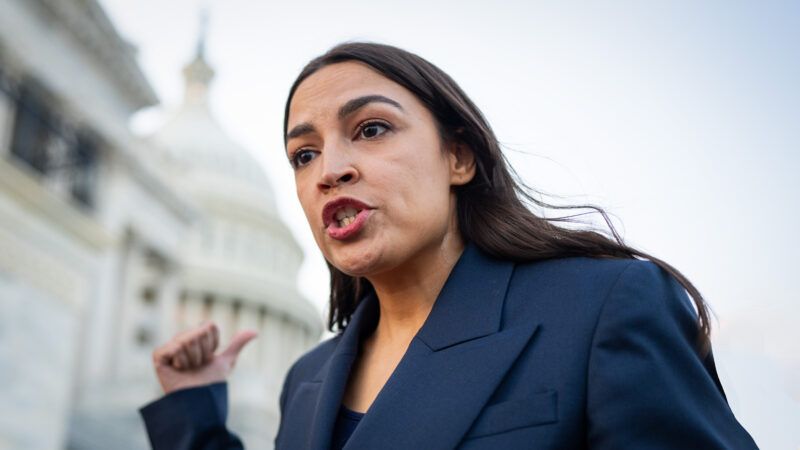
Rep. Alexandria Ocasio-Cortez (D–N.Y.) raised eyebrows this weekend when she merely shrugged off her previous enthusiasm for electorally toxic far-left cultural positions.
"I have a local city councilman who has this saying: 'Woke 1 was crazy,'" said AOC with a laugh. She was referencing a tweet by Chi Ossé, a New York City councilman, who similarly uttered this line in an attempt to explain why he had previously said a "white man should not be the next speaker" of the City Council.
Simply put, this attitude is far too blasé. While it's encouraging that so many progressives have backed away from some (though by no means all) of their really terrible ideas, no one should be so naive as to accept these conversions at face value. Moreover, it's quite deflective of them to act as if "Woke 1" was something bad that just sort of happened—like a hurricane or an earthquake—and they passively accepted it because what else could they do?
In fact, AOC and Ossé sound a bit like Anchorman's Ron Burgundy issuing his well-quoted lamentation about his team's outrageously violent, murder-fueled battle royale—"that escalated quickly"—while nonchalantly sipping a beer. Perhaps Woke 1 involved nothing quite so absurd as Steve Carell killing a guy with a trident, but it was still a fairly crazy time, and importantly, political figures such as AOC did absolutely nothing to try to stop it. She was more than complicit in it.
In 2019, AOC posted a video criticizing New Yorkers who wanted to grow cauliflower instead of yuca in their community gardens as complicit in colonization. (Neither cauliflower nor yuca is indigenous to New York.) In 2022, she weighed in on the fight over the gender neutral term Latinx, taking fellow Democrats to task for being too quick to abandon their attempts at inclusivity, despite polls consistently showing that large shares of Latin people did not like the term very much and would be less likely to vote for Democrats who used it. And she said that it was offensive for Secretary of State Marco Rubio to claim cowboy culture originated in Spain; AOC instead credited "African enslaved peoples" with this contribution. That was five months ago.
Those are just a few colorful examples of AOC willfully participating in wokeness discourse and militating in favor of the more ridiculous position.
It's true that broader debates about the excesses of wokeness inevitably involve competing definitions of what counts as woke. In the previous decade (and prior), people tended to label this thing political correctness and mainly focused on irritation at speech-related cultural policing: virtue signaling, the concepts of safe spaces and microaggressions, and cancel culture. But since political correctness is clunky and woke is just a single syllable—much better for headlines!—the latter eventually won out. Wokeness also became associated with far-left policy positions that are not strictly related to culture and speech, such as abolishing the police, borders, and various quasi-democratic aspects of the U.S. government (the Senate, the Supreme Court, the Electoral College, and so on). The policing issue in particular has become one of the defining aspects of woke overreach, as the killing of George Floyd sparked a backlash against excessive policing that went way too far and mostly became a pretext for far-left activists to do some thought policing of their own while professional grifters enriched themselves.
It's certainly fair to conclude that the cultural pendulum has swung back the other way, and note that left-wing media figures, activist students, and social media mobs no longer have nearly as much power to enforce orthodoxy and punish dissenters. Democratic politicians largely attribute their reticence to challenge such forces as one of the reasons they are now thoroughly out of power.
But much like Odysseus referring to his own time period as "our Age of Bronze" in Christoper Nolan's very successful (though not universally appreciated) adaptation, there's something a bit too meta about calling it "Woke 1" and saying, well, that's all over now, and we'd never do it again. Trust us.
At best, AOC's newfound ambivalence for wokeness is a profoundly weak choice, and one that she would clearly eagerly jettison if the pendulum swung back in that direction.