
Trump Administration Will Pay $1.2 Billion To Cancel More Offshore Wind Projects, Calling It 'Common Sense'
German energy company RWE decided "there is no path forward to permit these projects in the U.S. for the foreseeable future."
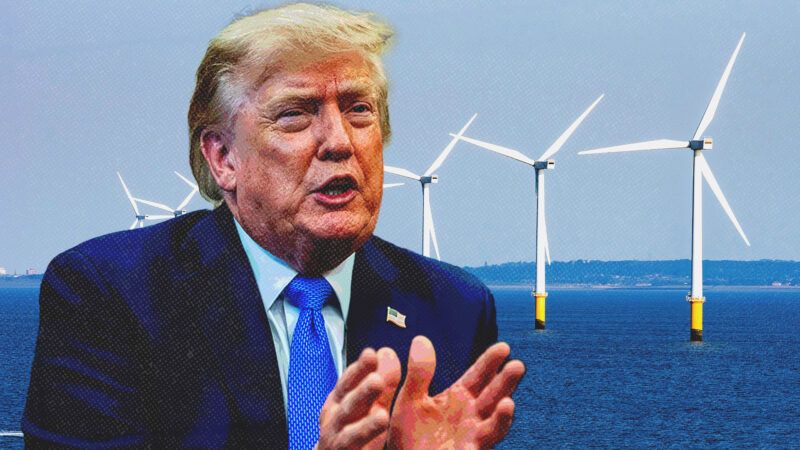
President Donald Trump's least favorite energy source was dealt another blow on Thursday when German energy company RWE announced that it was backing out of three early-stage offshore wind projects in New York, Louisiana, and California.
In exchange for giving up the lease rights, RWE will receive a $1.2 billion reimbursement—about what the company paid for the three leases—from the federal government. The company plans to "invest about the same amount" in natural gas projects, reports The New York Times.
The administration has touted the deal as a win for energy pragmatism. In a statement, Interior Secretary Doug Burgum said: "Americans deserve an energy system built on common sense, not one dependent on costly subsidies or technologies that can't meet our country's current demand."
However, a reading between the lines indicates that RWE's decision was based less on creating "an energy system built on common sense" and more on survival.
"After careful consideration, it was determined there is no path forward to permit these projects in the U.S. for the foreseeable future," the company said on Thursday. "This resolution best serves the interests of [RWE's] stakeholders and allows [RWE] to direct resources toward energy projects that can be advanced with certainty."
Given the wind's prospects over the past 18 months, it's hard to blame RWE for its skepticism.
Trump has long loathed offshore wind, and since returning to office, he has set his sights on halting its development by employing tactics not dissimilar to what his predecessor, Joe Biden, used against fossil fuels.
On Day 1, Trump issued a directive ordering a "temporary withdrawal" of all leasing and permitting of the energy source in federal waters. In December 2025, a federal judge struck down the order, calling it "arbitrary and capricious and contrary to law."
In March, the administration revived its attack on the energy source with a new strategy: paying developers to cancel development. That month, the government struck its first deal with TotalEnergies, which received a near $1 billion reimbursement to surrender two leases in North Carolina and New York and invest the sum in fossil fuel projects. The administration has since reached four other such agreements, including Thursday's with RWE.
The president's disdain for wind energy hasn't remained at sea or even on public lands under his jurisdiction; his administration has also stalled projects on private lands.
Under standard procedure, large inland turbine projects must receive approval from the Defense Department to ensure that development won't interfere with radar systems or flight paths. Most of the time, these projects are approved with no issues. But if they interfere with radar, a developer can pay for the Pentagon to update its radar system. These assessments "can take as little as a few days to complete," according to the Financial Times.
Since April, the Pentagon has halted all approvals for these projects under the guise of "national security." The order has frozen 106 projects nationally, "representing an estimated $47 billion in potential investment," reports the Times. On Thursday, a federal judge issued a preliminary injunction requiring the Defense Department to resume its reviews while a court challenge against the order continues.
Conservatives and MAGA-types might justify Trump's payouts and pauses of wind power as necessary to correct against the green energy spending spree and fossil fuel antagonism of the Biden administration. On one hand, they aren't wrong that Biden's moves were bad for energy markets (and thus prices). However, needlessly making it impossible for an entire industry to function in the U.S. isn't "common sense," like Burgum says. It's just trading one bad energy policy in for another.