
'Scrap It and Start All Over': Ex-Bush and Obama Officials Say the War on Terror's Powers Have Gone Too Far
In a rare display of candor, former Attorney General Alberto Gonzales and former Homeland Security chief Jeh Johnson reflected on torture, Guantanamo Bay, and the 2001 Authorization for Use of Military Force.
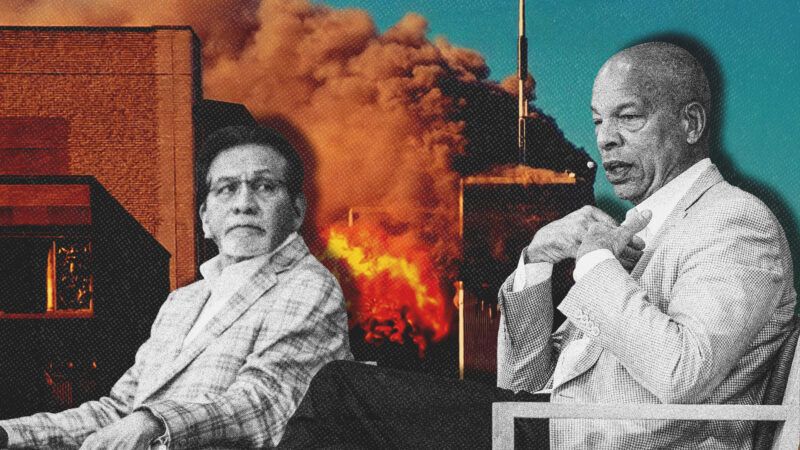
ASPEN, Colo.—The senior U.S. officials who coordinated and enforced the response to 9/11 have long since left government. But the legal architecture put in place in the wake of the terror attacks remains, in many ways, more robust than ever.
How do some feel now?
Alberto Gonzales—who was White House counsel on September 11, 2001, and later attorney general—and Jeh Johnson—who was general counsel of the Department of Defense and secretary of homeland security under former President Barack Obama—provided a rare window into that question at the Aspen Ideas Festival late last month in a conversation that spanned the 2001 Authorization for Use of Military Force (AUMF), torture, and Guantanamo Bay.
"I think President Bush and certainly I were stunned, were surprised that the AUMF is still in existence and relied upon, quite frankly," said Gonzales. That resolution—which gave the president power to use force against the nations, groups, and people involved in 9/11—has been invoked continuously to carry out counterterrorism activities in a slew of countries, even when the mission appears to have little connection to the terrorist attacks almost 25 years ago.
"We never envisioned that it would go beyond dealing with the particular threat that existed in 2001," Gonzales continued. "I think all of us have an obligation to ensure that our branches of government are checked when they exercise power, particularly the executive branch, even in a time of war."
This is relevant right now amid the war in Iran. "I interviewed a bunch of members of Congress who voted for the 2001 authorization and the 2002 authorization," said Johnson. "One of them told me that once an authority is conferred, it's almost impossible to take it back." (This is true in many ways.) "The interpretation of the 2001 authorization is way beyond what I'm sure any member of Congress in 2001 would have envisioned….So in principle, a sunset is a good idea." Gonzales' answer was a bit more direct: "I think it should sunset," he said. "If a new threat arises, go to Congress, make a case, and Congress gives another authorization or a declaration of war."
On torture, Gonzales sought to draw a distinction between the "enhanced interrogation techniques" used by the George W. Bush administration and the notorious human rights abuses that took place at Abu Ghraib prison during the Iraq War. When it came to waterboarding, Gonzales said he takes "comfort in the fact that there've been sworn testimony by the director of the CIA, by the director of the [National Security Agency] NSA and by my successor at [the Department of] Justice…that information was extracted from these interrogations that made a difference in keeping America safe." In response to a question from journalist Mary Louise Kelly about it violating the Geneva Conventions, he responded: "That was certainly not the position of the Department of Justice."
Johnson, meanwhile, got at one of the more eternal dilemmas: Do we prioritize freedom or feeling safe? "There's a pendulum effect between what Americans are willing to accept by way of an imposition on our civil liberties during times of high anxiety and more security," he said. "By 2009, that pendulum had swung in the other direction, and we wanted change….I think the big challenge for Americans is to recognize manufactured fear, manufactured anxiety spun up by our leaders."
Yet the most sparks flew when the two were pressed about Guantanamo Bay, the U.S. military base and detention camp in Cuba that has held many detainees—some of whom have long been cleared for release—for years without charge or trial.
"It was never the intention this would be a long-term solution," Gonzales said. "It was a short-term solution to an immediate problem." On the subject of why they weren't transported to the U.S. to stand trial, he conceded that "perhaps there is a basic rule of law question" but countered that "some people don't" want them brought here, though it's worth noting that the beauty of a constitutional right like due process is that it is not supposed to be up for a vote.
Johnson, meanwhile, admitted to being the Obama administration's "biggest proponent of keeping that system," but said he would not have done so "if you had told me that there had been not a single trial."
Johnson's most notable role, as the head of the Department of Homeland Security (DHS), was itself an outgrowth of the 9/11 response. "The thinking that created [DHS] in 2002 is way outdated. The thinking then was…we didn't need a ministry of interior or Department of Homeland Security because we're separated from the rest of the world by two oceans. And that all changed on 9/11," he said. "And if we consolidate into one Cabinet-level department, the regulation of all the different ways somebody can get into this country—land, sea, and air, TSA, Coast Guard, Border Patrol, Customs—we will have kept the bad guys out. That thinking is now outdated."
So now what? "Frankly," he said, "I think we need to scrap it and start all over again."