
1776 All-Stars: Patrick Henry Knew To Fear American Kings
Henry's warning about presidential powers is especially prescient today.
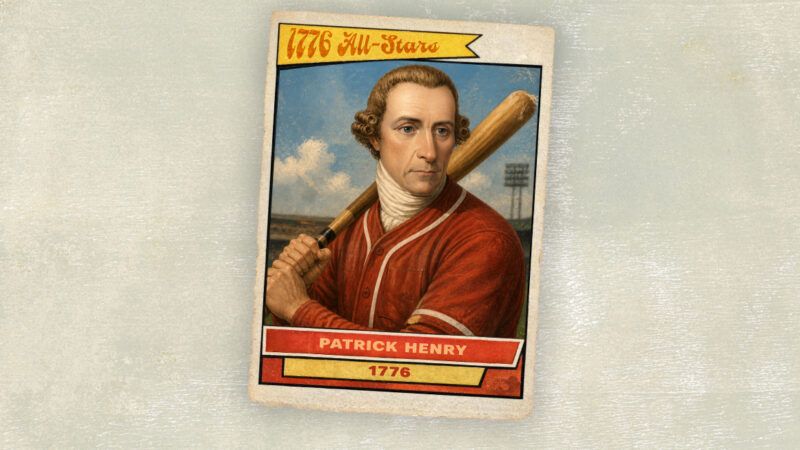
This is part of 1776 All-Stars, a series about Reason's favorite American Founders. Read more here.

The proposed U.S. Constitution "squints toward monarchy," Patrick Henry complained at the Virginia Ratifying Convention in 1788. "Does not this raise indignation in the breast of every true American? Your president may easily become king."
Henry's warning about presidential powers, which looks especially prescient today, was part of his broader case against James Madison's replacement for the Articles of Confederation. Although Henry lost that battle, his heroic reputation as an early and eloquent advocate of independence earned him a respectful hearing, and his critique helped shape the Bill of Rights.
Madison's plan, Henry warned, repudiated the principles that drove the Revolution. "Here is a revolution as radical as that which separated us from Great Britain," he said. "It is as radical, if in this transition, our rights and privileges are endangered, and the sovereignty of the states be relinquished: and cannot we plainly see, that this is actually the case? The rights of conscience, trial by jury, liberty of the press, all your immunities and franchises, all pretensions to human rights and privileges, are rendered insecure, if not lost, by this change."
The Virginia convention nevertheless approved the Constitution. But it also proposed a raft of 40 amendments that reflected Henry's concerns. They included explicit protections for freedom of speech, religious liberty, trial by jury, and the right to arms, along with an amendment affirming the "sovereignty of the states" that Henry feared would be lost, similar to the language that was later ratified as the 10th Amendment.
The man who would play a central role in the Revolution and the debate over the Constitution began his adult life as a failed retailer whose business setbacks drove him to a job serving drinks at his father-in-law's tavern. Determined to support a growing family that would eventually include 17 children, Henry lived in constant dread of debt as a struggling planter, ever-hopeful land speculator, and self-taught lawyer whose formal education ended when he was 10. But he made a name for himself as a fiery advocate of the American cause.
In 1763, when Henry was 27, he defended a 1758 Virginia law that reduced the colony's compensation for Anglican clergy against a lawsuit by James Maury, an aggrieved minister. King George II's Privy Council had overturned that law in 1759, and Henry, who represented the parish vestrymen who would have to pony up the back pay that Maury claimed he was due, viewed that veto as an outrageous example of interference with local rule.
"A king, by annulling or disallowing laws of this salutary nature, from being the father of his people, degenerates into a tyrant, and forfeits all rights to his subjects' obedience," Henry declared. These were shocking words at the time, but they evidently swayed the jury, which awarded Maury just a penny in damages.
Henry made a similar splash as a freshman Virginia legislator in 1765, when he denounced the Stamp Act, which imposed the first direct tax on American colonists. Henry reportedly noted that "Tarquin and Julius had their Brutus," while "Charles had his Cromwell," adding that "he did not doubt but some good American would stand up, in favour of his country." When House of Burgesses Speaker John Robinson condemned the implied endorsement of assassination as treason, Henry withdrew his comment, attributing it to his passionate concern for "his country's dying liberty." But according to a tradition that Henry biographer Thomas S. Kidd describes as "almost certainly apocryphal," Henry was more defiant, saying, "If this be treason, make the most of it!"
Henry delivered his most famous speech as a delegate to the Second Virginia Convention, which was convened after the colony's royal governor suspended the House of Burgesses in 1775. Speaking a month before the Battles of Lexington and Concord, Henry said it was folly to call for peace, although his exact words are uncertain. "Is life so dear, or peace so sweet, as to be purchased at the price of chains and slavery?" he reportedly asked. "Forbid it, Almighty God! I know not what course others may take; but as for me, give me liberty or give me death!"
Henry later served several terms as Virginia's governor and as a member of its House of Delegates. But his participation in politics was intermittent and reluctant, and he turned down various offers of presidential appointments, admirably preferring family life to the temptations of power.
Less admirable: Like many other prominent Virginians, Henry recognized the immorality of slavery but nevertheless owned and sold its victims. In a 1773 letter to a Quaker abolitionist, Henry described slavery as a "lamentable evil" and "abominable practice" that was "repugnant to humanity," flagrantly inconsistent with Christianity, and "destructive to liberty." Although "I am drawn along by the general inconvenience of living without" slaves, he wrote, "I will not, cannot justify it."
Publicly, Henry opposed the African slave trade, and he seems to have supported a bill that allowed Virginia slaveholders to free the people they held in bondage. But he never liberated any of his own slaves, even in his will. And as Kidd notes, Henry's objections to the new federal government's taxing authority stemmed partly from his fear that Congress would impose a prohibitive tax on slaves.
While Henry's slaveholding contradicted his rhetoric of liberty, his concerns about oppressive taxes and unbridled executive power still ring true. In fact, contemporary controversies combine those two threats in a way that even Henry never would have imagined.