
Lawsuit Argues Hawaii's Harsh New Hemp Regulations Will Stifle Competition
A dispensary owner believes Hawaii’s hemp regulations are unconstitutional. He’s suing to stop their enforcement, but the law may not be on his side.

Starting in July, Hawaii will begin earnestly enforcing some of the strictest hemp regulations in the country. One dispensary owner is suing to stop it.
Lance Alyas, a Hawaii resident who owns four hemp dispensaries, alleges that the state's hemp laws violate "federal constitutional and statutory law, including the Supremacy Clause, the Dormant Commerce Clause, and the Due Process Clause." Alyas tells Reason he's the victim of "selective regulation" by state officials who favor the medical marijuana industry over hemp.
Under Hawaii's Act 269—passed in July 2025 and effective January 2026—all retailers and distributors of manufactured hemp products, including online and out-of-state sellers, must register their business with the state. The bill also tasks Hawaii's Health Department and its Office of Medical Cannabis Control and Regulation with enforcing existing regulations for hemp businesses, including registration and product compliance.
State officials gave business owners until July 1 to come into compliance with regulations, after which they would be subject to penalties, including fines of up to $10,000 for "each separate offense." The Health Department, the attorney general, and law enforcement will also be empowered to seize and destroy any prohibited product found.
Hemp and marijuana are the same species of plant. The 2018 Farm Bill, which legalized hemp nationwide, drew the line for marijuana at 0.3 percent delta-9 THC—the main psychoactive ingredient in cannabis—with anything below counting as legal hemp, including "all derivatives, extracts, [and] cannabinoids," containing less than 0.3 percent delta-9 THC. The bill also legalized hemp-derived products containing delta-8 THC, an isomer with similar effects to delta-9 THC.
Alyas argues that federal statutes preempt Hawaii's hemp laws. But the 2018 Farm Bill specifically states that nothing in its text "preempts or limits" state regulation of hemp production so long as the regulations are consistent with the law and do not interfere with interstate commerce.
Geraldo Scatena, an attorney who has practiced cannabis and marijuana law in Hawaii, tells Reason the state has the "right" to regulate hemp so long as it stays within the bounds of the Constitution. As to Alyas' claims of selective enforcement, Scatena says there's "no statute of limitations" on Hawaii's hemp laws, meaning the state is free to enforce them at its discretion.
Still, Alyas hopes to find favor with the Hawaii District Court, though it seems unlikely he'll prevail. Two federal courts, the 4th and 8th Circuit Courts, have already concluded that the Farm Bill did not preempt state laws restricting the sale of hemp products. The most favorable ruling has come from the 9th Circuit, which has jurisdiction over Hawaii, in AK Futures LLC v. Boyd Street Distro (2022), when it found that hemp-derived delta-8 THC fit within the legal definition of hemp so long as it contained less than 0.3 percent of delta-9 THC. But even that appears to offer little hope; the 9th Circuit's ruling only dealt with the legal definition of hemp, not the products sold.
After the Farm Bill passed, Hawaii spent the next several years narrowing its definition of hemp, using the authority afforded it in the legislation.
In 2021, Hawaii's Department of Health implemented expansive new rules that prohibited the sale of any oral hemp products not in pill, powder, or liquid form—including gummies—and any cannabinoid-infused food and beverages, vapes, hemp flowers, and cigarettes. In 2022, the state banned the use of delta-8 and delta-10 THC as ingredients in hemp products.
In 2024, roughly a year before Sen. Mitch McConnell's (R–Ky.) amendment banning the sale of any "hemp-derived cannabinoid product" with more than 0.4 milligrams of total THC passed, Hawaii broadened its definition of total THC to include delta-8 THC as part of the equation, sweeping in many of the same hemp products McConnell hoped to ban.
The stringent regulations on hemp are in part due to lobbying efforts from Hawaii's medical marijuana industry, which views businesses like Alyas' as illegitimate competitors. Hawaii was the first state to legalize medical marijuana through its state Legislature in 2000, but it caps the number of licensed dispensaries at eight. Alyas has tried to get a medical marijuana license, but he says the state's cap on dispensaries makes that "impossible."
Alyas tells Reason he knows state law bans the majority of his products. Still, they are "so similar" to those of the medical marijuana retailers that he finds the difference negligible.
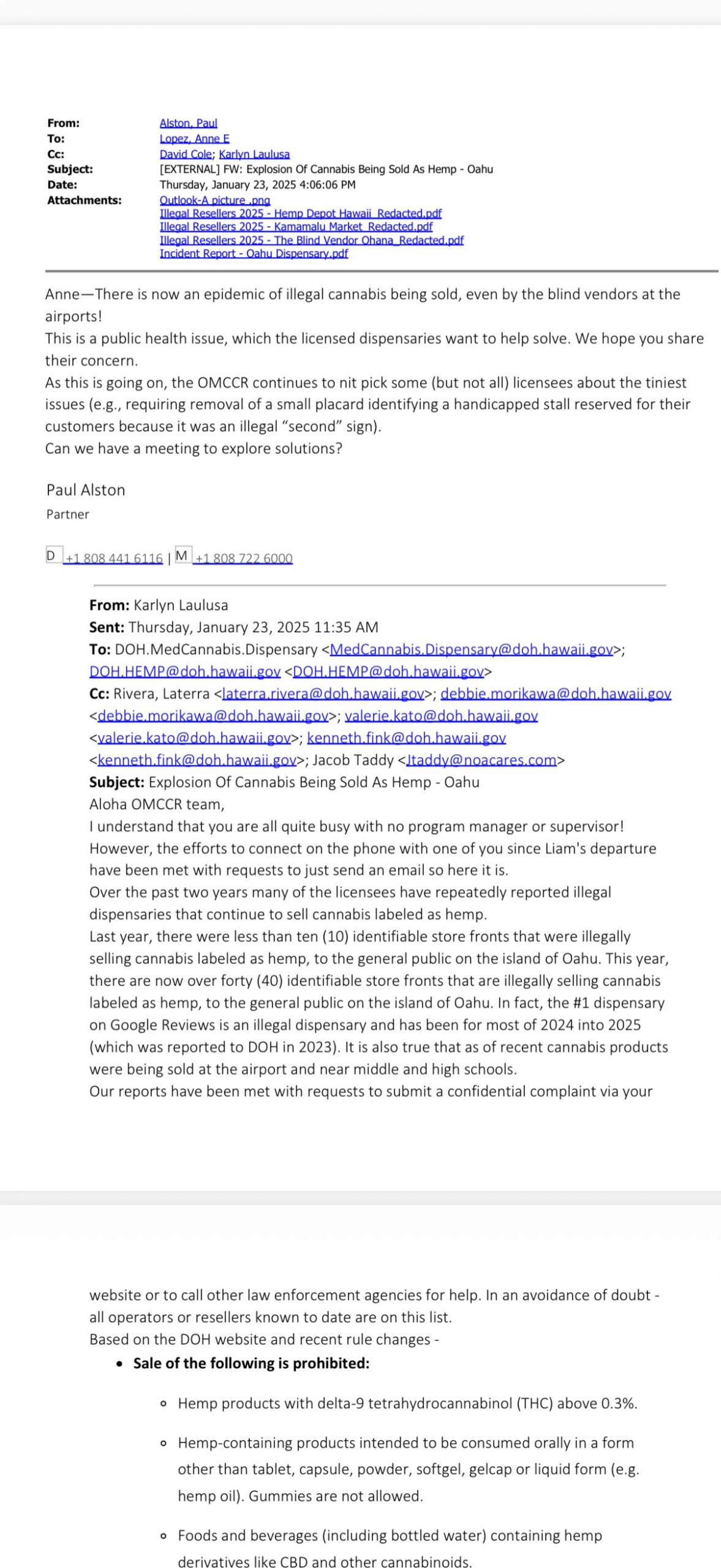
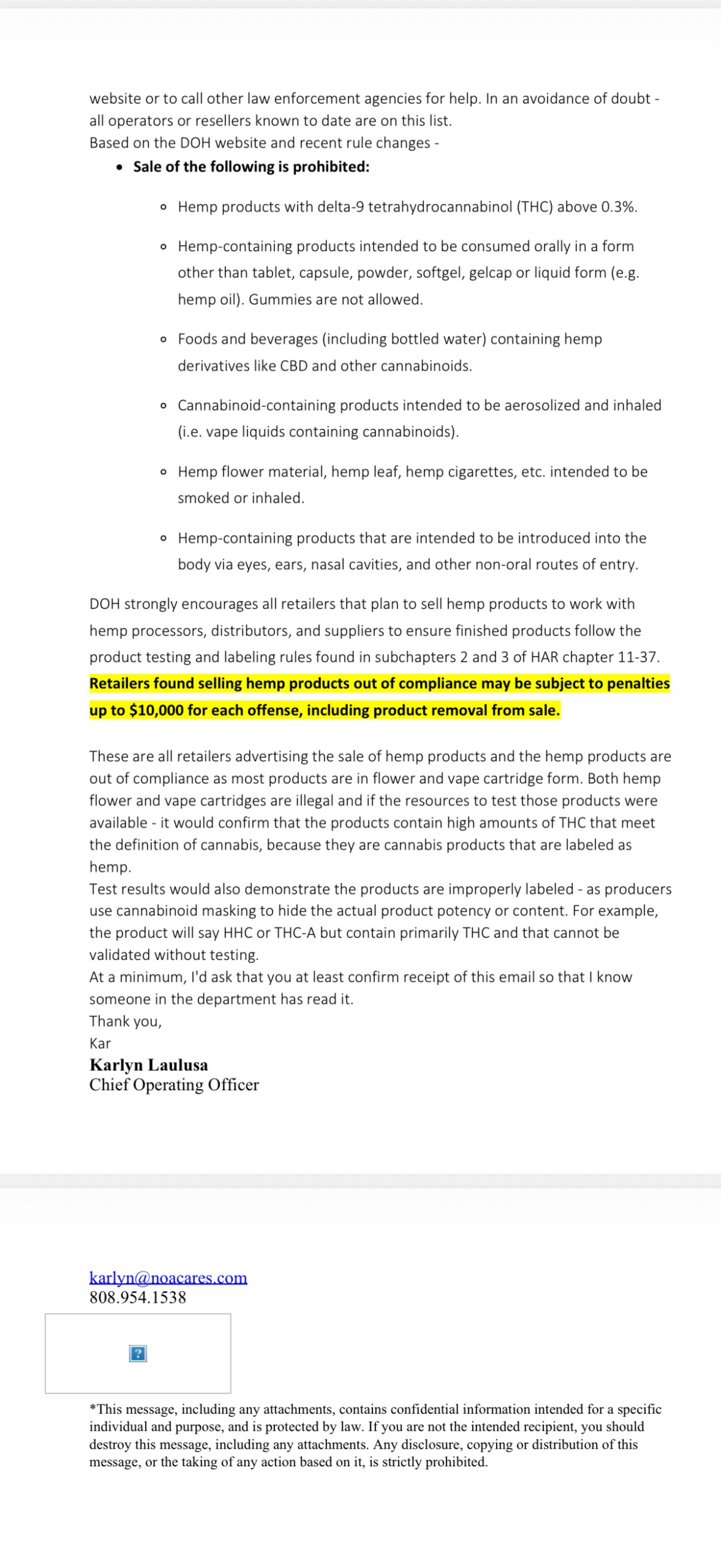
Despite the restrictions, Alyas has built his hemp business into the No. 1 cannabis dispensary in the state, based on Google reviews. However, it appears Hawaii's medical marijuana industry isn't eager to entertain the competition. In emails to the Health Department, Karlyn Laulusa, CEO of Noa Botanicals—one of the eight dispensaries licensed to operate in the state—asks state officials to intervene and enforce the law against "illegal dispensaries" that are "out of compliance."
So far, Alyas has been unable to substantiate his core claims in court. In December, he voluntarily filed a motion to dismiss his lawsuit, and Judge Jill Otake granted it without prejudice. She also noted that Alyas and his legal team had already "taken numerous bites at this apple" and wasted the court and defense counsel's time in the process, warning them that the court would take any prior mistakes in the case into account in future decisions.
The state's attorney general's office has framed the dismissal as a win, telling Reason in an email that the department "prevailed in the prior case" and has now filed a motion to dismiss Alyas' follow-up suit for a preliminary injunction. The court will consider Alyas' suit for a preliminary injunction to stop enforcement of state laws against his businesses, as well as the state's motion to dismiss, on July 2.
The dismissal may be a win for the state's eight legal dispensaries, but not for its consumers, who overwhelmingly turn to the black market for more affordable products. Alyas' products may not be popular with his competitors or their defenders in the state government, but Hawaii's residents seem to have made their choice. The least regulators could do is respect it.