
Bernie Sanders Proposes AI Tax To Give Everyone $1,000 a Month. His Bill Would Do a Lot More Than That.
The Vermont senator's American A.I. Sovereign Wealth Fund Act would also create an entirely new regulatory regime for the tech industry.
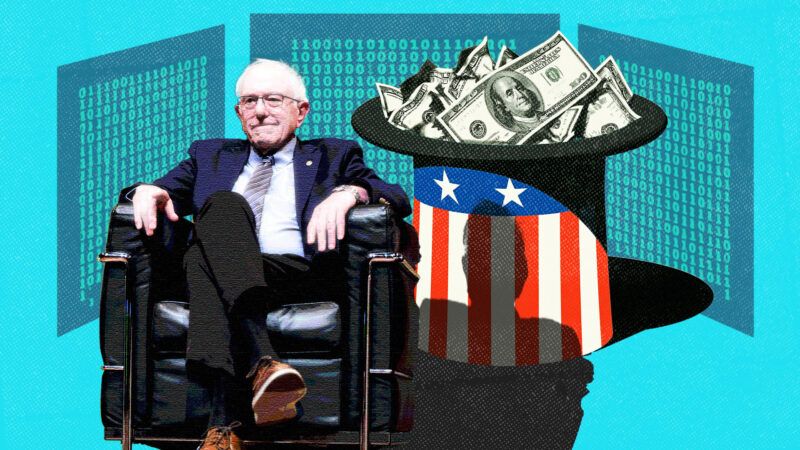
When Sen. Bernie Sanders (I–Vt.) teased his new AI bill in The New York Times, he undersold the socialist vision he had for the tech industry. Now that the bill text has been released, we know just how much government ownership of AI he wants.
On Thursday, Sanders unveiled the American A.I. Sovereign Wealth Fund Act, which would impose a 50 percent tax, paid through stock, on any AI company with annual "gross receipts" of at least $200 million. Taxing gross receipts rather than revenue is a savvy move by Sanders, since most businesses traditionally considered AI companies aren't yet profitable, and gross receipts allow him to include total money earned from all sources, widening the pool of companies subject to the tax.
Under the bill, the Treasury Department would also get a 50 percent stake in all applicable AI companies through newly issued shares, and the federal government would be allowed to tax any shares issued after the initial seizure, so the government's half stays at half over time.
Each fiscal year, every "man, woman and child" in the U.S. will receive direct payments from the fund, paid for by a 5 percent draw of the average value of the total stock held by the government. According to Sanders, that could mean as much as "$1,000 to everyone in America."
Sanders claims that the fund could raise $7 trillion based on "current valuations" of the companies he hopes to tax. But a company's gross receipts are tied to its economic worth, which this bill would likely depress.
While the bill's name might make one think that companies like Anthropic and OpenAI would be subject to the tax, Sanders doesn't spare any sector of the tech industry. Instead, his bill would apply to any "corporation or partnership" engaged in a "trade or business" tangentially related to data centers, computing infrastructure, AI services, or the research, production, or manufacturing of advanced robotics. Companies like Tesla, Waymo, Nvidia, and Dell would all be subject to the 50 percent tax, even though their business models predate those of companies like OpenAI and Anthropic, the types of AI companies Sanders has railed against.
Adam Thierer, resident senior fellow of technology and innovation at R Street Institute, says Sanders' bill is "the most hideous form of crony capitalism." He tells Reason the bill contains a "lot of counterintuitive reasoning."
Indeed, the bill makes no distinction between private and public ownership and overrides any corporate charter limits, forcing companies to create and surrender stock to meet the 50 percent mark, regardless of their shareholders' wishes.
It also requires AI companies to spin off their AI businesses as stand-alone entities. It bars them from conducting non-AI business, entering into joint ventures with non-AI companies, or sharing personnel or financing with non-AI companies.
As if seizing property weren't enough, the bill also creates an entirely new regulatory regime for the AI industry and the tech sector in general. It establishes an Independent Commission for Democratic AI within the Treasury, consisting of seven presidentially appointed commissioners nominated by congressional leadership for a term of five years. Five of the commissioners must have specific expertise, including an expert in "labor interests," the AI industry, national security, privacy, and management of a comparable fund.
No more than four commissioners can be from the same political party, and they can "exercise all voting and governance rights" inherent in the government's ownership stake through appointed representatives on each company's board of directors. The number of representatives must be commensurate with the government's stake in the company, and representatives may cast their votes only in ways that advance the interests of "worker welfare, public safety, fair competition among applicable AI companies, environmental sustainability, and financial solvency."
In a warped recasting of fiduciary duty, the bill requires commissioners and their representatives to vote for these interests even when doing so "conflicts with the financial interests of the company or its other equity holders." Here, Sanders contradicts the very purpose of his bill. A business acting against its financial interests can hardly expect to remain profitable, which would ensure that its wealth fund would fail.
Sanders isn't the only one pushing the idea of a sovereign wealth fund. The leaders of OpenAI, Anthropic, and xAI, as well as President Donald Trump, have all naively called for a system of formalized direct payments funded by the AI industry.
The president has also made a habit of taking "golden shares" in companies he deems vital to the country's economic or security interests. Now, Sanders has taken the next logical step in the socialist ladder, from voluntary disbursement to outright seizure of property.