
The Correspondents' Dinner Shooting Is No Excuse for More Security Theater
Calls for more aggressive security measures evoke the post-9/11 security theater that brought us the TSA.
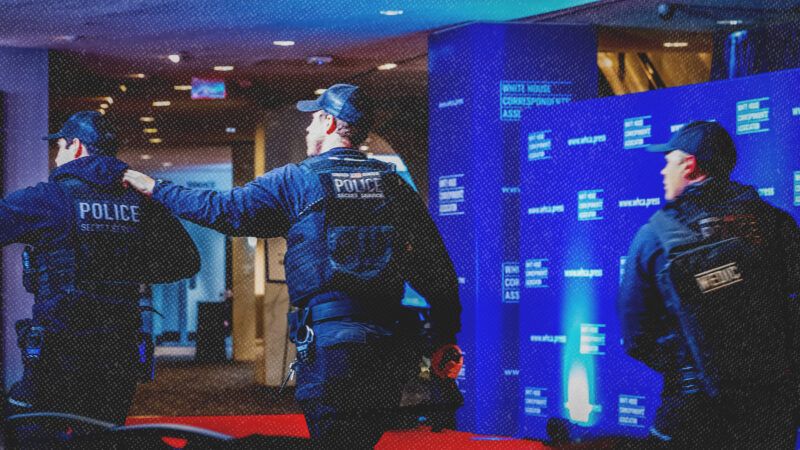
Secret Service agents reportedly subdued a gunman Saturday at the Washington Hilton hotel, during the annual White House Correspondents' Association dinner.
"A man charged a security checkpoint armed with multiple weapons, and he was taken down by some very brave members of Secret Service," President Donald Trump said while posting security camera footage to social media.
Officials later identified the assailant as Cole Tomas Allen, a 31-year-old California man, and said he was armed with a shotgun, handgun, and knives. Allen reportedly exchanged gunfire with Secret Service, and one agent was hit, though further details are still unknown.
Allen reportedly told law enforcement he was targeting "Trump administration officials," not Trump himself. But in a digressive manifesto purportedly sent to family members, and published by the New York Post, Allen criticized a number of Trump policies and seemingly deemed the president "a pedophile, rapist, and traitor."
Some, on both the left and the right, see Allen's near-miss as a failure that requires more extensive security measures in the future. That's a mistake, and we should always proceed with caution before subjecting ourselves to more extensive scrutiny.
Trump said the event underscores the need to build a giant ballroom at the White House, in place of the East Wing he recently demolished, where such events could be safely held in the future. "We need the ballroom," he said in an address later that night. "Today, we need levels of security that probably nobody's ever seen before." Many on the right immediately took the same position.
Earlier this month, in response to a civil lawsuit, a federal judge halted construction on the ballroom. On Sunday, Acting U.S. Attorney General Todd Blanche posted a letter on X asking the plaintiffs to "voluntarily dismiss" their "frivolous lawsuit today in light of last night's assassination attempt on President Trump."
But as Reason's Eric Boehm notes, "the White House Correspondents' Association is a private entity, and the president is a guest at their dinner. Assuming that the dinner would take place at the White House, if it had a ballroom, seems erroneous."
This doesn't mean the Washington Hilton is the most secure possible venue. It has, after all, already been the site of a previous presidential assassination attempt. The New York Times noted in 1999 that the Hilton was simply "the only hotel with a banquet room large enough to hold the 2,700 guests." MS NOW's Carol Leonnig writes that the hotel "boasts one of the largest ballrooms in the city but is a functioning hotel that is difficult to secure."
The Wall Street Journal reported Sunday on the "simple security flaws" that allowed a gunman to get near a sitting president who, less than two years ago, survived an assassination attempt at a campaign rally in Butler, Pennsylvania.
Allen, Saturday's assailant, even wondered in a postscript to his manifesto, "what the hell is the Secret Service doing?…I walk in with multiple weapons and not a single person there considers the possibility that I could be a threat. The security at the event is all outside, focused on protestors and current arrivals, because apparently no one thought about what happens if someone checks in the day before."
Within hours of Saturday's events, The Daily Beast executive editor Hugh Dougherty published an article about his experience, when he discovered the shooter was booked in the hotel room next to his own.
"It does not take a security expert to unravel the layers of failure that happened at a Washington, D.C. hotel on Saturday night," Dougherty wrote. "How on earth could someone with a disassembled long gun check into a room at a hotel where the president was going to speak?"
Dougherty complains that security was simply too lax, that when he and a colleague checked into the hotel on separate days, security didn't check their luggage or usher them through a metal detector.
But these complaints ignore the fact that the Secret Service actually performed its task reasonably well. Unlike the fiasco in Pennsylvania in 2024, when a single shooter with a long gun shimmied up the side of an unsecured building within range of a major presidential candidate, agents at the Hilton successfully prevented Allen from entering the ballroom.
"Guests were able to access the Hilton's lobby and lower levels without going through security scans, and only passed through magnetometers before they entered the ballroom where the dinner was held," marveled The Wall Street Journal. But that checkpoint is where Allen, likely aware he couldn't get through with his weapons, apparently tried to simply sprint past the agents, who successfully subdued him before he reached the event.
"It's not—and shouldn't be—the job of the Secret Service to secure the whole building. There was a threat to the president and it was stopped well before it could pose a threat to the president," Garrett Graff wrote on Substack. "So far as we know right now, this seems like the system basically working as designed amid the always necessary trade-offs of security in a free society."
Indeed, Dougherty—and, ironically, Allen—would apparently prefer the Secret Service either lock down the entire 1,100-room hotel, or subject every single guest to an invasive search of their luggage and effects, any time the president briefly appears at a private event.
Such an expansion of public security calls back to post-9/11 security theater. Desperate to prevent a repeat of that day's terror attacks, officials dedicated trillions of dollars to tasks like shoring up airport security, taking over a job previously done by the private sector. Years later, the agents of the federal Transportation Security Agency (TSA) not only do no better than private screeners, but they do considerably worse, failing to catch weapons in 90 percent of tests.