
Rodrigo Duterte's 'Death Squads' Fought in the Philippines' War on Drugs. Now He Might Get Life in Prison.
As many as 30,000 people may have died at the hands of the state-sponsored death squads.
"Her dream was to go to school," Lydjay Acopio says of her daughter Myca, speaking in her native Tagalog. "When my eldest son was in first grade, she helped him put on his uniform. But she never got a chance to study."
On the night of June 29, 2019, the family was sleeping at home on the outskirts of Manila when they heard glass shattering downstairs. Someone was trying to break in. Outside they saw seven men in dark jackets and masks. Lydjay's husband, 41-year-old Renato, removed the air conditioner and climbed onto the roof. Lydjay says three-year-old Myca followed her father.
Realizing the intruders were most likely cops, Lydjay told the rest of the kids to go downstairs.
"I was shaking by then. My chest was hurting. I was having a nervous breakdown," she remembers. "I kept saying that there was still a kid with his dad. They hadn't gone in yet. And then I heard a gunshot."
"You fucking whores!" her enraged husband shouted.
Lydjay believes the police opened fire and hit her daughter.
Myca became the youngest victim of the war on drugs in the Philippines. From 2016 through 2022, as many as 30,000 Filipinos may have died in suspicious encounters or been summarily executed by police officers and state-sponsored death squads—one of the worst state-sponsored killing campaigns of the 21st century.
The police raid was supposedly the culmination of a sting operation against Renato, who'd allegedly sold meth to an undercover agent. Lydjay insists that no such sale took place, and statements by witnesses interviewed by the Philippine Commission on Human Rights (CHR) seem to support her claim—although, afraid of reprisals, they've refused to go on record. Renato, an ex-soldier, did have a gun, and according to Lydjay, a firefight broke out after the bullet struck her daughter. The cops, meanwhile, claim Renato used his daughter as a human shield.
Everyone agrees that the result was a shootout in which Myca, Renato, an acquaintance, and a police officer all died. The cops had, at the very least, acted recklessly in the presence of multiple children, the CHR ruled.
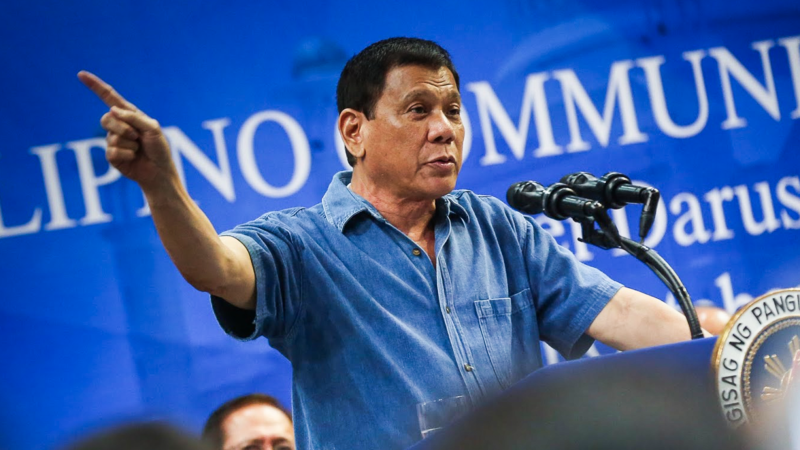
Whatever happened on that rooftop, the highest levels of Philippine society have given the green light to police brutality. "If you know of any addicts, go ahead and kill them yourself, as getting their parents to do it would be too painful," then-President Rodrigo Duterte told a small crowd in 2016.
Duterte—who has likened himself to Hitler and said he'd be "happy to slaughter" 3 million "drug addicts"—now sits in a Dutch prison cell, awaiting his fate at the International Criminal Court (ICC) in The Hague, where he's accused of crimes against humanity. In February, the ICC judges held a hearing to weigh the evidence and decide whether the trial against the 80-year-old man nicknamed "The Punisher" will proceed. Their decision is due by the end of April.
Lydjay Acopio was among those in attendance.
If the case goes to trial, the court can impose a maximum penalty of 30 years—or in exceptional circumstances, life. In December, a Sudanese warlord received 20 years for war crimes and crimes against humanity in Darfur. For the elderly Duterte, that's effectively a life sentence.
Death Squads
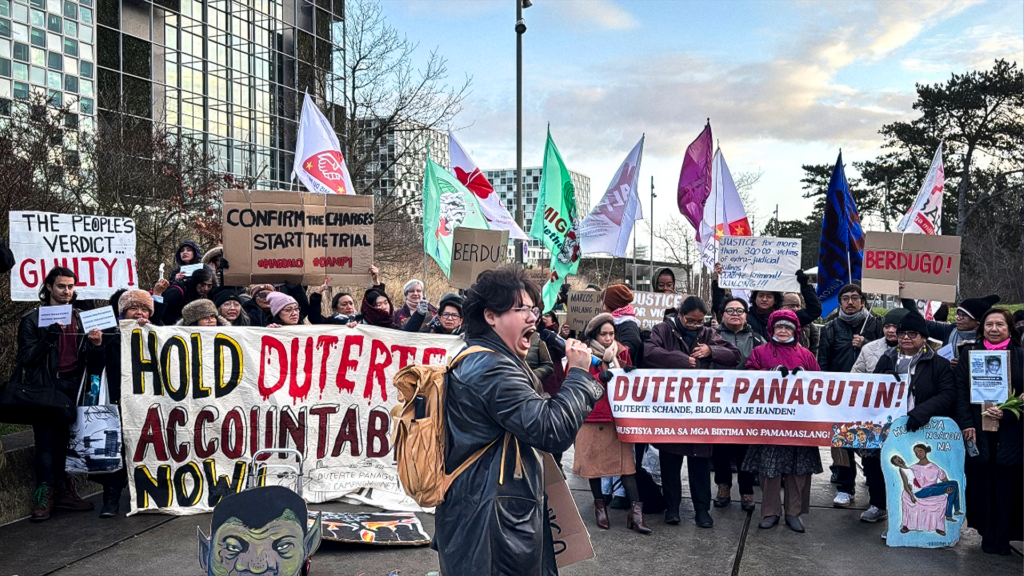
The former president still has supporters. Outside the courthouse, backers from the Filipino diaspora placed cutouts of Duterte in his signature fist-bump pose.
Even before Duterte, extrajudicial killings were not uncommon in the Philippines, dating back to the Cold War-era military dictatorship. By the 1980s, Duterte's home city of Davao had a lawless reputation for slums controlled by the leftist New People's Army (NPA) and its hit men (the "sparrows"), and for right-wing vigilantes (Alsa Masa, or "Masses Arise") who carried out murders of suspected communists.
That conflict had died down by the time Duterte became mayor, but the ruthless counterinsurgency tactics continued in the war on petty crime. Starting from the second term of Duterte's mayorship, the Davao Death Squad—comprised of ex-cops, gangsters, and NPA defectors—executed hundreds of drug addicts, peddlers, thieves, and street kids, plus the occasional unlucky witness. Their handlers (senior policemen acting as the intermediaries with City Hall) granted them weapons and a salary, with a bonus paid for each hit. Victims were stabbed, shot, and in at least one case fed to a crocodile. Ex-members say they assassinated the mayor's political opponents as well. The murders were investigated to keep up appearances, but detectives already knew who did it.
"They say I am the death squad? True, that is true," Duterte admitted in a 2015 TV interview.
In 2015 Duterte ran for president, promising to cleanse the country of drugs and crime. He presented himself as a tough-talking man of action battling out-of-touch, nepotistic elites. Human rights and global condemnation be damned, he said: He'll do what needs to be done.
"I don't want to kill people, so don't elect me as president," he warned voters.
But even some liberals voted for him, believing all that trigger talk was just meant to rouse the rubes.
"I never thought that he was going to be serious with the killings," says Father Flavie Villanueva, a Catholic priest who became one of the president's most outspoken opponents. "But I was wrong to believe that. And I regretted that decision that I voted for a mass murderer." Duterte, he says, created "a culture of killing" that "has wiped out almost everything that is good, clean, and decent in our Philippine society."
Coming to power amid fears of meth labs run by Chinese crime syndicates, Duterte claimed that there were 3.7 million drug addicts in the Philippines and that they were responsible for such sickening crimes as raping month-old babies. He vowed to "slaughter these idiots for destroying my country."
According to the country's Dangerous Drugs Board, that was more than twice the actual number of drug users—not even addicts, but users—in the Philippines. The majority smoked pot, not meth. Rather than depraved child molesters, most of the meth users were blue-collar workers who consumed it to carry them through tiring shifts.
Operation Double Barrel, as Duterte's anti-drug campaign was known, began on the day of his inauguration. The aim was to strike at drug bosses while simultaneously addressing consumption and retail sales through a program called Tokhang. The program's name comes from the Visayan words toktok and hangyo—"knock" and "plead." In theory, the local community was to volunteer the names of drug suspects, who police would then visit and ask nicely to change their ways.
In practice, anyone who had a beef with the neighbors could just say they've been slinging shabu—meth—and their names would land on what amounted to a kill list. The playbook was almost always the same: A dealer under surveillance was approached by an undercover cop or an informant, made a sale, and then died violently when the law closed in. Sometimes handguns with the same serial numbers would appear at different crime scenes.
"The sachets of shabu planted in the ground of the crime scenes revealed that these are small-time peddlers, if ever they were peddling," says Villanueva.
The top brass actively encouraged the killing. According to the testimony of one high-ranking lawman before the senate, Philippine National Police (PNP) officers had to carry out 50–100 Tokhang operations per day. Cops were awarded bonuses of up to 100,000 pesos ($2,000) for eliminating a "high-value" target, and up to 20,000 pesos for a minor league pusher or "addict." Duterte later admitted that he instructed his cops to provoke resistance from suspects.
No doubt, the police's propensity for lethal encounters encouraged some suspects to return fire, leading to heartbreaking outcomes like Myca's death.
Dehumanized and Dead
"I'd like to be frank with you," the president asked of the drug war's victims. "Are they humans? What is your definition of a human being?"
The Filipino police officially acknowledge 6,252 dead from the country's antidrug operations from mid-2016 through mid-2022. Others, they say, were killed by private vigilantes or by gangsters settling scores.
Anti-drug vigilantes do exist in the Philippines, but they do not necessarily act on their own. In 2017, when the Manila-based Confederate Sentinels Group (CSG) was accused of extrajudicial killings, the police admitted they'd enlisted the group (which had publicly backed Duterte's election) as neighborhood peacekeepers. But the cops denied authorizing the Sentinels to carry weapons.
The existence of such gangs provided plausible deniability. But more often than not, the death squads were simply cops in disguises. Even when third parties such as the CSG were allegedly involved, the orders could still come from the police and security forces: As a hit man I interviewed while researching my book Dopeworld told me, men in uniform paid out bounties for each hit.
"The war on drugs also became a campaign of inflicting fear on society," adds Villanueva. "If you cross [Duterte], you would be an easy target."
Drug war orphans dropped out of school to support their families, while widows were shunned by their neighbours. Villanueva's church supports victims' families, helping to pay for funerals, food, and schooling and sometimes helps them find new livelihoods. But it can only reach so many.
Other priests have sheltered families and police operation survivors from further reprisals—making themselves into targets. Villanueva has lost count of how many threats he's received.
"Pre-pandemic, a masked and hooded man was trying to enter our office. And when he was unable to after several attempts, he started sizing up our building and left alongside a white van," the priest recalls.
When Villanueva showed footage of the incident to Edgar Matobato, a whistleblower who used to belong to the Davao Death Squad, the self-confessed enforcer smiled with disbelief.
"That's a good thing, Father, that he was unable to get hold of you," he told the priest. "I don't think he's there to kill you. But most certainly he's there to abduct you!"
In a 2017 op-ed for The New York Times, Colombia's former president, César Gaviria, urged Duterte not to repeat his mistakes while he was hunting down Pablo Escobar. "While we managed to make Colombia a bit safer, it came at a tremendous price," he wrote. "Not only did we fail to eradicate drug production, trafficking and consumption in Colombia, but we also pushed drugs and crime into neighboring countries. And we created new problems." Duterte responded by calling Gaviria an "idiot."
At least one head of state outside the Philippines admired Duterte's methods.
"I just wanted to congratulate you, because I am hearing of the unbelievable job on the drug problem," U.S. President Donald Trump gushed in a 2017 phone call. "Keep up the good work. You are doing an amazing job."
The second Trump administration is now waging an extrajudicial drug war of its own. Since September, the U.S. military has sunk scores of alleged smuggling boats in the Caribbean and eastern Pacific, claiming at least 157 lives, as of mid-March. At least one of these was a "double-tap" strike, meaning the boat was hit twice, wiping out any survivors. While the U.S. is outside the ICC's jurisdiction, a former chief prosecutor of the court has warned that the boat strikes—executions at sea with no trial—constitute war crimes.
And the attacks won't even work. Treating alleged drug runners like Al Qaeda is not going to stop the flow of narcotics into the United States.
Duterte left office in 2022 at the end of his term (Filipino presidents cannot run for reelection), and his daughter Sara took over as vice president. For a time, it looked like he'd get away with his alleged crimes. But Sara quickly fell out with President Ferdinand Marcos Jr., the son of the dictator who governed the islands from 1965 to 1986. Duterte senior and Marcos Jr. publicly traded barbs, accusing one another of being drug addicts. (Duterte has admitted taking fentanyl to soothe the pain from a motorbike accident.) Marcos finally had enough and decided to cooperate with the ICC arrest warrant. Within 24 hours, The Punisher was marched onto a jet bound for The Hague.
The country's Dangerous Drugs Board says there were 1.8 million illicit drug users a year before Duterte's presidency began. By 2019, three years into the killing frenzy, the number had fallen—to 1.7 million, a decline of just 4.6 percent. All that shock and awe had spooked just one in every 20 druggies into sobriety.
To date, only nine officers have been convicted of extrajudicial killings in the antidrug campaign. The rest are sitting in cafés, sharing stories with journalists and enjoying the company of their families and friends. Meanwhile, lethal antidrug operations quietly continue under the Marcos presidency, albeit on a lesser scale.
"There's not so much killing as before, but we need to take note of how cheap life has become," concludes Villanueva. "We really were truly deeply scarred when Duterte left. There's a deep, deep wound that needs to be healed after his presidency."