
Project Hail Mary Is Another 'You Can Just Do Things' Story From Sci-Fi Novelist Andy Weir
A dazzling, ridiculously charming sci-fi adventure from the author of The Martian
If there is a poet laureate of the "you can just do things" crowd, it's novelist Andy Weir. Weir broke into the mainstream with The Martian, a science fiction novel about a man stuck on Mars who sciences his way to survival and eventually a daring rescue, making his own luck through engineering and ingenuity. It's a technically sophisticated, hard science fiction space adventure story in the style of Robert Heinlein, but with far more potato math. Weir has said he never expected such a nerdy story to find a mainstream audience. But not only did that novel become a bestseller, it also spawned a superb big-budget movie adaptation directed by Ridley Scott and starring Matt Damon.
The Martian's surprise success was itself a triumph of the you can just do things mindset: It was originally serialized on Weir's website for a small group of readers, and then it rocketed up Amazon's charts when it was published for Kindle. Weir had always wanted to be a writer and even took several years off from work to write a novel before The Martian. That novel went nowhere, but he kept writing, and, like his book's protagonist, made his own luck. He didn't just do one thing. He kept doing things until something worked.
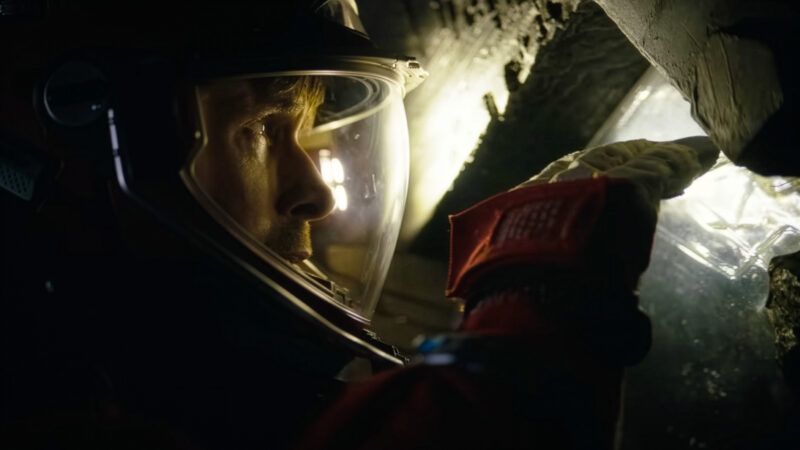
That's a reasonably good précis of Weir's third novel, Project Hail Mary, which has now been adapted into blockbuster movie form. Directed by Chris Miller and Phil Lord and starring Ryan Gosling, it's set in a near future in which the sun is dimming thanks to an intergalactic environmental catastrophe.
At the center of the story is Ryland Grace, a lovable science teacher who improbably finds himself on an interstellar journey to save humanity. Along the way, he makes friends with a technically sophisticated but childlike alien rock creature whose own world is facing the same sun-imperiling threat. The two must learn to communicate and work together to save both their civilizations. It's a buddy movie, in other words, about a pair of nerdy, brilliant goofballs who just do things to save their worlds.
Project Hail Mary is in some ways predictable and in some ways formulaic. It is also preposterously, implausibly, verging on ludicrously charming—a triumph of crowd-pleasing Hollywood moxie. It's hard to think of another movie from this decade that is so eager to please, and also so successful.
The movie looks great, is consistently funny, and even with a two-and-a-half-hour runtime, zips right along. But most of its success can be attributed to its central comic pairing.
With his floppy hair, zany comic affect, and goofball grin, Gosling carries the movie, which for long stretches is essentially a one-man show. But the real star is his alien counterpart, Rocky, a rock-like alien brought to life with sophisticated puppetry augmented by modern computer effects.
Lord and Miller come from the world of animation; their last directorial outing was with the magnificent Spider-Man: Into the Spider-Verse. And Rocky works as a sort of animated character, faceless but with expressive limbs and body language. He's something like a jittery puppy made of stone who can, with the help of a computer, talk.
The relationship between the two makes up the film's warm center, its relational core. Rocky is a classic, cute sidekick character, part E.T., part R2D2, and part Johnny 5 from Short Circuit—rambunctious, funny, somewhat awkward with language, and lovable in a way that almost defies description.
Yes, this is once again a story about using science and ingenuity to save the day. But beyond its brains, it's got a real heart. I found myself more emotionally engaged by a jittery alien rock puppet than by many of the human characters I see on screen. I saw this movie weeks ago, and since then, at least once a day, I've had the thought: How did I fall so hard for a puppet? It's borderline embarrassing, frankly, how much I cared for that little guy. But that's the magic of the movies: Somehow, the painstaking craftsmanship and technical wizardry of a team of puppeteers and filmmakers transforms into something profound and powerful and deeply moving.
That's Weir's worldview too. Although he told Reason in 2015 that he harbors some "small-l" libertarian views, he's also said he doesn't want people to think about his politics when reading his stories, because he personally hates stories that feel preachy. When he spoke to Reason in 2022, he also denied that Project Hail Mary, with its dying sun and environmental overtones, is a metaphor for global warming.
Even if you ignore the obvious allegorical implications of Project Hail Mary, it's hard to miss the through line in his stories: Faced with survive-or-die scenarios, humans—perhaps with the help of an alien—solve their problems through scientific acumen and sheer doggedness.
Sometimes these solutions create new challenges: Weir published The Martian serially and has said that the schema was that each time the hero solved a problem, his solution would create the next set of problems. There's always something else that needs to be done. But his heroes just do things until the day is saved.
There are multiple lessons in this approach for people and for politics. One is that this sunny, can-do attitude is popular; people respond positively to a chipper attitude. Another is that taking responsibility is a prerequisite for solving big problems. Challenges aren't overcome because everyone somehow comes together; they're overcome because someone decides to fix the problem.
Another is that you too can just do things—like, for example, go see this excellent, delightful movie.