
Before RFK Jr. Can Crack Down on 'Processed Foods,' He'll Have To Figure Out How To Define Them
HHS Secretary Robert F. Kennedy Jr. is importing a failed European idea.
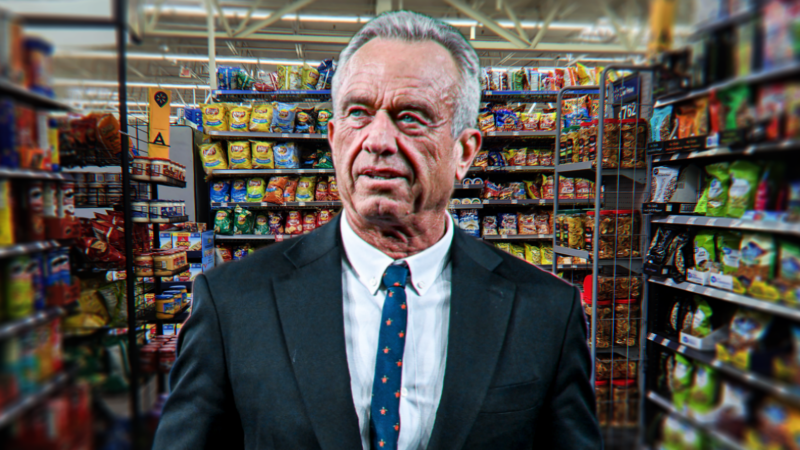
Department of Health and Human Services (HHS) Secretary Robert F. Kennedy Jr. has promised that by April, the federal government will issue a definition of ultra-processed foods (UPFs) as part of the "Make America Healthy Again" campaign. Kennedy told Joe Rogan on his podcast that a definition will be used to create a nutritional label that indicates, in red, yellow, and green, how nutritious a processed food product is. Whether it will lead to bans on ingredients is still unclear.
Kennedy is importing a failed European idea. For years, the European Union has promoted Nutri-Score, a label that grades food from A to E for nutritional quality. Yet even after all that time, it has not been made mandatory because the system is widely criticized as misleading. For good reason: A label like this cannot meaningfully tell consumers whether a product belongs in a healthy diet. Nutri-Score can give Coke Zero a favorable rating even though it contains none of the fiber, vitamins, or minerals that actually nourish the body.
Meanwhile, Europe is still struggling to define what an ultra-processed food actually is. For all the political rhetoric, regulators have not agreed on a clear definition or on which processing methods should be allowed. So despite Europe's more precautionary approach and a few differences on additives, Europe and the United States permit broadly similar kinds and quantities of ultra-processed foods.
It goes far beyond the lack of a working definition. Attempts by Brazilian scientists to create a grouping system for processing levels largely failed to account for the fact that processing is essential to how we consume food. Fortified foods (cereal, bread, butter) are highly processed and essential for consumers with specific dietary needs, as well as for those who adapt their diets to their workout routines.
Processing methods can be as simple as precutting and packaging fruit, which is essential for people with disabilities, as well as children looking for an easy snack in the fridge. Political discourse has flattened processed to mean fake, even though it can include milk, olive oil, cheese, and yogurt.
Even in a Whole Foods grocery store, most products will still be processed.
There's also no getting around price point, from a consumer perspective. Ultra-processed foods are roughly 62 percent cheaper on average than minimally processed foods, according to research led by Liberty University's Paula Trumbo, formerly of the FDA and the Institute of Medicine. This is because they're produced more efficiently and have a longer shelf life than other products. When food has a longer shelf life, producers can make less of it and lower prices.
Ultra-processed foods are in especially high demand among people with office jobs—commuters who are juggling meetings, long drives, and short lunch breaks. In that context, "grab-and-go" often isn't a preference so much as the only workable option, and those choices tend to be more highly processed.
Americans understand this because their culture is built around mobility and the family car in a way most Europeans simply don't experience. And in this respect, Kennedy ends up echoing a certain strain of European food elitism: He talks down to people trying to manage demanding work schedules, family obligations, and hours in traffic, as if they can realistically meal-prep to match dietary guidelines every single day. "70 percent of the food that our kids eat is ultra-processed food—and it's just poisoning them," he told Rogan.
Parents are not poisoning their children. Kennedy may be well-intentioned—but that's not how normal people live.
Moderation remains the best way to navigate dietary questions, and that extends to eating highly palatable and highly processed foods. It's not that helpful to have boxer Mike Tyson on camera slapping donuts out of people's hands and telling them, "Processed foods kill." They do not, and everyone knows that. We have a remarkably safe food supply chain—safer than it has ever been.
Excess remains the problem of the day, because too much of any one thing creates deficiencies and health problems. Sugar and salt are no longer luxury products and have clearly become problematic due to their ubiquity as added ingredients. Consumers should keep track of their consumption when possible.
Ultimately, there isn't a reliable way to classify and restrict processed foods without bulldozing access for vulnerable groups or being seen as unnecessarily paternalistic. As much as we may want to pursue quick fixes and absolutist messaging like #EatRealFood, nutritional science remains too abstract for us to legislate on it.