
250 Years Later, The Wealth of Nations Still Has Lessons To Offer the Political Class
Governments have yet to accept that free societies are also prosperous societies.
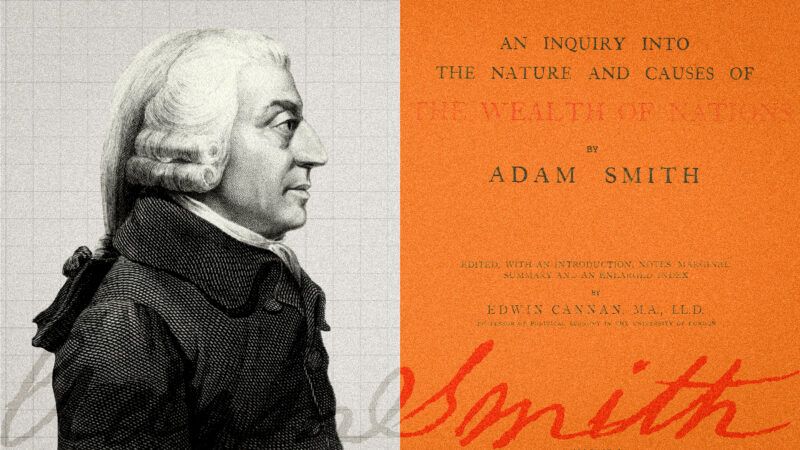
Few books can be said to have withstood the test of time 250 years later, but Adam Smith's An Inquiry into the Nature and Causes of the Wealth of Nations (usually shortened to The Wealth of Nations), published for the first time in 1776, certainly has. At a time when even the governments of nominally free countries once again dabble with guiding economies, and the president of the United States rails against trade as if it's a team sport where some countries are winners and others are losers, Smith's book reminds us that unfettered societies are both good and productive, and that free trade produces the best outcomes for all.
You are reading The Rattler from J.D. Tuccille and Reason. Get more of J.D.'s commentary on government overreach and threats to everyday liberty.
'Every Individual…Can In His Local Situation Judge Much Better Than Any Statesman'
Smith is often referred to as the "father of capitalism" as if he designed an economic system as a thought experiment. But that's not the case. Instead, he described what he saw working in the voluntary interactions of people around him, and the government policies that got in the way of prosperity.
As Smith wrote in The Wealth of Nations:
What is the species of domestic industry which his capital can employ, and of which the produce is likely to be of the greatest value, every individual, it is evident, can in his local situation judge much better than any statesman or lawgiver can do for him. The statesman, who should attempt to direct private people in what manner they ought to employ their capitals, would not only load himself with a most unnecessary attention, but assume an authority which could safely be trusted, not only to no single person, but to no council or senate whatever, and which would nowhere be so dangerous as in the hands of a man who had folly and presumption enough to fancy himself fit to exercise it.
That was an important insight at a time when Europe's rulers insisted that the path to building wealth required hoarding precious metals, limiting imports, and guiding economic activity to serve the interests of the state. It remains a key point a quarter-millennium later when countries that built prosperity through relatively free markets now squander what they created with government priorities and policies that sideline the creative efforts of workers and entrepreneurs.
"Unregulated markets tend to overly exploit natural resources and contribute to global warming," complained a 2018 publication by the German government's Deutsche Gesellschaft für Internationale Zusammenarbeit (German Society for International Cooperation). "Hence, ecologically imperfect market outcomes require interventions to safeguard a healthy environment."
Unsurprisingly, two German economists fretted last summer in an International Monetary Fund publication that "for the past five years, Germany's economy has been stagnant, growing by just 0.1 percent since 2019" while the comparatively free U.S. economy grew by 12 percent. Analyses regularly warn about the country's deindustrialization caused by factors including "high taxes" and burdensome "regulations" often connected to the German political class' environmental preoccupations.
Environmental fetishes are recent justifications for interfering in market transactions, but old fears that international trade is somehow unfair also, once again, underlie political interference in commerce. Last April, the protectionist Trump administration published a trade report promising that the president's policies would "reduce our destructive trade imbalance…by putting America First" with tariffs and other restrictions on trade.
Adam Smith was familiar with such arguments and dismissed them as nonsense.
'Nothing…Can Be More Absurd Than This Whole Doctrine of the Balance of Trade'
"To lay extraordinary restraints upon the importation of goods of almost all kinds, from those particular countries with which the balance of trade is supposed to be disadvantageous, is the second expedient by which the commercial system proposes to increase the quantity of gold and silver," he wrote. "Nothing, however, can be more absurd than this whole doctrine of the balance of trade, upon which, not only these restraints, but almost all the other regulations of commerce, are founded….Trade which, without force or constraint, is naturally and regularly carried on between any two places, is always advantageous, though not always equally so, to both."
Whether for novel environmental reasons or in the name of old-fashioned nationalism, government interference in economic activities is often justified on the grounds that people are "selfish." By that, of course, politicians mean that people act for their own reasons and not to advance the priorities of those in office. But to Smith, that was part of the productive glory of a free society.
"He intends only his own gain; and he is in this, as in many other cases, led by an invisible hand to promote an end which was no part of his intention," Smith observed of people going about their daily business. "By pursuing his own interest, he frequently promotes that of the society more effectually than when he really intends to promote it."
Free and Peaceful Societies Through Self Interest
Adam Smith wasn't purely an economist in the modern sense. He worked for over a decade as a professor of moral philosophy at the University of Glasgow, before writing The Wealth of Nations first penned The Theory of Moral Sentiments, and was close friends with the classical liberal philosopher David Hume. He addressed economic activity as part of his study of the range of human actions people undertake in pursuit of prosperous and fulfilling lives.
"He realised that social harmony would emerge naturally as human beings struggled to find ways to live and work with each other," the U.K.-based Adam Smith Institute notes in a short biography of the man who inspired the organization's foundation. "Freedom and self-interest need not produce chaos, but—as if guided by an 'invisible hand'—order and concord."
"So a prospering social order did not need to be controlled by kings and ministers. It would grow, organically, as a product of human nature. It would grow best in an open, competitive marketplace, with free exchange and without coercion," the biography adds.
Smith's ideas were widely discussed—if not always implemented—at home but found their most fertile soil in the new United States, founded the year The Wealth of Nations was originally published. Indeed, Smith believed the British government should let the American colonies separate in peace under terms that "secure to her a free trade" and join the nations as "faithful, affectionate, and generous allies."
But however celebrated Smith's lessons have been, they remain unlearned by too many politicians. Two hundred and fifty years after the publication of The Wealth of Nations, its insights remain unwelcome revelations to many of the officials who make us less free and less prosperous than we could otherwise be.