
Don't Call It a Realignment
Trump is squandering the record gains he made with minorities in 2024.
In December 2025, the conservative Manhattan Institute released a report examining the coalition that had come together a year earlier to elect President Donald Trump to a second term. It found that today's Republican coalition is composed of two very distinct kinds of voters.
"The majority segment—longstanding Republicans who have backed the party for many years—are consistently conservative on economic, foreign policy, and social issues," the authors explain. "But a sizeable minority—new entrants to the GOP coalition over the past two presidential cycles—look markedly different."
Those "new entrant Republicans" in no way embody the conservatism of the pre-Trump era. They are younger, more racially diverse, more prone to conspiratorial thinking, and more progressive on both economics and social questions than traditional American right-wingers.
Perhaps most importantly, while they favored Trump in 2024, new entrants to the GOP are significantly less likely to say they'll definitely vote Republican in the future. They don't feel the same loyalty as do people who have been pulling the lever for Republicans their whole lives—and if they don't get what they want from Trump or his party, they're more willing to take their support elsewhere.
Two months into 2026, there's evidence that something along those lines is happening. Recent polling has found Trump's approval ratings slipping across the board, and the slippage has been enough to erase his gains with some of the demographic groups that garnered attention in recent years for swinging from left to right.
A lot of attention has been paid to the idea that the United States is undergoing a political realignment. Several longstanding Democratic constituencies did indeed shift noticeably toward the GOP over the last decade. Yet the concept of realignment seems to imply a permanent reorganization of political loyalties. A year ago, it was reasonable to wonder whether we might be in the incipient stages of such a lasting change. Today, that's harder to maintain.
Instead, the situation is best understood in terms of dealignment: Several groups that were once considered a lock for Democrats have demonstrated a new willingness to cross party lines, but that doesn't mean they're becoming a reliable Republican voting bloc. They're up for grabs, and at the moment, Trump is letting them slip through his fingers.
* * *
In early 2024, I took a stab at summing up America's changing partisan landscape:
Whereas the GOP once was popularly associated with country club members and other relatively wealthy, highly educated constituents, the party is increasingly being referred to as the natural home of America's "multiethnic working class." The distinction is less about income, at least for now, and more about education: In 2020, [Joe] Biden won handily among voters with a college degree, while Trump edged him out among those without one.
Meanwhile, the Democratic Party—once associated with labor unions and the relatively less well-off—is struggling with parts of its former base. A staggering two-thirds of white voters who didn't graduate from college went for Manhattanite Trump over Scranton-born Biden. The former vice president did earn the support of seven in 10 nonwhite voters, a respectable showing, but also an underperformance compared to [Hillary] Clinton's numbers in 2016 and Barack Obama's before that.
These trends were only amplified that November. "After three Trump elections, almost every traditional Democratic constituency has swung to the right," wrote The New York Times' Nate Cohn in an election postmortem. "In fact, Mr. Trump has made larger gains among Black, Hispanic, Asian American and young voters in his three campaigns since 2016 than he has among white voters without a college degree….In each case, Mr. Trump fared better than any Republican in decades."
Overall, according to the Times, the net shift in favor of Republicans between 2012 and 2024 amounted to a staggering 29 points for Hispanics, 37 points for nonwhite voters without a college degree, 21 points for nonwhite voters with a college degree, and 14 points for the 18-to-29 age bracket.
Impressive as those gains were, they seem to have lacked staying power. In January—a year into Trump's second term—the Times released a new poll showing that the president's support has "snapped back" roughly to where it was before he lost to Biden in 2020. "If anything, young and nonwhite voters are even likelier to disapprove of Mr. Trump than they were then," Cohn reports. The article refers to those former Democratic constituencies as groups who have taken "a U-turn" on Trump.
That survey is no outlier. Quantus Insights recently released a poll finding that seven in 10 voters between the ages of 18 and 44 say they strongly disapprove of Trump's performance in office. Note that he won almost half of that same age group in 2024, according to exit polls.
The Substack publication The Argument also recently released a poll finding that Trump has lost a huge amount of ground with low-income voters, including the lower-income white voters who have long been considered a core part of the MAGA base.
And Pew Research Center has found not only that Hispanic Americans overwhelmingly disapprove of Trump but that one-third of Latinos who voted for him in 2024 now say his policies have been harmful to Hispanics. Pew has been surveying that community for nearly two decades, and this is the first time a majority of respondents said the situation for U.S. Hispanics got worse over the preceding year.
* * *
A February survey from YouGov and The Economist throws the sad state of Trump 2.0 into relief.
The president's net approval rating is currently 17 points underwater. Drooping numbers basically always follow an initial honeymoon period, but these are worse than at the same point during Trump's first term (minus 11) and worse than Biden's at the same point in his presidency (minus 9). Trump is also underwater with virtually every demographic group: male and female, black and white, even voters without college degrees are now more likely to disapprove than to approve of his job performance.
But perhaps most striking is that the president has for some time now been in negative territory on the specific issues—economics and immigration—where he had the most support at the beginning of his second term.
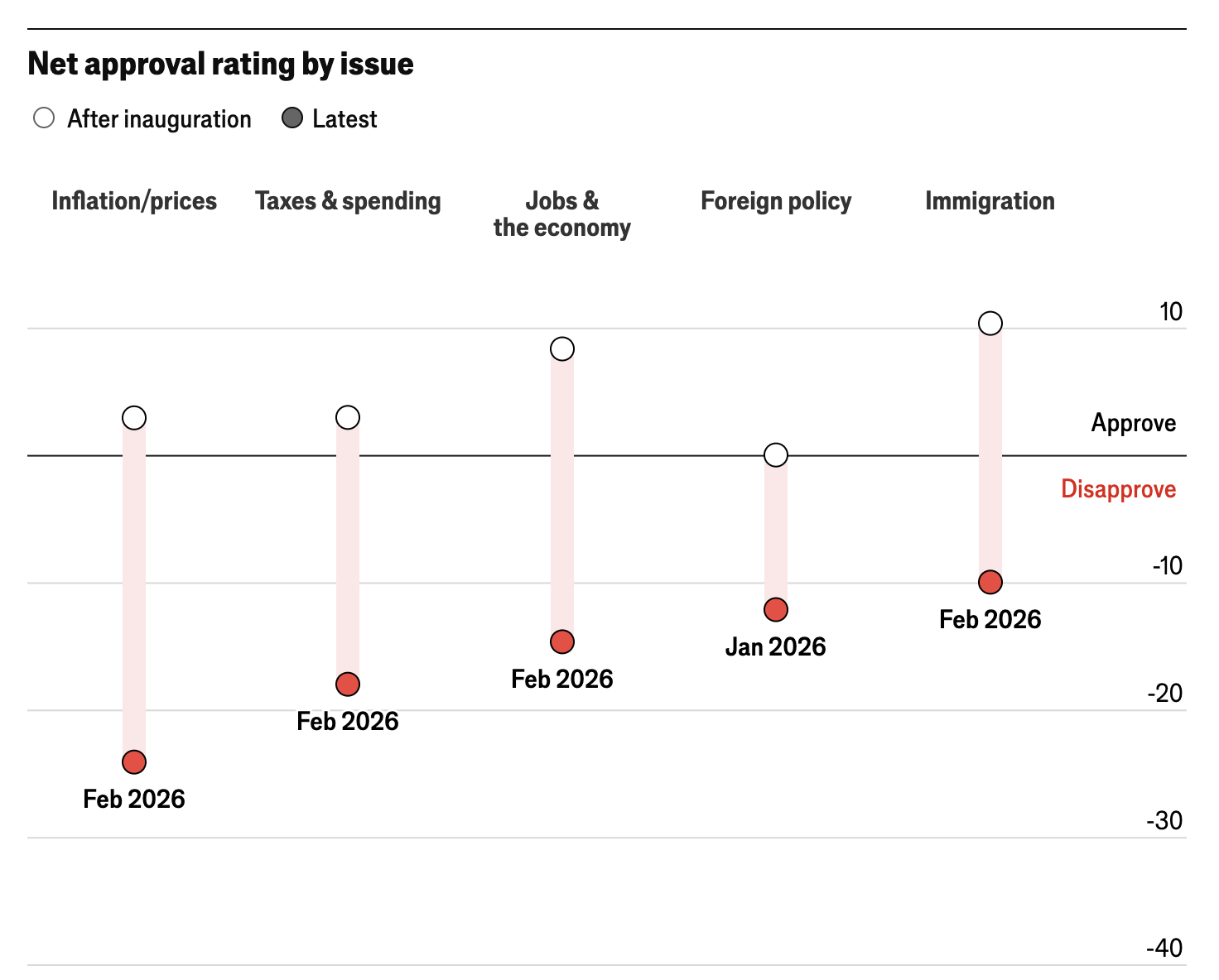
When it comes to inflation and prices, the Economist survey found that Americans disapprove of the job Trump is doing by a 24-point margin. On jobs and the economy, they disapprove by some 15 points, and on taxes and spending, they disapprove by almost 20 points.
This erosion could matter quite a lot, because discontent with the Biden/Harris approach to the economy was a major driver of Trump's victory in 2024. The cost of living was a top concern for voters at the time and remains so today. But the public has lost confidence in Trump's ability to make good on his campaign promises in this department.
No wonder. From demanding that the Federal Reserve slash interest rates to imposing large and constantly fluctuating tariffs on imported goods to driving federal spending (and the national debt along with it) ever higher, this administration's policy choices seem almost as if they were designed to put upward pressure on prices.
As young people and lower-income Americans sound the alarm about the cost of housing, a grassroots movement has emerged to push for stripping away restrictions that make it hard to build new homes. But rather than seize the chance to become a champion of deregulation and affordability, Trump declared that his goal is to drive the price of houses up rather than down. "Trump has said that he wants to keep home prices high to increase people's net worth," the Associated Press explains, "but doing so will likely keep construction levels low and price out possible first-time buyers."
People have noticed. According to Pew, fully half of Americans now say that since taking office Trump's economic policies have made economic conditions in the country worse, and according to CNN, almost two-thirds think he is focused on the wrong priorities (like, say, taking over Greenland).
* * *
The data tell a similar story when it comes to immigration, an issue that spiked in subjective importance to voters in the lead-up to the 2024 election. This is also an issue where Trump began his second term in sterling territory and where voters have long given the trust edge to Republicans.
But according to The Economist, Trump's immigration-related job performance has fallen by 20 percentage points since his second inauguration. And this is despite the fact that his handling of the border itself continues to earn positive marks. On the issue overall, a year's worth of headlines about heavy-handed enforcement, including denials of due process and violations of court orders, repeated instances of legal residents mistakenly being caught up in sweeps, the deployment of National Guard troops into U.S. cities, and multiple American citizens shot to death on camera by Immigration and Customs Enforcement agents, proved to be too much.
One way to make sense of these numbers is that, on immigration in particular, people recoil from chaos and disorder. A big part of the reason Biden was graded so poorly on the issue was people's sense that he had failed to contain what many viewed (fairly or not) as an invasion at the southern border and imposed disruptions on American communities by allowing an unprecedented influx of migrants on his watch.
Too many Republicans wrongly interpreted public dissatisfaction with Biden on immigration as a mandate to crack skulls (and torch the Constitution if need be) en route to cleansing the heartland of anyone and everyone without proper documentation. In contrast, the American people are broadly positive toward the immigrants who pick our food, build our homes, and start successful businesses at higher rates than native-born Americans. A June 2025 survey from Gallup found that 79 percent of respondents say immigration is a good thing for the country.
Contrary to what someone like White House Deputy Chief of Staff Stephen Miller wants you to believe, Pew found in January that solid majorities of Americans are opposed to policies like suspending asylum applications and keeping large numbers of immigrants in detention centers. They want a government that reliably evicts violent criminals, not one that drags old men into the snow in their underwear, sends gay makeup artists to be tortured in foreign gulags, and shuts the door on innocent people fleeing genuine humanitarian disasters.
If voters were bothered by chaos and disorder along the Rio Grande, it's hardly surprising they would be troubled by chaos and disorder closer to home. And little could be more chaotic and disorderly than watching masked federal agents assaulting their neighbors with impunity.
"What was once an issue that Mr. Trump could rely on as a political asset…has now curdled into a tragic debacle," the Republican pollster (and my former boss) Kristen Soltis Anderson wrote last month. "Americans are seeing horrifying video clips of clashes with ICE agents that instill a sense of fear, not of immigrants, but of their own government."
* * *
Trump's numbers are abysmal pretty much across the board. Half of Americans, including half of independents, think the country is worse off today than it was a year ago, according to the latest New York Times survey.
There isn't necessarily a one-to-one correlation between disapproving of a Republican president and voting for Democrats. But Trump's unpopularity has been accompanied by some ugly numbers for Republicans overall. Quantus reports "a clear Democratic edge" heading into the 2026 midterm elections, while CNN finds "a clear advantage on the generic congressional ballot" for the Democratic Party.
At the very least, this calls into question the narrative that the GOP now represents the "multiethnic working class."
The aforementioned Times poll did find that respondents without a college degree are slightly more likely to say they'd vote Republican than Democrat if the midterms were held today, and that's even more true for whites without a college degree. Among those with a bachelor's degree or higher, by contrast, Democrats have a 20-point edge, and among nonwhite voters, Democrats are ahead by 30.
Thus, the working class part of the Republican realignment at the moment seems more solid than the multiethnic part. But since those without a college degree are even more likely than those with one to rate the current state of the economy as poor, there's no guarantee they won't eventually sour on the GOP too. Conversely, it's plausible that a Republican Party that nominated someone less inflammatory for president in the future could win back some portion of the college-educated electorate that fled the Trump-era GOP en masse.
Despite Trump's fairly shocking gains with young and nonwhite voters in the 2024 election, it was probably premature to be talking full-on realignment. A more accurate read is that American partisanship has undergone a dealignment, where certain constituencies have become less wedded to the Democratic Party than they once were and more willing to defect as party leaders became unmoored from their base and started catering to the fringes.
But whether those groups continue to trend toward the GOP is obviously affected by how the president and his party govern. Trump spent his first year back in the White House behaving erratically, disregarding the rule of law, and ignoring voters' consistent No. 1 issue in favor of half-baked industrial policy and plans to invade the world. If his goal had been to drive away swing voters and new entrants to the GOP, he could hardly have pursued it better.