
The E.U. Wants 'Deforestation-Free' Products. Consumers May Pay the Cost.
In its effort to protect global forests, the E.U. is imposing complex tracking requirements that could raise prices and create new trade hurdles.
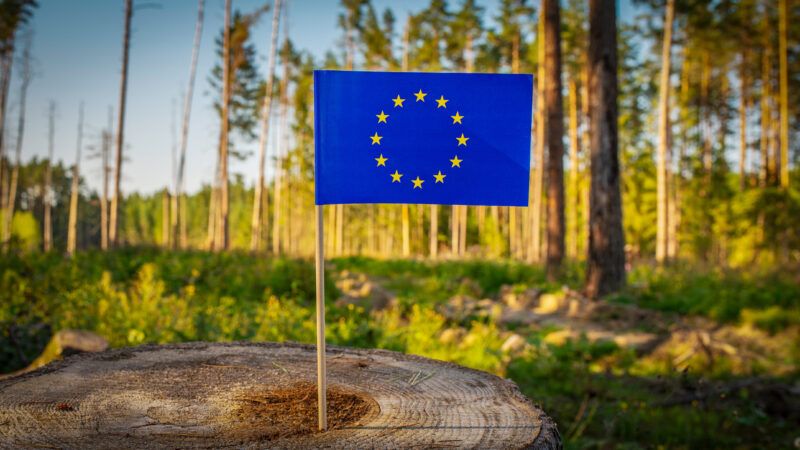
Are the products you're buying BPA-free? Nut-free? How about GMO-free? If the European Union (E.U.) has its way, we'll soon be adding a new label to our shopping list vocabulary: "deforestation-free."
Far from being another joke at the expense of Europe and its regulatory self-sabotage, this is precisely the aim of the E.U.'s 2023 Deforestation Regulation (EUDR), which began applying to large companies last December, and will extend to small and medium-sized firms in June.
As with many regulations out of Brussels, the intention sounds noble: To stop the cutting down of forests elsewhere in the world, the new rule forces companies selling products in E.U. member states to certify that they didn't source materials from lands classified as forests before 2020.
In practice, this means everything from paper products to furniture and even beef will be more expensive for consumers. More hurdles and fewer options for manufacturers necessitate higher prices.
Take IKEA's best-selling KALLAX shelf unit—a particleboard bookcase made from wood-derived materials covered by the EUDR, which currently retails for around $80. With only 15 percent of what IKEA sells in the U.S. actually made domestically, this means that many IKEA products imported from Europe (including the KALLAX) must comply with expensive E.U. sourcing rules. Stack deforestation paperwork on top of tariffs, and the affordable furniture Americans count on starts looking a lot less affordable.
Compliance isn't limited to European producers, but American ones too. Companies exporting to Europe must prove through a granular process of geolocation tracking and paperwork that their products weren't sourced from deforested land. If European consumers want to buy or access any product, they need legal assurances that no forests were touched in the process.
For a trading partner like the U.S., which exported nearly $400 billion in goods to Europe in 2024, the burden will be significant. U.S. Trade Representative Jamieson L. Greer flagged EUDR as a significant foreign trade barrier in April 2025, giving President Donald Trump's trade negotiation team yet another bone to pick with Europe.
The E.U. acknowledged in last year's U.S.-E.U. trade framework that it would have to "address the concerns of U.S. producers and exporters" to avoid "undue impact on U.S.-EU trade." But nothing has yet changed.
All this comes even though the U.S. poses a negligible risk to global deforestation thanks to robust forest management that has sustained our country for decades and is only improving.
Yet American producers are still facing a regulatory regime that treats responsibly managed U.S. forests the same as high-risk tropical supply chains in developing nations. The geolocation and data-sharing requirements—which demand latitude and longitude coordinates to six decimal places for every single plot—are completely disconnected from how U.S. forest product value chains actually operate.
For harvests larger than four hectares, or about 10 acres, the mandate to provide precise digital polygons essentially forces foresters to act as amateur cartographers before a single log can move.
Consumers from IKEA weekend shoppers to Costco bargain hunters will pay more for the added labor required to document each log that goes into a TV stand or the legs of a chair.
The absurdity of the rule becomes clearer when looking at some of Europe's own energy choices. Since ridding its territory of emission-free nuclear energy, Germany now relies on burning mostly wood-based biomass for nearly eight percent of its total electricity production. Wood accounts for nearly 55 percent of Germany's "renewable" energy generation, and U.S. exports are one of the key providers.
So while European nations continue to use wood to heat their homes and industries, they plan to coerce American timber producers into complex track-and-trace programs and sustainability paperwork. Critics argue they are doing this for the same reason social media firms are being shaken down for billions in fees and penalties: to have Americans subsidize their lifestyles and strained government budgets.
If the goal is truly to reduce risk rather than punish low-risk producers, a compromise must be found that works for both sides of the Atlantic.
The E.U. could allow low-risk countries like the U.S. to designate a single government agency, such as the U.S. Forest Service, to produce forest data and issue a single due diligence statement that complies with European regulations—simple, practical, and honest about where the actual risks lie.
It would place less burden on consumers whose main concern is affordability. American families are already facing high prices on everyday goods thanks to a global trend toward protectionism.
Free trade is the foundation of prosperity for consumers everywhere. Congress, the administration, and U.S. trade negotiators should be pushing back—hard—before this becomes the new normal.