
Wuthering Heights Is a Kinky, Revisionist Fever Dream
A problematic hyperpop romance that collides with the manosphere
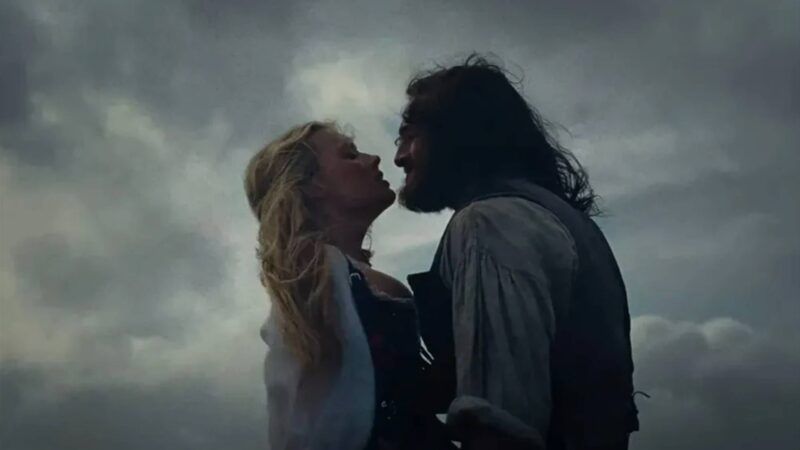
The new Wuthering Heights is technically a literary adaptation of Emily Brontë's 1847 gothic romance about class and society, but it plays more like the hot-and-heavy fever dream of an avid reader of lusty contemporary romance fiction. It's not a story so much as a series of storm-like adolescent moods that our heroine, young Catherine, is weathering. Her father is a sad old drunk, a once-noble man whose health and fortunes have declined. His vitality is faded and shriveled; in every way, he's withering. His decline has manifested in the craggy and desolate estate at which he, his daughter, and a moody but smoldering young man named Heathcliff reside; it's named after local rocky heights that are windy and raging, which is to say they are, well, wuthering.
If nothing else, we finally have a movie that will help viewers understand the difference between withering, weathering, and wuthering.
Sadly, there isn't much wordplay in Wuthering Heights; this is a mood piece about how people feel rather than what they think or say. But with its music-video compositions and ironically melodramatic soundtrack, it captures the tumultuous and rampaging drama of youthful lust and desire. Directed by Emerald Fennell, who previously helmed Promising Young Woman and Saltburn, this take on Wuthering Heights is designed to cater to the same crowd that puts romantasy fiction on the bestseller list and buys tens of thousands of kink-specific AI-written novels in microgenres that, according to The New York Times, now include "dark mafia romance."
What subgenre would Fennell's Wuthering Heights belong to? It's a love triangle with one woman and two men; I'm told the current parlance is "reverse harem." But I might describe it as something like "decision angst romance," a subgenre it shares with last year's contemporary romance Materialists. Like that film, it is fundamentally about a woman caught between two suitors, one shaggy and poor, the other wealthy and wise to the world. Come to think of it, this is essentially the plot of the Twilight films, too.
There are no vampires or werewolves in Fennell's Wuthering Heights. But there is a monster, in the form of Heathcliff, played by Jacob Elordi, last seen delivering a lithe and sinuous take on Frankenstein's misbegotten creation.
Here, he is a fully carnal creature; in the movie's first hour, he appears as a long-haired, lower-caste ruffian, a man of no stature who has been taken in by Catherine's father. Even as children, they share a special bond, and they long for each other. Yet Heathcliff is poor and without status, so she accepts an offer of marriage from Linton, the ostentatiously wealthy man down the road.
With Linton, her life is stable and more than comfortable, a fantasy of wealth and ease. But it lacks romantic passion. And when Healthcliff returns, cleaned up and newly wealthy after years abroad, her youthful emotions are reignited. She wants the bad boy she cannot have. And this modern Heathcliff, a smoldering kink shaman who would be at home in 50 Shades of Grey's red room of pain, is very, very bad.
Part of what makes Fennell's adaptation so tricky and unnerving is the way it is simultaneously designed to appeal to and titillate female viewers while following a script right out of manosphere propaganda. I apologize in advance for phrasing it this way, but it's hard not to see this movie in that community's nonsense lingo: Heathcliff is a low-status beta who, as he comes of age, locks in, looksmaxxes and wealthmaxxes, increases his, er, sexual market value, and returns a triumphant Chad. There's no mention of cortisol, but still, I'm surprised Clavicular wasn't involved.
Heathcliff drives Catherine mad with lust by treating her badly, by ignoring her and refusing to explain himself and eventually taking another woman who he treats like a literal leashed dog. Catherine, in her marriage to the rich, safe, and stable Linton, has all the comforts she could ever imagine. But she wants what is high status, dangerous, and forbidden—and she wants it so much that she feels like she might die. Uh, happy Valentine's Day?
Fennell captures the movie's emotional turbulence with vivid, riotous imagery that matches Catherine's erotic intensity. Every shot is designed for maximum memeability; even if you don't see the movie, you'll see its frames on social media. High-energy pop star Charli XCX contributes to the soundtrack, which seems right: Her manic musical subgenre has been dubbed hyperpop, and this is the hyperpop version of Wuthering Heights.
Like so many teenagers, I was assigned to read Wuthering Heights in school. I haven't looked at it since. I didn't care for it then; I was a boy, and more into brontosauruses than Brontë. Decades later, this movie version is still not for me. But I admire its gumption, its fervor, its willingness to be both bizarre and ridiculous in service of passion. It carries an intensity that I had to weather, for the frantic strength of Fennell's erotic, romantic vision can be withering.