
A Viral Story Claims an ICE Worker Was Caught in a Child Sex Trafficking Sting. The Truth Is Much Stranger.
The way people are misconstruing this prostitution sting mirrors the way ICE tries to mislead us about deportation stings.
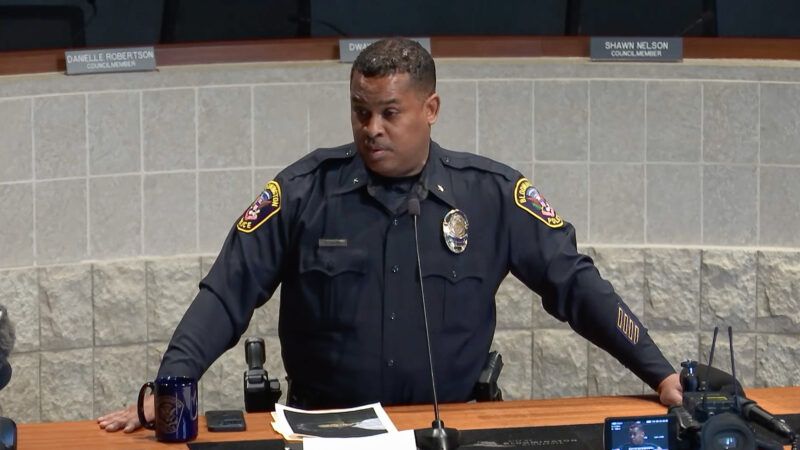
A man who reportedly does background checks for Immigration and Customs Enforcement (ICE) was arrested in a Bloomington, Minnesota, sex sting. But the story is being twisted—by people employing the same sort of despicable smear tactics we see from ICE and the Department of Homeland Security.
"Police in Bloomington, MN just announced that one of the guys they arrested in an underage sex trafficking sting was a background checker for ICE agents," the Minnesota House of Representatives Democratic-Farmer-Labor (DFL) Caucus posted on Bluesky yesterday. "He had a high security clearance in the Trump administration… and he was caught trying to abuse children. Sickening."
You are reading Sex & Tech, from Elizabeth Nolan Brown. Get more of Elizabeth's sex, tech, bodily autonomy, law, and online culture coverage.
The post includes a clip from a Bloomington Police Department press conference. "This is the most disturbing arrest that we've had here," says Police Chief Booker Hodges in the video, holding up a picture of someone identified as Brashad Johnson. "He's a backgrounder for ICE, Homeland Security, and federal agencies.…We locked him up."
"Thank you to Minnesota's local law enforcement for keeping our communities safe and getting the worst of the worst off our streets," Minnesota Gov. Tim Walz posted on X about the sting.
News media and countless folks on social media have been running with the child sex trafficking narrative, using this story as an opportunity to dunk on the caliber of people employed by federal immigration agencies. "ICE is a child trafficking operation for the pedophiles of the regime," says one post on Bluesky. "An administration of pedophiles, for pedophiles," says another.
As much as I share folks' abhorrence at ICE generally, the ire and smirking here is misplaced. Minnesota politicians may be calling this a "sex trafficking sting," but—as is so often the case—it's just a vice operation aimed at adults looking to find other adults for sexual activity.
"Operation Lookin' for Love in All the Wrong Places" involved Bloomington police posing as sex workers and arresting those who allegedly took the bait.
The operation yielded 30 arrests. Of those, 28 people face misdemeanor charges. Two more people face felony charges because they have prior criminal records. No one was arrested on sex trafficking charges, though "one person who spoke with the undercover officers is now under investigation for potential sex trafficking," according to local news station KSTP.
(Hodges said at his press conference that finding even a potential sex trafficker is a "first" for the department's sex stings, which sort of gives the lie to the idea that these stings suppress anything but adult sex workers and their customers.)
Johnson is not an ICE employee but a Department of Defense contractor, according to KSTP.
Bloomington Police's press conference and post about "Operation Lookin' for Love in All the Wrong Places" are truly bizarre. The YouTube video of the conference opens with an elaborate skit, acted out by Bloomington cops, in which a scruffy dude on a couch books a date with a "sex worker" who is really a police officer. "Be careful who you're messaging this Valentine's Day," one man in a Bloomington police uniform says. "It could be us."
Chief Hodges—who spends part of the press conference singing "Looking for Love in All the Wrong Places" and most of it making quips about those arrested as he shows their mugshots—complains that ICE "interfered with our operation" because people were suspicious of meeting the undercover cops, thinking they might be ICE.
Hodges makes a big deal about stressing that his officers are not ICE. But the way police and politicians talk about people caught in prostitution stings sure mirrors the way the Trump administration talks about people caught in deportation stings.
DHS and ICE officials, and others in the Trump administration—including the president himself—routinely portray their immigrant roundup efforts as being aimed at "the worst of the worst," including "kidnappers, pedophiles," and "violent assailants." Again and again, it comes out that people being taken in and slated for deportation have no criminal records. Trump and his administration's descriptions of their deportation efforts don't match the reality.
And it's no wonder: Many people—including people who nominally support immigration enforcement crackdowns—are against aggressive tactics like we've been seeing from ICE. They don't like the idea of a massive mobilization of federal money and resources aimed at nabbing peaceful people guilty, at most, of minor immigration infractions.
We see the same thing happening with so-called sex trafficking stings.
Even people opposed to prostitution often balk at the idea that Homeland Security and the FBI should be used to stop it, or that tons of money and time should go toward arresting people who may be looking to privately and consensually hook up. So authorities have rebranded vice stings and prostitution busts as "sex trafficking stings" and "human trafficking operations." They say that by arresting sex workers and their clients, they're "finding victims" or "ending demand" for human trafficking. They use words like prostitution and trafficking interchangeably, and do nothing to correct impressions that their operations nab people for truly heinous crimes.
Authorities manufacture support for prostitution stings the same way the Trump administration manufactures support for its deportation raids. And neither are keeping anyone safe.
Follow-Up: Arizona Drag Bill Passes Two Committees
Last Wednesday, this newsletter covered an Arizona bill that would make it a felony to bring your kid to a drag performance or let them be in a building where one was taking place. The House Judiciary and Rules committees have now advanced that measure, with votes of 6–3 and 5–2, respectively. Meanwhile:
Having muscled age-verification through last session, AZ Republicans are pushing forward even greater restrictions on sex, including banning porn entirely (HB 2900), threatening adult producers with warrantless AG inspections (HB 2133) and HB 2720, which would make purchasing sex a felony.
— Mike Stabile (@mikestabile.bsky.social) 2026-02-11T01:19:52.495Z
In the News
Texas' latest "bounty hunter" abortion law will get its first test in court. Passed in December, it says anyone can bring a lawsuit against someone who "manufactures, distributes, mails, transports, delivers, prescribes, or provides" abortion pills to a Texas resident. "Last week, Jonathan Mitchell—one of the architects of the state's total abortion ban—filed a revised lawsuit against Dr. Remy Coeytaux on behalf of Jerry Rodriguez, who first sued the doctor in July for allegedly sending abortion pills to his partner, which she used to end her pregnancy," reports Jezebel. "In his updated claim, Rodriguez accuses Coeytaux of violating the new law, even though the alleged abortion took place before HB 7 passed." Rodriguez's suit also invokes the Comstock Act.
On Substack
You can use artificial intelligence to write romance novels—but should you? Kathleen Schmidt at Publishing Confidential, dissects The New York Times' article "The New Fabio is Claude" and the ethics of AI book writing:
Flooding the market with AI slop hurts the industry. More importantly, it hurts the self-publishing ecosystem. It even hurts the hybrid publishing ecosystem. When you have endless self-published titles and, say, half of them are "written" by AI, discoverability becomes impossible. Using fake names and claiming to have written 200 books in a year when you really only came up with familiar concepts in romance is deceiving readers. You're collecting money, but you're not doing the work. It is downright insulting to actual writers who sometimes spend years writing and querying before they are published.
Read This Thread
When a sitting representative refers to the Super Bowl halftime show as "pornography," people should use that to reflect on how they and other representatives are simultaneously working to ban, censor, and restrict "pornography" and what that actually means
— Kat Tenbarge (@kattenbarge.bsky.social) 2026-02-10T18:52:11.532Z
More Sex & Tech
- Is it constitutional for the government to limit the number of sex offenders that can live in a house?
- "I found that xAI is indeed raising Section 230 as a defense to liability for Grok's bikini pics," posts Stanford's Riana Pfefferkorn on Bluesky. See the filing here. (Whether Section 230 applies to generative AI outputs is still an unanswered question and a matter of much debate.)
- AI systems will "inevitably form senses of self," said Amanda Askell of Anthropic. She's here to guide at least one of them, Claude, in the right direction.
- Is AI just creating more work for us? Kate Lindsay at Embedded makes that case.