
Trump's 25 Percent Tariff on Chip Imports Is Really an Export Tax
The order imposes duties on China-bound AI chips if chipmakers don't invest in American semiconductor fabrication.
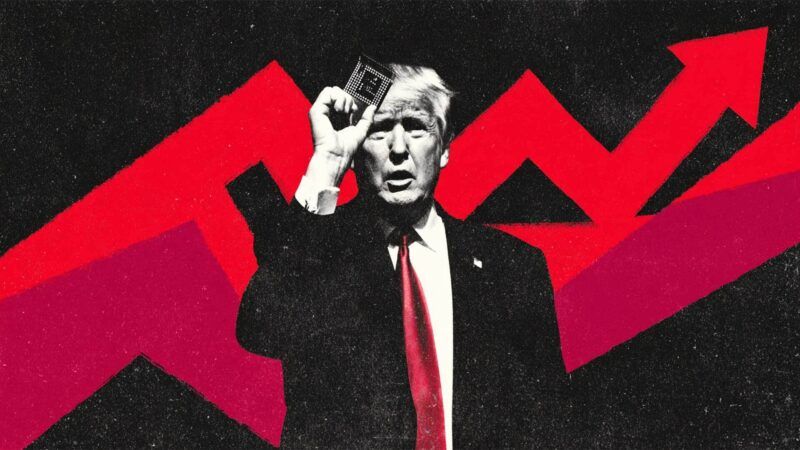
On January 14, President Donald Trump issued an executive order slapping a 25 percent import tariff on advanced semiconductors commonly used in AI data centers.
Trump imposed the duty in response to a Commerce Department investigation that concluded imported semiconductors "threaten to impair the national security of the United States." The order specifies that the importation of "semiconductors that enable artificial intelligence (AI) [poses] a threat to the national security."
Given the AI industry's insatiable demand for advanced chips, 90 percent of which are fabricated abroad by the Taiwan Semiconductor Manufacturing Company (TSMC), tariffing chip imports appears inconsistent with Trump's ardent support of American AI.
This is where the exemption language comes into play.
The order excludes nearly every conceivable domestic application of AI chips from paying the duty, including imports intended for use in American data centers, research and development, startups, consumer applications, civil industrial applications, and public sector applications. This means that "Nvidia's H200 and the AMD MI325X will be hit with the new import tax only if they are destined for customers in other nations," explains The Washington Post.
This move comes five months after the president allowed Nvidia and AMD to sell some of their AI chips to China in exchange for 15 percent of their revenue on those sales. There was debate over whether conditioning export approval on revenue-sharing was legal, given the Constitution's directive that "No Tax or Duty shall be laid on Articles exported from any State." Imposing import taxes before exportation to final, non-American destinations appears to be a constitutional workaround.
Still, Nvidia H200s destined for foreign nations, including China, may also avoid the duty.
The Commerce Department reported Thursday that it had reached a deal with Taiwan whereby Taiwanese companies will directly invest $250 billion in American "semiconductor, energy, and artificial intelligence production," for which Taiwan will provide $250 billion in credit guarantees to facilitate this investment. In exchange, the U.S. will allow those companies—such as TSMC, the manufacturer of Nvidia's H200—to import 2.5 times its planned American chip capacity duty-free during construction. (The deal also lowered the reciprocal rate on Taiwanese imports from 20 percent to 15 percent.)
The White House may paint this announcement as a win for American chip manufacturing, AI, and national security, but Republican industrial policy is doomed to fail just as miserably as Democratic industrial policy.