
Eric Trump Congratulates His Father for a Drop in Fentanyl Deaths That Happened Before He Took Office
The president's son also claims destroying cocaine boats somehow reduces fentanyl overdoses, echoing his father's confusion.
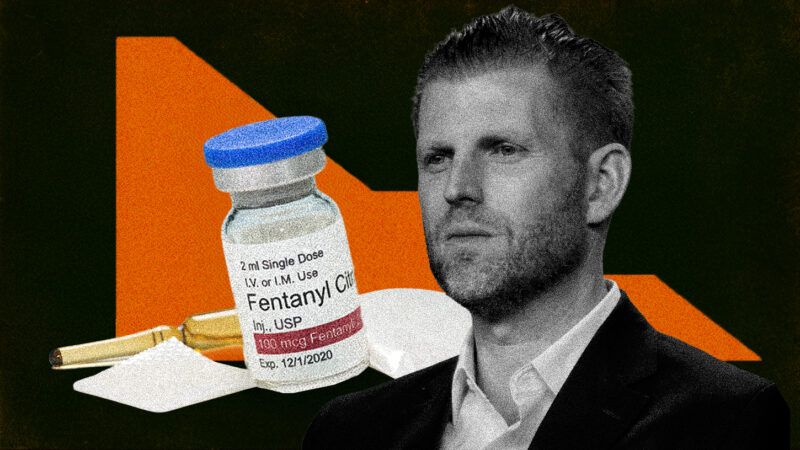
"No statistic has ever made me more proud," Eric Trump wrote in an X message posted on Saturday evening. "Well done @realDonaldTrump!! Keep blowing the shit out of those boats!"
The "statistic" to which the president's son referred was originally illustrated by a chart showing a sharp decline in fentanyl-related deaths. Trump apparently removed that illustration after X users, including Reason's Nick Gillespie, noted an obvious problem with his brag: The dramatic drop that he attributed to his father's murderous anti-drug strategy happened during the Biden administration, a year before Trump started bombing suspected smugglers in the Caribbean and the eastern Pacific. Nor was that the only flaw in Eric Trump's reasoning, which echoed the president in conflating cocaine, the drug allegedly carried by "those boats," with fentanyl.
Although we should not make too much out of one stupid X post, this one nicely illustrates the illogic of the war on drugs, which assumes that politicians have the power to stop Americans from consuming politically disfavored intoxicants if only they try hard enough. If that is true, and if we ignore all the other factors that might affect drug deaths, it follows that presidents can take credit for any decreases that happen on their watch. Conversely, they should be blamed for any increases.
Although Eric Trump wants us to accept that logic, he surely would rebel at the implications of applying it consistently. His father, after all, presided over an unprecedented jump in drug-related deaths, which rose by 30 percent during the last year of his first term. By the end of that term, the annual number of drug deaths was 44 percent higher than it was the year before Trump took office.
The death toll continued to rise during Joe Biden's first two years in office, reaching a record high of nearly 108,000 in 2022. It fell slightly in 2023 before plunging by 27 percent (another record) in 2024. The downward trend continued in 2025: During the year ending last August, according to provisional estimates from the Centers for Disease Control and Prevention, fewer than 73,000 people died after consuming illegal drugs, down from more than 91,000 during the year ending the previous August—a 21 percent drop.
The recent decline is due almost entirely to a drop in fentanyl-related deaths. Researchers have suggested several possible explanations.
A 2024 study found that "volatile drug use during the COVID-19 pandemic was common, appeared to be driven by structural vulnerability, and was associated with increased overdose risk." Another study published the same year concluded that "policies limiting in-person activities significantly increased" drug death rates.
If pandemic-related disruption drove the 2020 overdose spike, the return to normal life seems like a plausible explanation for subsequent decreases, although the death toll was still about 14 percent higher in 2024 than it was in 2019. University of North Carolina drug researcher Nabarun Dasgupta and his colleagues have suggested other possible factors, including wider availability of naloxone, an opioid antagonist that quickly reverses overdoses, and depletion of the vulnerable population due to prior deaths.
Dasgupta et al. deemed it "unlikely" that attempts to block the drug supply—the solution favored by Trump and Biden, echoing a long line of politicians—had played a significant role in reducing overdoses. That explanation, they noted, was inconsistent with the falling retail prices they had observed.
That observation suggests the error of assuming that overdose trends can be explained by any given president's zeal in prosecuting the war on drugs. Prohibition creates a powerful financial incentive for supplying Americans with the drugs that they want, and there are many ways to accomplish that. It is therefore unrealistic to expect that stepped-up enforcement will have a noticeable and lasting impact on the drug supply. So even if Eric Trump did not get his dates mixed up, his causal claim would be implausible.
Another obvious problem with Eric Trump's claim is that the traffic his father is trying to disrupt by "blowing the shit out of those boats" involves cocaine rather than fentanyl, which is generally transported in small packages over land, across the border with Mexico. The president himself is confused on this point. "The boats get hit, and you see that fentanyl all over the ocean," Trump erroneously claimed at a press conference in October.
Based on that mistaken belief and a couple of other demonstrably false assumptions, Trump has repeatedly asserted that he saves "25,000 American lives" every time he bombs one of those boats. As of January 10, his deadly military campaign against cocaine couriers had destroyed 36 vessels, killing 123 people. So according to Trump's math, he has already prevented 900,000 U.S. drug deaths—11 times the total recorded in 2024. That is even more impressive than the reduction that Eric Trump credited to his father, which was at least mathematically possible if you ignored the temporal difficulties.