
Will Iran Fall?
Plus: Border Patrol's recruitment problems, social media getting boring, RFK Jr. goes after food stamps, and more...
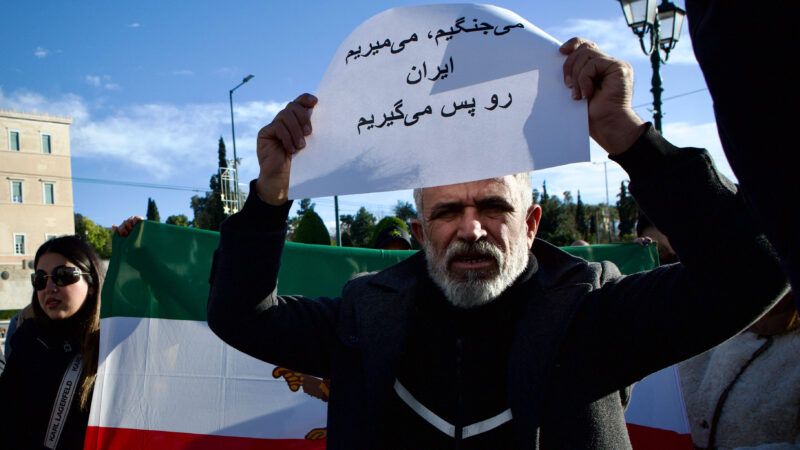
Protest movement continues to gain traction: "We can see from the news and from some government reactions that this regime is terrified to its bones," a 33-year-old protester named Sahar told The New York Times. In Iran, the weakening rial—due mostly to sanctions—has created an economic crisis. And on December 28, the crisis got so bad that people started to take to the streets, protesting the incompetence of the regime. Since then, the protests have morphed into a more generalized means of venting rage at those in power. And as Iran's security forces have started killing protesters in the streets—at least hundreds, if not thousands at this point—the rage has only grown.
The Reason Roundup Newsletter by Liz Wolfe Liz and Reason help you make sense of the day's news every morning.
It's not just in Tehran, but all over the country that anger with the regime is reaching a fever pitch:
Today, January 5, on the ninth day of nationwide protests, law enforcement and security forces fired tear gas and chased protesters in the city of #Yasuj.#IranProtests pic.twitter.com/SB7csRXSmt
— HRANA English (@HRANA_English) January 5, 2026
Bojnourd, North Khorasan, Iran.#IranProtests pic.twitter.com/SjfkhZhYzm
— Living in Tehran (LiT) (@LivinginTehran) January 7, 2026
An Iranian mother, her face bloodied by police, defiantly shouts: 'I'm not afraid! I'm not afraid! I've been dead for 47 years!' Her courage fuels the voices of countless protesters demanding freedom. #IranProtests #IranRevolution2026 #HRW pic.twitter.com/ULI07W2LGE
— Jahanzeb Wisa (@jahanzebwesa) January 8, 2026
"As the space for political dissent has shrunk in Iran, protests have become more frequent and violent," writes Reason's Matthew Petti. "In 2009, around 72 people were killed in protests by the reformist movement against a contested presidential election. In 2019, the government responded to protests about fuel prices by shutting down the internet, killing at least 321 people, and banning reformists from parliament. In 2022, when Iranians rose up against mandatory hijab laws, the crackdown killed at least 551 people."
The question remains: Is this time different?
The internet blackout, which has been in place since January 8, partially obscures the on-the-ground reality. The death toll remains unknown. But the scale of the protests—spreading far beyond Tehran—gives some indication that economic pain is a galvanizing force, and that the regime is more widely regarded as weak following the Israeli strikes on critical war infrastructure this past June.
Border Patrol recruitment and retention challenges: "In the wake of an ICE officer's killing of Renee Good, the Department of Homeland Security is rolling out 'Operation Metro Surge,' flooding Minneapolis with hundreds of additional federal agents—only to realize it doesn't actually have the confidence to match the bravado," reports Ken Klippenstein on his Substack. "While homeland secretary Kristi Noem and others in the administration preen about justifying last week's shooting and trumpet their war on 'domestic terrorism,' DHS is privately divided and hesitant about the latest deployments. According to documents leaked to me, not only is the Department seeking 'volunteers' for the apparently unpopular mission, it is urging its agents to maintain a low profile and comply with the use of force policies." Full piece is worth reading.
Scenes from New York: "To me, she is a very specific archetype of New York City girl, who wears boots everywhere all the time….It's a real kind of, like, feminist, young millennial/Gen Z look….She makes me feel old, both at how young she got married and became first lady [of New York]….I'm excited for her, but I don't envy her at how deeply everything she wears will be picked apart," says Vanity Fair senior staff writer Marisa Meltzer of Rama Duwaji's style on the podcast Fashion People. "I don't like her aesthetic and would probably steer it in a little bit less of a Brooklyn direction, but I'm deeply not her."
QUICK HITS
- "The era of student loan leniency in the US is officially over," reports Bloomberg. "During the Covid-19 emergency, mandatory payments on federal student loans were paused to shield borrowers from the financial repercussions of missed bills. Even after the economy recovered, multiple extensions and a grace period meant they could get away with ignoring their debts. President Donald Trump's return to office has brought that period to a close. His administration has restarted collections on borrowers in default, who are now eligible to have their credit scores penalized; settled a lawsuit to end the most lenient income-driven repayment plan available to borrowers; and announced that the US Department of Education will begin to dock wages and tax refunds from borrowers in default." Good!
- "I think we just left a year when social media got fundamentally less interesting. The only reason cutting down on screen time was ever hard was because we wanted to look at our phones. But over the past few months, as I methodically opened and closed my stable of apps, I slowly realized just how long it's been since I found what I was looking for," writes Kate Lindsay at Embedded. "Why would I open my phone to scroll advertisements when I'm already being served them every time I pause a TV show, open up Uber, or attempt to read a website?"
- "As the Trump administration deploys thousands of federal immigration officers and agents around the nation, a loose-knit but increasingly organized network of activists is tracking their whereabouts and documenting arrests," reports The Washington Post. "Federal court rulings say citizens can observe and record police activity in public areas as part of their First Amendment rights, and many of the observers are doing nothing more than that. They say that they believe authorities are less likely to use force if someone is recording and that they are providing a public service by letting their communities know when federal immigration officers are nearby. But as officers and agents employ aggressive tactics, some activists have blown whistles to warn community members of approaching law enforcement, tried to follow immigration enforcement vehicles or used their own cars to block the roadways—entering murkier legal territory."
- Interesting:
BREAKING: RFK says food stamps will no longer be able to be used on sugar & soda.
— Polymarket (@Polymarket) January 11, 2026
- Effective altruists thoroughly roasted:
Smart people being invested in shrimp welfare and forgetting to have children sounds like a 1980s B-movie plot device, where the Soviets invented mind magic to destroy the future of the US
— Simon Sarris (@simonsarris) January 11, 2026