
With Eddington, Hollywood Finally Starts To Reckon With the Madness of 2020
Ari Aster’s pandemic satire is the movie of the year.
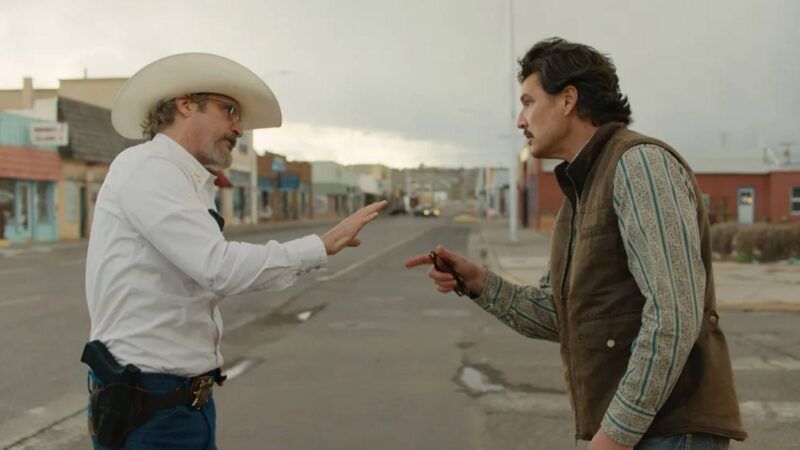
With Trump in office again and a nebulous vibe shift or two fully underway, 2025 sometimes felt more like an aftershock of 2020—a remake or a sequel or some sort of twisted spiritual successor—than its own distinctive year.
Nearly every significant debate in politics and culture, from the woke wars to the streaming wars to the actual wars, can be traced back to that seminal pandemic year, the annus horribilis that tore America, along with much of the rest of the world, apart.
And no movie better captured the anxieties and agitations of that year than Eddington, Ari Aster's manic satire of COVID-era madness and the damage it did to our national psyche. I saw dozens of new films in 2025, but this is the one I thought about most, because it's the first Hollywood film, and maybe the first mass-cultural product that isn't a podcast or an essay, that really reckoned with what happened in 2020. The pandemic made us paranoid. COVID made us crazy. Tech became even more of an all-purpose mediator for human relationships. And years later, when it was all over, everything was weirder and more insane than ever.
Eddington dramatizes the way in which COVID caused a kind of mass psychotic break from reality, a cultural cabin fever from which we are all still recovering. It's the movie of the year, and maybe of this whole cursed decade.
Part of the movie's appeal is that it starts with something simple and familiar: a debate about masking that pits haughty rulemakers against ordinary folks. Set in small town New Mexico in the summer of 2020, the film begins as a mild satire of COVID pieties, but quickly raises the stakes. The masking debate somehow merges with debates about crypto, social media, and Black Lives Matter, as a small town election between an incumbent mayor and an anti-masking sheriff takes on increasingly absurd dynamics. Yet the rapid ratcheting up of cultural-political stakes mirrors the real-world escalations of that year, in which politics and the culture war seemed to merge into a giant, ugly blob of undifferentiated anger and polarization, a vortex of political-cultural hysteria that overwhelmed society. There were a lot of specific gripes and complaints, but often it seemed that the real issue was that everyone was mad about everything.
The escalation continues in familiar ways until the final third of the film, which devolves into a fever dream of chaos and violence, the culture war as actual war, playing out on the streets of an ordinary American town. It's a farce, both terrifying and hilarious. And like all good farces, it makes its point through exaggeration.
In its final act, Eddington seems to go off the rails. It becomes bizarre, violent, impossible to reason with or fully understand, a deranged, hallucinatory experience that seems wholly disconnected from on-the-ground reality. What starts as pointed pandemic satire turns into something insane, something that cannot possibly be meant to reflect what's real.
That's the point. The movie's argument, to the extent that it can be boiled down, is that the pandemic year, and all the social upheaval it wrought, can't be understood on normal, grounded, realistic terms. What Aster seems to be saying is that 2020 is the year we all went crazy. And the only way to truly look back on that moment is as a kind of collective madness, an era that couldn't possibly have happened. And yet, somehow, it did.