
Avatar: Fire and Ash Is Part Spectacle, Part Retread
An eco-action film that covers too much familiar ground.
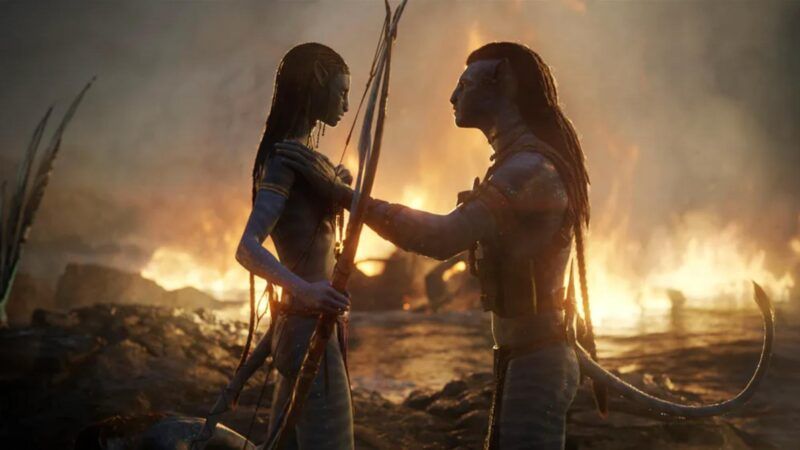
There are moments in Avatar: Fire and Ash when it plays like a propaganda reel for Greenpeace.
Like its predecessor, Avatar: The Way of Water, the film is an eco-action flick, an environmental revenge film, in which the well-armed forces of a capitalist-military resource extraction operation get their comeuppance at the hands of dragon-riding blue-skinned natives and a pod of pacifist space whales. (It's not much of a spoiler to reveal they don't stay entirely peaceful.)
And like its predecessor, it's a rousing, immersive, impressive big-screen spectacle. James Cameron's sci-fi fantasy epic, which runs three hours and 15 minutes, is about as fully realized as a big-budget, special effects-driven blockbuster can be. Even if these movies aren't to your taste, you do, in fact, have to hand it to him. Again.
The again part, however, is what makes the movie somewhat less successful than The Way of Water, which was an improvement on the original Avatar in nearly every way. Too much of Fire and Ash feels like a repeat of the prior film, from the thunderous whale attacks to the familial drama that drives so much of the story to the mechanics of the action scenes themselves. We've seen so many of these beats and big ideas before. It should have been called Avatar: Fire and Rehash.
Still, Cameron is stealing from himself, and that's not a bad thing. Cameron has a gift for scale and spectacle that few directors can match, an intensity and depth of cinematic vision that is always welcome on screen. Even warmed-over Cameron feels fresher than most of what passes for big-budget, big-screen ambition these days. There's an extended action sequence in which a caravan of alien traders flying airships pulled by what look like flying jellyfish is attacked by fire-wielding raiders. It's wild, electric, ecstatic, and a huge rush. Most movies would build to a sequence like this, positioning it as a climax. Cameron dispenses with it by the end of the first act.
Of course, most directors don't have three and a quarter hour runtimes to work with. The extended play format gives Cameron space for sprawl. Even more than in the two previous Avatar films, Fire and Ash is loaded, possibly overloaded, with environmental and cultural detail. There are moments when the movie almost feels like watching an alien nature documentary, a National Geographic dispatch from another planet.
Inevitably, however, the story intrudes. Once again, the film follows Jake Sully, a marine turned Na'vi, the series' big blue alien protagonists, and his family. They're still reeling from the death of a son at the end of the previous film, and they have a pressing issue with Spider, a human boy who has become a sort of surrogate family member, an adopted brother to the Sully children.
The problem, however, is that he's actually the son of the franchise's main villain, Col. Miles Quaritch, another marine turned Na'vi, who remains intent on hunting down Sully, who has been branded a traitor to humanity. Like so many Cameron films, it's a movie about fathers and found families struggling to keep together.
That struggle is further complicated by the entry of a new group of Na'vi, the Mangkwana clan, a murderous tribe obsessed with fire that calls themselves the Ash people. Some of the movie's best moments come from exploring the culture of the Ash people and their volcanic mountain lair.
But Cameron doesn't quite know what to do with his Na'vi nemeses, so he again circles back to the corporate-military bad guys trying to extract a life-giving substance from the alien whales. From there, the anti-whaling propaganda commences once again, with scenes of harpoon-toting whale-hunters menacing the distant planet's oceans until nature finally gets revenge.
More than even the previous Avatar film, Fire and Ash indulges in a kind of woo-woo, left-coast eco-spirituality that blends into biotech sci-fi. Eventually, the Ash people join forces with Quaritch, and Quaritch becomes their leader's lover. They spend a lot of time getting high on some sort of mind-expanding drug, becoming one with…something.
By the time Cameron actually shows us the beatific face of the planet's deity in a spirit realm that's only accessible by plugging into the planet's eco-internet, you have to decide whether you are comfortable accepting the movie on its own, frequently ridiculous, terms.
But for all the film's flaws, it is nonetheless a remarkable exercise in silver screen razzle-dazzle. There's something genuinely wondrous about the far-flung world Cameron has created, the complete alien ecosystem he depicts.
Cameron's action chops have been the best in the business since the 1980s, so it's no surprise that Fire and Ash's big sequences retain his signature kinetic kick. And they are brought to life by truly stunning effects work, with almost entirely computer-generated environments and motion-capture characters that often manage to look astoundingly realistic. Yes, Cameron had a giant budget at his disposal, but there are plenty of $200 million movies that simply look like garbage. Not every shot is perfect, but Fire and Ash looks so much better than nearly every other expensive, effects-heavy film that I found myself wondering if anyone in Hollywood other than James Cameron actually knows how to spend money on movies. Who cares if it's propaganda? Who cares if it's a retread? What matters is that it's awesome.