
Court Issues Preliminary Injunction Protecting Group Flying "8647" Flag
The flag, in context, likely doesn't fit within the First Amendment exception for true threats of illegal conduct or incitement of illegal conduct.
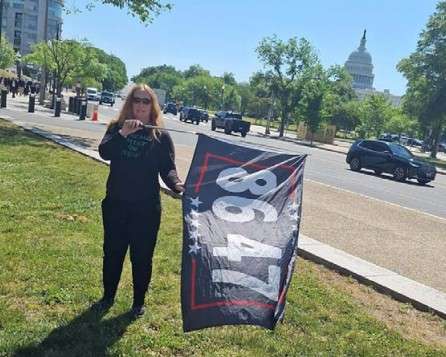
From yesterday's decision (which strikes me as correct) in Accountability Now USA v. Griess, by Judge Randolph Moss (D.D.C.):
Plaintiff, an unincorporated association that maintains a 24/7 demonstration calling for the impeachment and removal of President Donald Trump on National Park Service ("NPS") land, moves for an emergency order temporarily restraining the Superintendent of the National Mall and Memorial Parks Kevin Griess and the Secretary of the Interior Doug Burgum or their delegees "from taking enforcement action against them because of their display of a flag with the legend '8647.'" For the reasons that follow, the Court will grant Plaintiff's motion….
The parties' disagreement … turns on whether Plaintiff's display of the "8647" flag constitutes protected speech, as Plaintiff asserts, or a "true threat" to the life or safety of the President (or an incitement to violence), as Defendants maintain. At oral argument, both sides agreed that context is dispositive. Not every use of the slang phrase "86" constitutes a threat of violence; to the contrary, it is most often used to mean that an item is no longer available or that someone or something should be removed, ejected, or thrown out. But it can, in some contexts, mean "to kill." …
"True threats of violence, everyone agrees, lie outside the bounds of the First Amendment's protection." "'True threats' encompass those statements where the speaker means to communicate a serious expression of an intent to commit an act of unlawful violence to a particular individual or group of individuals." "The 'true' in that term distinguishes what is at issue from jests, 'hyperbole,' or other statements that when taken in context do not convey a real possibility that violence will follow." …
The Court starts with the premise that the word "86" is a slang term with no single meaning. According to Merriam-Webster, "Eighty-six is slang meaning 'to throw out,' 'to get rid of,' or 'to refuse service to.'" The phrase "comes from 1930s soda-counter slang meaning that an item was sold out[,]" and may have been used because it rhymes with "nix." It was first used as a noun to refer "to an item … that had been sold out," but by the 1950s, the term was used as a verb, at first meaning " 'to refuse to serve a customer,' … later meaning " 'to get rid of; to throw out,' " and still later coming to mean " 'shut out' or 'rejected.'" Merriam-Webster further notes that a recent extension of these meanings has included "'to kill,'" although the dictionary declines to endorse that meaning "due to its relative recency and sparseness of use." According to Merriam-Webster, "[t]he most common meaning of eighty-six encountered today is the one that is closer to its service industry roots." …
Plaintiff represents that its display of the flag was "not in any way a threat against the President" but, rather, was part of months-long demonstrations demanding "the impeachment and removal of President Trump." Although Defendants offer no evidence or explanation regarding how (and why) the NPS understood Plaintiff's actual use of the term, the Deputy Director of the Secret Service attests that he generally "regard[s] the statement '86-47' as a potential call for acts of violence directed at the President of the United States" and that he "understand[s] '86' to represent a euphemism for acts of physical violence." … Although the Court recognizes the importance and difficulty of the mission of the Secret Service, the First Amendment does not permit the government to censor political speech, which no reasonable observer would view, in context, as actually conveying a threat of violence, merely because the speaker uses a phrase that, in addition to other more common meanings, has been used to refer to an act of violence.
The question whether "8647" constitutes a true threat cannot be resolved in the abstract, without consideration of context, and, here, the relevant context makes clear that no reasonable observer could have viewed Plaintiff's display of the flag as a threat to the President's life or physical safety.
To start, the flag itself contains no symbols of violence; it is red, white, and blue, and is simply adorned with white stars. It contains no knives, skulls, nooses, or other threatening symbols. Even more to the point, the flag was displayed outside the courthouse, as part of an ongoing demonstration seeking President Trump's impeachment and removal from office. In a video submitted by Plaintiff, the flag can be seen hanging from one side of Plaintiff's tent, surrounded by not one, but four signs that read "IMPEACH. CONVICT. REMOVE." Yet another sign merely reads: "IMPEACH." In short, the surrounding signage urged Congress "to throw out" the President. Nor is there any evidence that Plaintiff or the volunteers who staffed the demonstration engaged in any threatening speech or conduct….
Under these circumstances, it is difficult to fathom how the NPS (or the Secret Service) could have concluded that a reasonable observer would view the flag as a true threat. The term "86" is used far more often to mean "throw out" than "kill," and it appeared at a demonstration that was focused, of all things, on the constitutional impeachment and "removal" of the President….
At oral argument, Defendants' counsel conceded that (1) the inquiry of whether particular speech is a true threat is context-dependent; (2) there are circumstances in which the term "8647" does not represent a true threat to the President; and (3) the Defendants are "not going to prosecute or go after everybody with an 8647 flag." But when asked, how, then, did Defendants conclude that Plaintiff's specific invocation of "8647" constituted a true threat, Defendants' counsel retreated, repeatedly asserting that the use of the term in the context of unprecedented and recent assassination attempts against the President constitutes a true threat. When asked whether the agency engaged in any case-specific fact-finding or undertook any analysis of whether Plaintiff's usage of 8647 in the context of its ongoing demonstration violated 18 U.S.C. § 871 [the statute banning threats against the President -EV], Defendants' counsel demurred, noting that he either did not know or that there was nothing in the record before the Court….
[T]he Court invited Defendants to supplement the record with any evidence or material explaining the NPS's thinking. Defendants failed to offer any analysis or consideration of specific context surrounding Plaintiff's display of the flag. Instead, Defendants simply repeated Deputy Director of the Secret Service Matthew Quinn's averment that he regards "the statement '86-47' as a potential call for acts of violence directed at the President," and noted that "a shooting occurred in the vicinity of the White House" on May 24, 2026, and that this "potential assassination attempt" was a "significant intervening event from when [the Secret Service] first encountered the individual holding [the] flag"; that "the Secret Service shared information with the U.S. Department of the Interior about its ongoing investigation relating to the individual holding [the] flag"; that the Secret Service has investigated or is currently investigating "over 1,300 instances of individuals using '86-47'" as a threat; that "[m]ost '86-47' investigations by the Secret Service involve online threats" and that the use of the "flag near the White House is a novel event"; and, finally, that "[t]he Secret Service does not construe '86-47' to mean impeachment."
Strikingly, only two or three of these assertions have any plausible nexus to the specific context of Plaintiff's display of the flag, and none of those assertions amounts to anything. The first relevant assertion merely notes that the Secret Service is conducting an ongoing investigation of the volunteer who spoke with the officers on May 12. But the government says nothing about whether that investigation has revealed any evidence to support a true threat claim, and an investigation is just an investigation.
The second and third assertions merely note that Plaintiff was displaying the flag in the same city in which the White House is located—albeit almost two miles away—and that a shooting occurred on the street near the White House on May 24. It sweeps far too broadly, however, to suggest that anyone displaying an "8647" flag in Washington, D.C. after the May 24 shooting has made a true threat to the President's life or safety.
The Court does not doubt that political violence is on the rise and that it poses a grave threat not just to the targets of the threats but to the country as a whole. But the enormity of that problem does not change the meaning of Plaintiff's speech, which by any reasonable measure merely advocated for the President's impeachment and removal from office—that is, "to throw [him] out." …
The court also concluded that the speech couldn't be plausibly be interpreted as falling within the First Amendment exception for incitement to violence (a separate exception from the one for threats):
The record contains no evidence that a reasonable observer would have viewed the flag as an incitement to imminent violence or that Plaintiff intended to incite political violence. Although Deputy Director Quinn attests that he believes that the term 8647 "as it is understood today, can incite violence by others," Brandenburg [the case defining the incitement standard -EV] does not refer to words that "can incite" imminent lawlessness—it refers to words that are "likely to incite"—and Defendants do not even suggest that Plaintiff's flag comes close to satisfying that demanding standard….
Arthur B. Spitzer, Aditi Shah, and Laura K. Follansbee (ACLU DC) represent plaintiff. Thanks to the Media Law Resource Center (MLRC) MediaLawDaily for the pointer.