
Not Judge Judy, Juror Judi—But "Stupid Mistake" Isn't "Actual Malice" for Libel Purposes
From Scheindlin v. Accelerate 360, LLC, decided today by Judge Kyle Dudek (M.D. Fla.):
For many decades, Plaintiff Judy Sheindlin—known to millions of daytime television viewers simply as Judge Judy—has cultivated a public reputation as a tough-on-crime, no-nonsense arbitrator. The defendants in this case, A360 Media, LLC and Accelerate360, LLC (collectively "A360"), operate in a very different sphere: they publish and distribute celebrity news and tabloids, including the National Enquirer and In Touch Weekly.
In April 2024, their worlds collided. A360 published articles claiming that Sheindlin had appeared in a true-crime docuseries to advocate for the resentencing of Lyle and Erik Menendez, the notorious brothers convicted of murdering their parents. The articles reported that Scheindlin felt the brothers had been railroaded. And they quoted her as claiming the trial was "rigged."
It turns out none of this was true. An A360 reporter had watched a clip from the docuseries and mistakenly identified a different older woman—an alternate juror named Judi Zamos—for the famous television judge. Predictably, Sheindlin was not pleased. She filed this defamation lawsuit, alleging that the false reports subjected her to public ridicule and tarnished her carefully curated brand.
A360 now seeks summary judgment. It readily admits the stories were wrong, but argues that the misidentification was an honest, if unfortunate, mistake. Because of this, A360 contends that Sheindlin cannot clear the high constitutional hurdle of proving actual malice—a strict requirement for public figures suing for defamation. Furthermore, A360 argues that Sheindlin cannot prove she suffered any actual, compensable damages under Florida law.
Because the First Amendment requires a showing of actual malice rather than mere negligence, and because Sheindlin has failed to produce evidence meeting that heavy burden, her defamation claim must fail. A360's motion for summary judgment is thus GRANTED….
Here's the court "side-by-side comparison of the two" women's images:
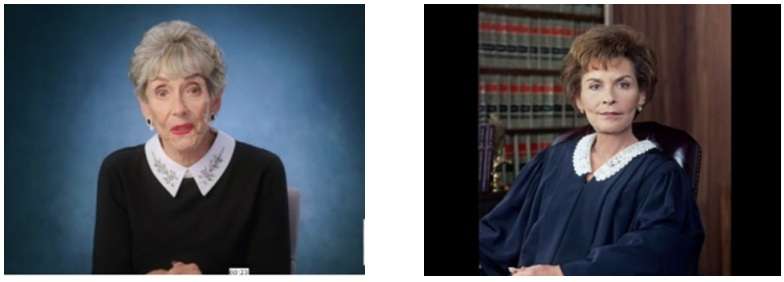
And a bit more:
How did a reporter make such a colossal mix-up? The misidentification traces back to a promotional pitch. In March 2024, Fox News contacted A360 about an upcoming docuseries on the Menendez brothers. The pitch included a link to the show's trailer. That trailer featured a brief clip of an older woman with short hair, wearing a black top with a decorative white collar, who opined that the brothers' trial was rigged. The woman was not identified by name in the video.
Upon watching the trailer, A360 reporter Michael Jaccarino jumped to a conclusion: the woman was Judge Judy. He based this on her clothing—which he thought resembled Sheindlin's signature judicial robe and lace collar—and the fact that she was commenting on a high-profile legal matter. Jaccarino admitted he had not seen a photograph of Sheindlin in years and simply assumed she had aged into the woman on his screen.
Seeking to flesh out his story, Jaccarino emailed Fox asking for more footage of the "Judge Judy interview." A Fox public relations representative replied with a link to a longer, 40-second clip, telling Jaccarino to "please see below for a link to the Judge Judy clip."
This is where the investigation fatally stalled. In this second clip, an on-screen caption appears for roughly three seconds, explicitly identifying the interviewee as "Judi Zamos," an alternate juror from the first Menendez trial. Jaccarino testified that he completely missed this flashing red warning sign. His explanation was simple: he was looking down at his keyboard, laser-focused on transcribing the audio rather than watching the screen.
Operating under the unshaken assumption that he had his star subject, Jaccarino pressed forward with the article. He researched the gruesome details of the murders and called a defense attorney for a quote on the current legal proceedings. What he did not do, however, was conduct a basic internet search coupling Sheindlin's name with the Menendez brothers to verify the connection. Nor did he follow standard journalistic practice by reaching out to Sheindlin or her representatives for comment prior to publication.
The editorial review process provided no safety net. Jaccarino sent his draft to his editor, Michael Hammer, and included the link to the video clip—the very clip that identified the speaker as Judi Zamos. Hammer never clicked the link or watched the video. He testified that he simply took his reporter at his word. From there, the story was cleared for the National Enquirer and In Touch Weekly….
Despite this, the court concluded (legally correctly, I think) that there wasn't enough evidence "proof that a defamatory statement was published with either 'actual knowledge of its falsity or with a high degree of awareness of its probable falsity'" (so-called "actual malice") for the case to go forward:
A publisher's failure to investigate a statement's accuracy alone won't cut it. Nor will "even an extreme departure" from reasonable journalistic standards…. Against this backdrop, it is apparent that A360 merely made a genuine (though stupid) mistake.
Charles D. Tobin, Jacquelyn N. Schell, Bradley Gershel, and Saumya Vaishampayan (Ballard Spahr LLP) represent defendants.