
House Sellers Needn't Disclose That Basement Floor Had Swastika and Nazi Eagle Tiles
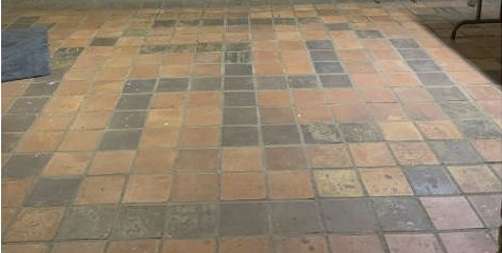
From Wentworth v. Steinmetz, decided Nov. 12 by the Pa. Super. Ct. Judge Mary Jane Bowes, joined by Judges Victor Stabile and John Bender (see the full opinion for more):
Given the procedural posture of this case, we accept as true the following facts alleged in the Wentworths' complaint. The Wentworths purchased a residential property from Steinmetz …. After moving in, the Wentworths discovered under rugs in the basement a tile floor that incorporated both a swastika and what they perceived to be a Nazi eagle. The Wentworths claimed that they would not have purchased the home had they been aware of the Nazi symbols tiled into the floor, that they could not be expected to live in or sell the home in that condition, and that it would cost $30,000 to replace the floor. Accordingly, they maintained that Steinmetz was liable for compensatory and punitive damages due to his failure to disclose the defect….
{Steinmetz has denied creating the floor pattern in support of Nazism, citing the history of the swastika predating its use by the Nazis. See Steinmetz's brief at 8. The Wentworths acknowledge that the swastika is an ancient symbol that had been used around the world, but suggest that since it is here "styled in the fashion of that used by the Nazis," and accompanied by the German eagle, no reasonable person would believe that this is Native American or Buddhist imagery. In resolving this appeal, we view Steinmetz's subjective intent as irrelevant and accept the Wentworths' allegations that these are pro-Nazi emblems and would likely be viewed as such by guests to their home and prospective buyers.}
RESDL [the Pennsylvania Real Estate Seller Disclosure Law] applies to all residential real estate transfers and mandates certain disclosures thusly:
Any seller who intends to transfer any interest in real property shall disclose to the buyer any material defects with the property known to the seller by completing all applicable items in a property disclosure statement which satisfies the requirements of [§] 7304 (relating to disclosure form). A signed and dated copy of the property disclosure statement shall be delivered to the buyer in accordance with [§] 7305 (relating to delivery of disclosure form) prior to the signing of an agreement of transfer by the seller and buyer with respect to the property.
Our legislature defined the term "material defect" as follows:
A problem with a residential real property or any portion of it that would have a significant adverse impact on the value of the property or that involves an unreasonable risk to people on the property. The fact that a structural element, system[,] or subsystem is near, at or beyond the end of the normal useful life of such a structural element, system[,] or subsystem is not by itself a material defect.
The mandatory disclosure form must address the following subjects:
- Seller's expertise in contracting, engineering, architecture or other areas related to the construction and conditions of the property and its improvements.
- When the property was last occupied by the seller.
- Roof.
- Basements and crawl spaces.
- Termites/wood destroying insects, dry rot and pests.
- Structural problems.
- Additions, remodeling and structural changes to the property.
- Water and sewage systems or service.
- Plumbing system.
- Heating and air conditioning.
- Electrical system.
- Other equipment and appliances included in the sale.
- Soils, drainage, boundaries and sinkholes.
- Presence of hazardous substances.
- Condominiums and other homeowners associations.
- Legal issues affecting title or that would interfere with use and enjoyment of the property.
- Condition, if known, and location of all storm water facilities, including a statement disclosing whether ongoing maintenance of the storm water facilities is the responsibility of the property owner or the responsibility of another person or entity.
Claims for violation of the mandatory disclosure of material defects typically concern latent flaws in the soundness of the structure or functioning of its integral systems….
The court noted that Milliken v. Jacono (Pa. 2014) had held that sellers had no obligation under RESDL to disclose that a murder-suicide had happened on the premises, and then reasoned:
We agree with the Wentworths that the instant action is factually distinguishable from Milliken. Here, the alleged devaluation of the property results from a physical attribute of the property, not the knowledge of events that happened in the home. Further, although a past murder/suicide cannot be undone, the stigma caused solely by a physical feature of a property can be cured. Additionally, while the sellers in Milliken took no action to prevent the buyer from learning what had happened in the home, a fact that was of public knowledge, Steinmetz covered the objectionable floor tiles with rugs such that the Wentworths were unaware of them until they cleared the area.
Nonetheless, we are compelled to concur with Steinmetz that these are distinctions without a difference. Based upon our precedent establishing what constitutes a material defect, the Wentworths' claims must fail because they suffer from the same lack of an objectively-quantifiable flaw as the one alleged in Milliken. In each scenario, the existence, and degree, of the defect is in the eye of the beholder. Certainly, a significant portion of homebuyers would eschew a house with a crude mosaic of Nazi iconography in its basement. Yet there is, sadly but undeniably, a segment of the population who would deem it an asset to the property. Further, even among the majority of prospective buyers who would not welcome having hate symbols adorning their basement floor, the degree to which the images impacted the value of the property would inevitably vary from person to person.
It is for these reasons that our Supreme Court has insisted that condition of the property constituting a material defect must be one that not only substantially impacts the value of the real estate, but lends itself to recognition and quantification by objective standards. Otherwise, the law "would be impossible to apply with consistency and would place an unmanageable burden on sellers, resulting in disclosures of tangential issues that threaten to bury the pertinent information that disclosures are intended to convey." {We observe that, like the floor in this case, some of the scenarios that the Milliken Court conjured in rejecting the RESDL claim in that case had a physical component as well as psychological one. See Milliken (referencing "that a next-door neighbor is loud and obnoxious, or on some days you can smell a nearby sewage plant, or that the house was built on an old Indian burial ground").}
A basement that floods, a roof that leaks, beams that were damaged by termites, an asbestos-tile kitchen floor: these are the conditions our legislature requires sellers to disclose if they are known. For more than ten years, our General Assembly has been aware that this Court and our High Court have taken the position that expansion of the definition of a material defect beyond these types of problems outlined in § 7304(b) of RESDL must come from that body, not from the courts. Yet no enactment has altered that definition for purposes of failure-to-disclose claims for violation of RESDL, fraud, or misrepresentation.
We are not dismissive of the Wentworths' outrage, nor their concern that the existence of the images could taint them as Nazi supporters. With this lawsuit, however, they have made a public record to counter any supposition in that regard. Further, as the trial court observed, with pains not to minimize the enormity of the situation, the Wentworths can prevent people who come into the home from viewing the symbols by covering them or painting over them.
Accordingly, we hold that the symbols on the Wentworths' otherwise sound and functional tile floor do not constitute a material defect that Steinmetz had a duty to disclose. We also agree with the trial court that, since the alleged flaw was not a material defect, the fact that Steinmetz covered it was rugs is immaterial….