
Did Elon Musk Sentence Millions to Death by Dismantling USAID?
The study cited by Rep. Ro Khanna as the basis for that claim is statistical nonsense.
California Rep. Ro Khanna (D) said last month that Elon Musk had "possibly sentenced to death" 4.5 million children by dismantling the U.S. Agency for International Development (USAID). Musk called him a liar, threatened to sue, and suggested he belonged in prison.
Khanna was citing a 2025 study in The Lancet that claimed USAID prevented 91,839,663 deaths between 2001 and 2021 and projected more than 14 million additional deaths by 2030 if the cuts held. That study was cited in articles by NPR, the BBC, the Associated Press, NBC, The New Yorker, and The Washington Post.
None of these news outlets picked up on The Lancet study's absurdity. The New Yorker's legendary fact-checkers didn't catch it, nor did the journal's editors or the paper's peer reviewers.
As I explained when I first wrote about the Lancet study for Reason in July of last year, with some basic arithmetic and a bit of common sense, you can see why the study's topline figures are nonsense. Just put the claim that nearly 92 million people were saved by USAID between 2001 and 2021 into perspective: During this period, the world's total death rate fell substantially. If the death rate prior to 2001 had remained steady for the next 20 years, about 79 million additional people would have died, according to data from the United Nations.
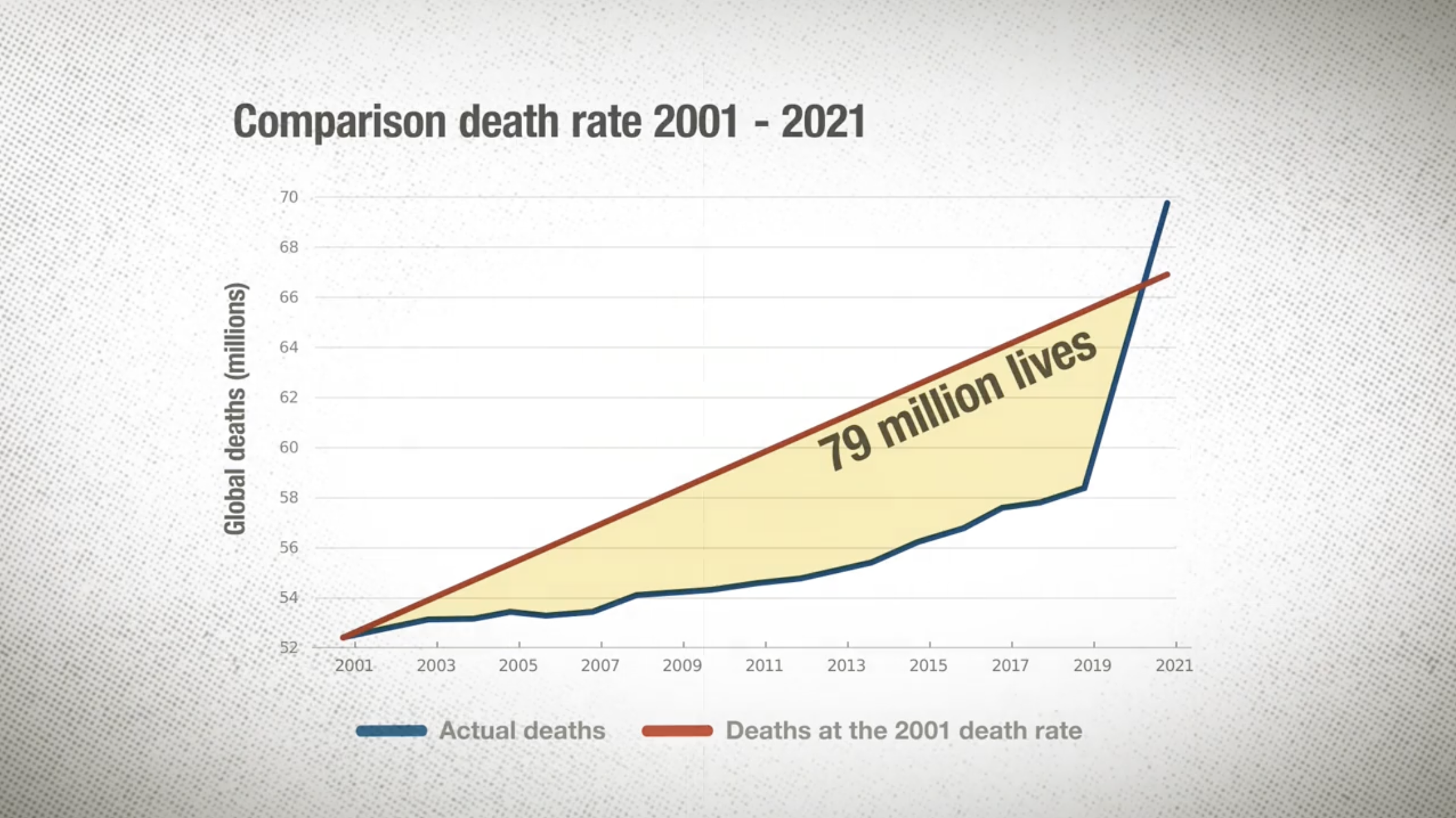
So how could USAID have saved 92 million lives? That's more than 100 percent of the global mortality decline, meaning that not only was USAID responsible for saving all 79 million people who didn't die thanks to the fall in the total death rate, but it saved an additional 13 million who otherwise would have died if not for USAID's charitable efforts.
Since I wrote about this study, its authors have effectively backed away from their number. The Lancet published formal critiques and a non-response reply. None of this produced a correction, a retraction, or a single follow-up story in the outlets that ran the 92 million figure. The number is still in circulation, still being cited by Khanna, and still generating threats of litigation from Musk.
Reason emailed several of the study's co-authors, laying out the criticisms cited in this article and video. They didn't respond.
The study's authors failed to establish that USAID saved any lives at all because they built a statistical model based entirely on correlation: Funding for USAID doubled during the study period. Since global mortality fell over the same time span, the two trends correlate, which is all their evidence adds up to. The authors did do a lot of complex statistical hocus-pocus, which they explained in a dense, technical online appendix, making the analysis look sophisticated. But all they were doing was correlating two lines with no evidence that one affected the other.
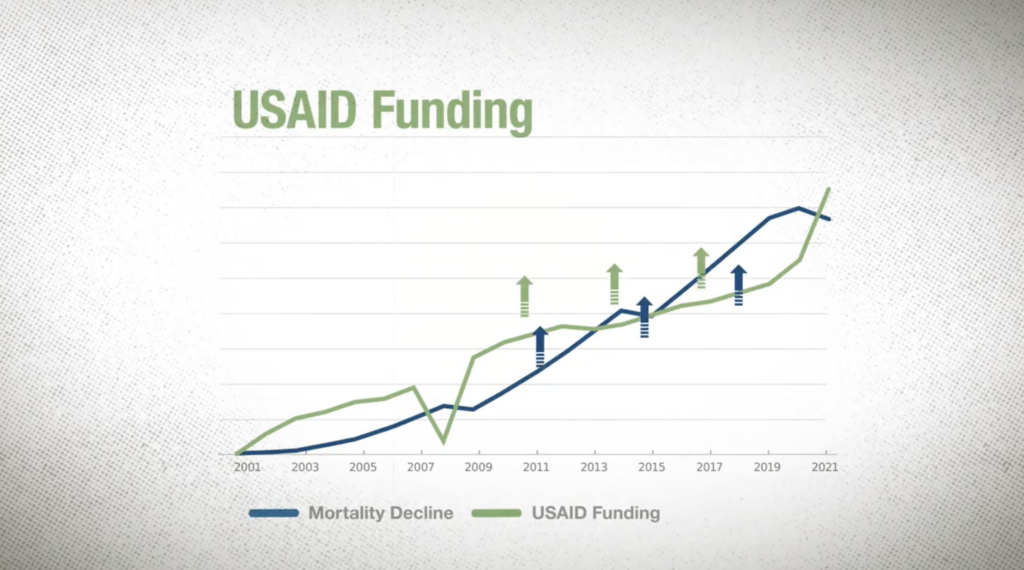
Swap out the upward trend in USAID funding, and the same model could have been used to credit anything that rose over this period: The S&P 500. The U.S. national debt. The proliferation of selfies.
Pick your variable. The methodology guarantees the answer.
On February 2, 2026, Lancet Global Health, a sister journal of The Lancet, published by the same house, ran a paper titled "The Impact of Two Decades of Humanitarian and Development Assistance and the Projected Mortality Consequences of Current Defunding to 2030." It came out of the Barcelona Institute for Global Health and the Federal University of Bahia, the same institutional pairing behind the original USAID paper, using the same two-stage, retrospective-plus-forecast design.
The new paper looks at all official development assistance: every donor country, every agency, roughly $250 billion in 2023—and found it associated with a 23 percent reduction in age-standardized all-cause mortality across low- and middle-income countries. The original paper looked at USAID alone, which, at its peak, was somewhere around a sixth of global official development assistance, and found it associated with a 15 percent reduction.
These estimates don't square. The same research group, using the same technique, has now credited one agency with roughly two-thirds of the mortality effect of all foreign aid on Earth. The samples aren't identical (133 countries in the first paper, 93 in the second, with slightly different windows), but no plausible adjustment closes a gap that large. Either the first estimate is wildly inflated or the second one is wildly deflated. They can't both be right.
The projections shrank too. The original paper forecast more than 14 million additional deaths by 2030 from USAID cuts alone. The new paper forecasts 9.4 million by 2030 from the ongoing decline in aid from every major donor—the United States, United Kingdom, France, Germany—under its baseline scenario, and 22.6 million under a severe scenario involving much deeper cuts than have actually occurred. The new paper looked at much deeper cuts in foreign aid and found a smaller effect.
That is a walkback, though it's not labeled as one. The journal published no correction and no expression of concern. The original paper still stands unamended, still says 91,839,663, and is still the citation of record for every politician and news outlet using the number.
Writing in The Argument in June, Kobe Yank-Jacobs made the one serious counterargument I've seen. The global population grew and aged over those two decades, he argued. An older population with no medical or economic progress at all would have seen its crude death rate rise. So merely holding the death rate flat was itself an achievement, and the true "lives saved by everything, everywhere" figure is larger than 79 million.
Yank-Jacobs is half-right, but his point fails to absolve The Lancet. Global population growth doesn't matter since my analysis cites the 2001 death rate, not the number of 2001 deaths. But an aging population does give a higher ceiling and a higher estimate of what would have happened with zero progress from any source. If I had assumed the 2001 age-adjusted death rates had remained constant, 160 million additional people would have died over the study period, rescuing The Lancet from the complete absurdity of its 92 million estimate, and replacing it with the still-absurd estimate that USAID accounts for 58 percent of the decline from all sources.
Since I first wrote about the topic, the U.N. has gathered a tiny bit of actual data that casts doubt on that prediction.
Egypt, a major USAID recipient, is one of the few low- and middle-income countries that report mortality data reasonably quickly. The Lancet model would predict roughly 58,000 deaths in Egypt in May 2025 following the demise of USAID, which is the only month for which the U.N. has released 2024 and 2025 data.
Yet the U.N. reported 46,365 deaths that month. Fewer people died in Egypt in May 2025, after the cuts, than in the same month in 2024.
We might eventually see a spike in deaths in Egypt. It's also possible that some of the awarded money was still being spent in May 2025. This single data point also doesn't mean that USAID grants weren't doing plenty of good.
Egypt also isn't the poorest country in the world, and we won't have full data on truly low-income countries for a couple more years. But it does at least raise doubts about the apocalyptic predictions of what shutting down USAID will mean.
We also now have some bottom-up estimates that match actual USAID dollar cuts to specific results (this many bed nets weren't distributed; this many people went off antiretrovirals; here is the case-fatality rate). The Center for Global Development, working from lives-saved-per-dollar figures for specific programs and matching them to actual funding cuts, estimates 500,000 to 1 million lives lost in 2025 and 670,000 to 1.6 million annually going forward. Boston University's Brooke Nichols maintains a running tracker that puts the one-year projected toll from USAID's elimination at 781,343 as of July 30, 2026.
There are data and methodology issues with these estimates as well, but they are serious attempts to get at the truth. They are also about one-third of the original 2025 Lancet paper projection, and roughly in line with the 2026 Lancet Global Health walkback. They are what a serious argument about the cost of dismantling USAID should address.
UCLA's James Macinko, one of the co-authors of the original Lancet paper, was quoted by NPR last July, reflecting on whether USAID was "a good use of resources."
"We found that the average taxpayer has contributed about 18 cents per day to USAID," he said. "For that small amount, we've been able to translate that into saving up to 90 million deaths around the world." Macinko didn't respond to our request for comment.
He seems more interested in producing political slogans than in doing basic science. (I'll add that his math is wrong, and taxpayers actually contributed more like $1 a day to USAID, but that's beside the point.) The implication is that anyone who supported axing USAID valued pocket change over tens of millions of lives.
You might think killing USAID was reckless and cruel. You might think foreign aid saves lives, as I do. Even so, you should advocate for a scientifically sound analysis that takes an honest look at the evidence, even if it's a messy picture that doesn't produce a headline-grabbing finding.
When you hear an outrageous statistic, don't be afraid to apply some basic math. The person spouting that eye-popping number is probably betting that you won't bother.
To keep up with our video series Wrong Number featuring Aaron Brown, and to receive bonus content and more, click here to enter your email address. By joining our list, you'll also have a chance to win a copy of Brown's new book, Wrong Number: How to Extract Truth From a Blizzard of Quantitative Disinformation.