
Human Extinction Scheduled for…Huh, How About That? Today!
Back in 1960, a Science paper predicted that human beings would go extinct on November 13, 2026. Have you packed?
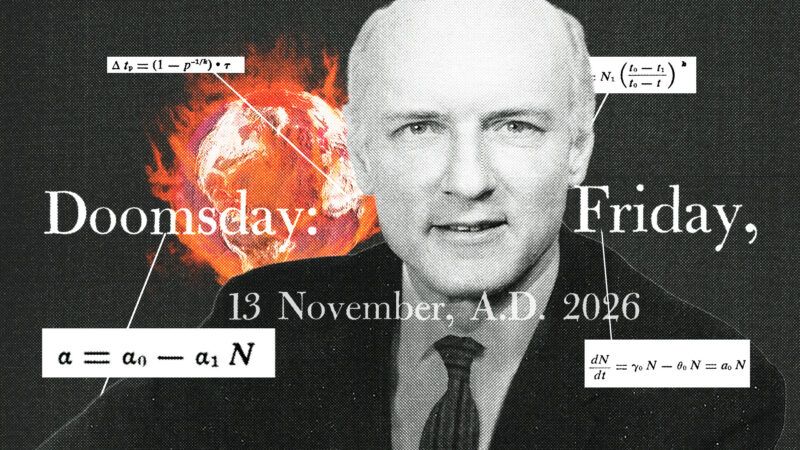
Paraskevidekatriaphobics rejoice! Doomsday has been averted! Sixty-six years ago, physicist Heinz von Foerster and his colleagues calculated in their article, "Doomsday: Friday, 13 November, A.D. 2026" that the end of humanity would arrive today. Why? Because as The New York Times reported, Foerster calculated that on this date "the human population will have expanded so far as to approach infinity and thus will automatically annihilate itself." Unannihilated, we are still here.
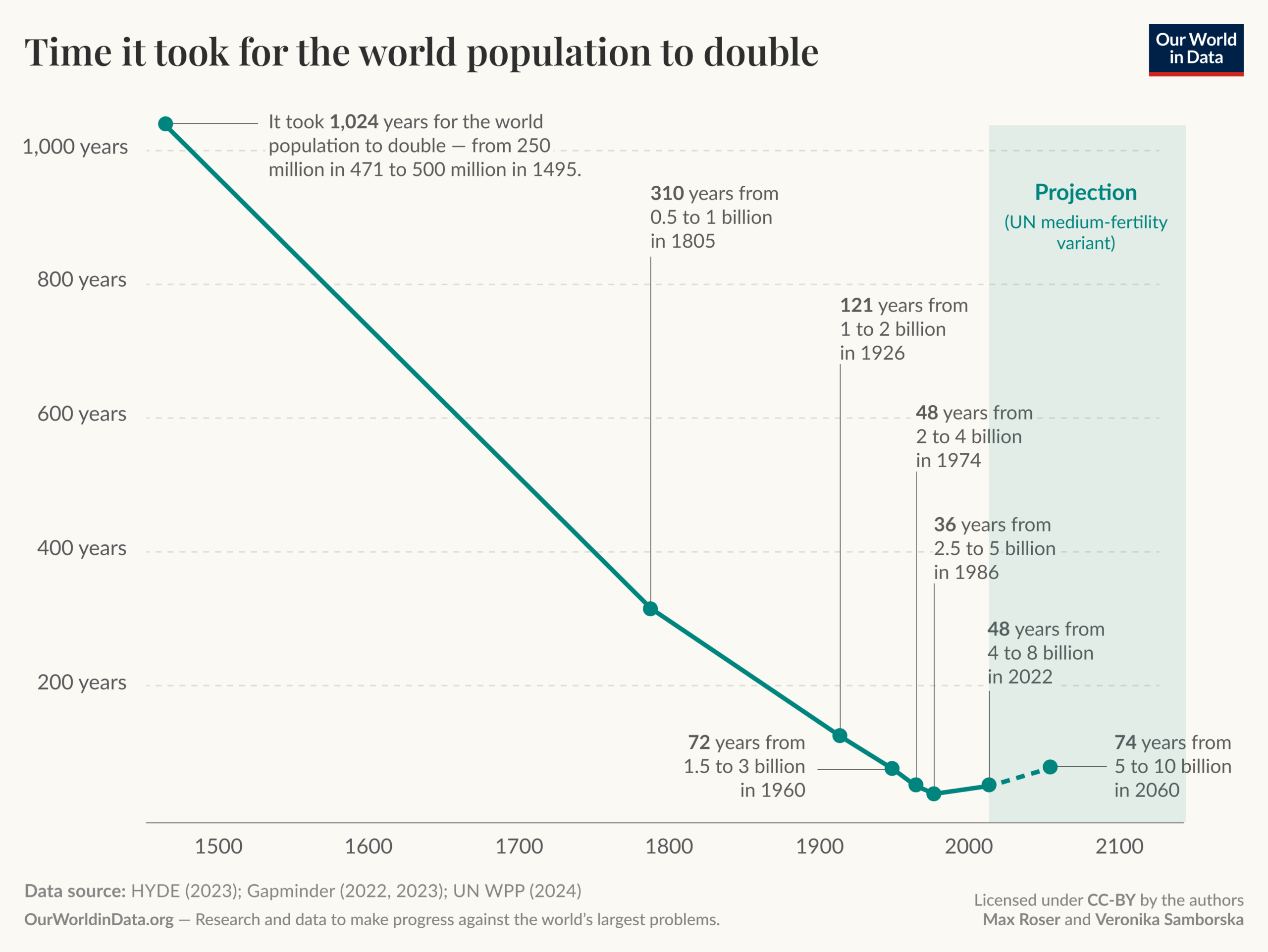
To reach their apocalyptic conclusion, Foerster and his colleagues noted that the doubling time for human population growth had been shortening, and they basically extrapolated that trend.
Foerster observed "the optimists" must be "hoping that at some time, somehow, something will happen that will stop this ever-faster race to self-destruction." Later in the decade, biologist Paul Ehrlich would bolster Foerster's doomsday projections in his The Population Bomb. In 1968 Ehrlich infamously declared, "The battle to feed humanity is over. In the 1970s, the world will undergo famines--hundreds of millions of people are going to starve to death in spite of any crash programs embarked upon now."
As it happens, both men were making their prophecies of doom just as the global fertility rate peaked and began falling. In the early 1960s, the global total fertility rate hovered around 5 children per woman over the course of her life. Today the global rate is just over the population replacement rate of 2.1 children, and some demographers suggest that it has actually fallen below that level. Foerster and Ehrlich did not account for the demographic transition in which richer healthier people choose to have fewer children.

Unlike all other species, humans do not just instinctively turn more food into more offspring.
In any case, these dire predictions of population doom encouraged the adoption of coercive measures, including China's one-child policy and involuntary sterilization in India. Instead of rising to infinity, the United Nations most recently projected that world population will increase from 8.2 billion today to 10.3 billion in the 2080s before declining to 10.2 billion by the end of the century. In other words, human numbers will not double again. In fact, some demographers are now worried about the opposite trend, that is, depopulation.
For example, another physicist, Victor Yakovenko, thinks the U.N. is way off the mark. Unchastened by Foerster's extrapolative failures, Yakovenko also engages in "social physics," which he defines as applying "mathematical methods developed in physics to social phenomena." Yakovenko's calculations "predict a population peak in 2030 at 8.23 billion people and subsequent decline." In fact, Yakovenko calculates world population could fall to around 5.82 billion as soon as 2062, which is where it stood 30 years ago, back in 1996.
In his recent article in Science critiquing Foerster's hyperbolic extrapolations, economist Javier Birchenall observes, "If we were to assume that Japan's current annual rate of natural population decrease of 0.77% represented a universal and enduring trend, we would predict that the planet will be devoid of people on Tuesday, 5 May 3108." One thousand and eighty-two years from now, there would be no one around to raise a tequila toast to Cinco de Mayo.
Epidemiologist Mark Woolhouse over at The Conversation notes, "The latest doomsday will pass uneventfully, but there's always another waiting round the corner – it's a recurring theme of human history." In the meantime, Happy Friday the 13th everyone!