
Democrats' Investigations Could Constitute 'Blatant Criminality,' Says White House Counsel
Democrats have warned the administration to "lawyer up" and prepare for "subpoenas." The White House countered that this could be illegal.
After last week's midterm elections swept them into power across the country, Democrats pledged to conduct aggressive oversight of President Donald Trump and members of his administration.
This week, a White House official suggested that conducting investigations, or even threatening to do so, could be illegal.
On election night, as the returns indicated sizable Democratic gains in both the House and Senate, Rep. Robert Garcia (D–Calif.), the ranking member on the House Oversight Committee and its likely next chairman, wrote a simple message on X: "LAWYER UP." Added Sen. Ron Wyden (D–Ore.), likely the next chairman of the Senate Finance Committee: "Subpoenas."
In the week after the midterms, numerous top officials at the Department of Justice (DOJ) resigned, though the department insists its work will continue.
Unsurprisingly, this did not sit well with the president. Over the weekend, he wrote on Truth Social that this was "extortion at the highest level" for which Democrats should face "imprisonment," and he called for the DOJ to investigate. Attorney General Todd Blanche agreed, though as Reason's Jacob Sullum notes, neither Trump nor Blanche could articulate how routine political rhetoric rose to the level of any crime, extortion or otherwise.
Then this week, the White House warned that even calls for investigating Republicans could be against the law.
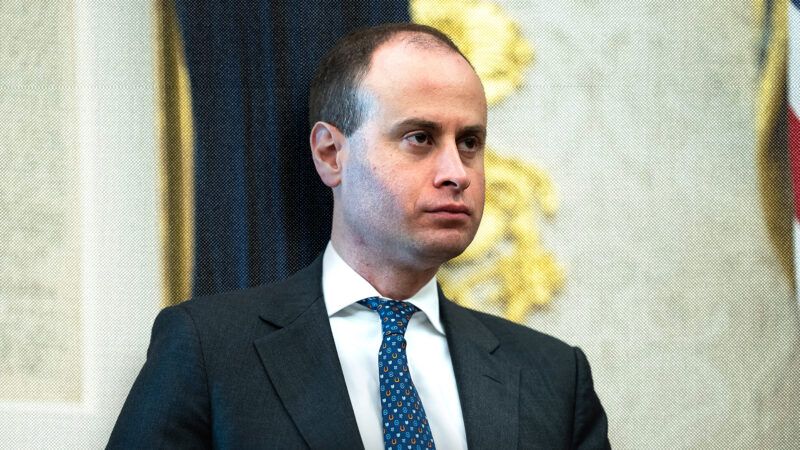
"I write to remind you of the foundational limits that the Constitution imposes on congressional investigations and subpoenas, which you and members of the new Congress have evinced a clear intent to transgress," White House counsel William Scharf wrote in a letter to Garcia that was first reported by Punchbowl News. "We are monitoring the abusive and capricious threats that are now proliferating from Democrat legislators who seek to abuse the legislative process to intimidate and to interfere with the lawful functioning of government."
Kyle Cheney and Chris Marquette at Politico called the letter "a departure from precedent, as the Justice Department is typically the front line for engaging with Congress on matters related to congressional oversight."
Scharf cited a number of instances, like Garcia's "lawyer up" post, when Democratic lawmakers have pledged to go after the administration.
"We're going to be passing out subpoenas like candy," Rep. Emily Randall (D–Wash.), for example, wrote on BlueSky. Sen. Ed Markey (D–Mass.) added, "They are going to need to plant new forests for all of the subpoenas we'll be printing."
Of course, these are the kinds of things that politicians say about their opponents all the time. Heated political rhetoric can be obnoxious, but it is generally a protected form of speech.
This, says Scharf, is different. "Abusive threats and public statements about the indiscriminate issuance of subpoenas, along with threats directed at prospective targets within the Administration make it abundantly clear that any forthcoming investigative processes will be deployed to harass and aggrandize, rather than to advance any legitimate legislative end," the letter warned. "Threats to executive branch officials designed to deter them from public service, or process designed merely to abuse or instill fear in the recipient may cross the line into blatant criminality. And issuing unlawful subpoenas with the intention of depriving citizens of their constitutional rights and privileges may warrant further investigation."
Writing on social media, New York University law professor Ryan Goodman called the letter "legally repulsive." He added that it ignores the Speech or Debate Clause from Article I, Section 6 of the U.S. Constitution, which legally protects members of Congress "for any Speech or Debate in either House." The U.S. Supreme Court has broadly applied the rule to anything that lawmakers say in the course of their legislative duties.
Princeton University law professor Deborah Pearlstein agreed, calling Scharf's letter a "particularly ham-fisted stab at intimidation" that was "worth the paper it's written on, not more."
It's also particularly rich for the Trump administration to suggest that threatening a political opponent with investigation or impeachment is, itself, grounds for reprisal. After all, Trump routinely does just that, and worse.
Put aside for a moment the irony that Trump's response to being threatened with investigation is to, in turn, threaten investigations right back. In his second term, the government indicted former FBI Director James Comey, a longtime Trump foe, three separate times, in increasingly desperate fashion.
In a Truth Social post last year that was reportedly intended as a private message to then-Attorney General Pam Bondi, Trump raged that "nothing is being done" about people like Comey, Sen. Adam Schiff (D–Calif.), and New York Attorney General Letitia James.
Last year, six Democratic lawmakers with military service, including Sens. Elissa Slotkin (D–Mich.) and Mark Kelly (D–Ariz.), recorded a video reminding those in active duty, "You can refuse illegal orders."
While that message should have been completely anodyne, the president took offense. "It's called SEDITIOUS BEHAVIOR AT THE HIGHEST LEVEL. Each one of these traitors to our Country should be ARRESTED AND PUT ON TRIAL," he wrote in one post, adding in another, "SEDITIOUS BEHAVIOR, punishable by DEATH!"
It's also quite ironic for Trump to say that Democrats "going around threatening a lot of people…with Impeachment" constitutes "extortion at the highest level." While campaigning in 2024, the then-former president said "Congress ought to impeach crooked Joe Biden," and that once reelected he would "appoint a real special 'prosecutor'" to go after Biden.
He also admitted that the calls to impeach Biden were directly related to his own two impeachments during his first term. At that time, he had said lawmakers like Schiff and Rep. Nancy Pelosi (D–Calif.) had committed "High Crimes and Misdemeanors, and even Treason" and "must all be immediately Impeached!" (Members of Congress can be censured or removed but not impeached.)
This is not to say that Democrats are completely justified in their efforts. As Reason's Tosin Akintola noted this week, Democrats plan to expand their investigations beyond federal officials to include private companies that have done business with the administration, including perhaps under duress.
But to suggest that any pledge to investigate the administration could constitute extortion or any other crime is laughable, an affront to the constitutional principles of both free speech and the separation of powers.
"Let's be clear: Congress' authority comes from Article I of the Constitution, not from the permission of the White House. Congress has wide latitude to conduct investigations and oversight, an authority inherent in the power to legislate," Garcia told Politico in a statement. "We are a co-equal branch of government and will not be deterred by baseless threats from a weaponized DOJ or from the President's lawyers."