
Democrats Have Big Plans for Artificial Intelligence
Yes, that's as ominous as it sounds.
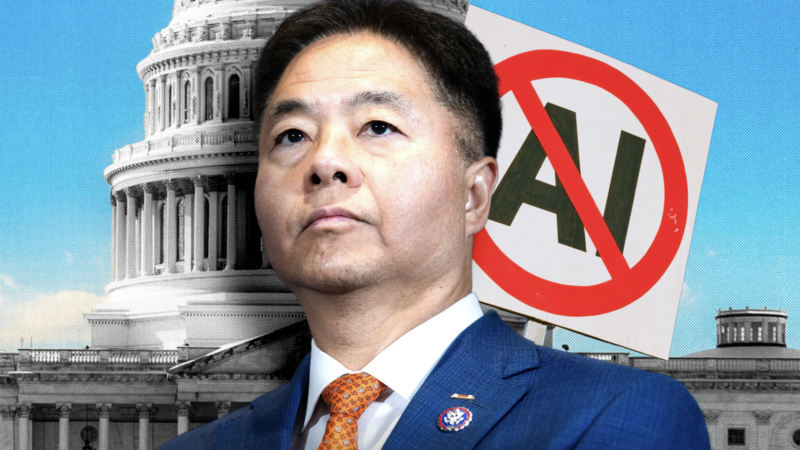
Despite being excited to see some Republicans lose control of the Congress, I'm already dreading the Democrats' takeover, especially what it will mean for tech policy. Doing nothing to allay this feeling is this Reclaim the Net peek at Democratic proposals regarding artificial intelligence.
Voter animosity toward AI was strong in the midterm elections, and Democrats apparently plan to waste no time using their forthcoming majority to start giving the government much more control over the AI industry and AI outputs.
You are reading Sex & Tech, from Elizabeth Nolan Brown. Get more of Elizabeth's sex, tech, bodily autonomy, law, and online culture coverage.
"Top of the Democratic agenda on day 1 needs to be a pause on advanced AI development, regulation of this out of control industry, and a ban on artificial superintelligence," posted U.S. Rep. Yassamin Ansari (D–Ariz.) the day after the election.
A Democrat-led Congress will call AI companies in for hearings and insist on "reasonable guardrails on AI," Rep. Ted Lieu (D–Calif.), vice chair of the House Democratic Caucus, said at a post-election press conference.
Guardrails sound quaint. Moderate. Who could oppose guardrails?
But "the 'guardrails' Lieu and other Democrats want to put in place are those that would give the authorities the power to decide who can build and use software, and under what conditions," Reclaim the Net's Dan Frieth writes.
@RepYassAnsari A ban in US while China moves ahead?
— Christina Hoff Sommers (@CHSommers) November 5, 2026
"Guardrails" mean letting foreign entities persist in building more powerful AI while U.S. companies lag behind. Or letting federal regulators pick winners and losers in the U.S. AI market, opening us up to political corruption (does anyone really want the Trump administration using this power?) and giving Washington undue influence on all aspects of AI development and deployment.
(If the federal government has the power to say whether your company can expand or even exist, you're unlikely to say no to many of its demands, even if those demands are things like robot weapons and mass surveillance machines.)
"Guardrails" mean telling companies that chatbots must monitor and report more conversations to authorities. That they must stop the spread of "misinformation"—as defined by whoever is in power, of course. (What could go wrong?) That they must ban minors by verifying everyone's identity.
Guardrails mean less privacy for all AI users and less free speech.
"Guardrails" might also mean giving people, including attorneys general, more power to sue AI companies—something that invites all sorts of culture war–based lawsuits, if the way things have played out on social media is any indication. It means politicians and personal injury lawyers continuing to scapegoat Big Tech for social maladies. And demanding crackdowns on "harmful" content that leads to censorship of sexuality, mental health information, and more.
Some incoming Democrats also campaigned on AI restrictions. For instance, Colorado Democratic Rep.-elect Manny Rutinel supported "age checks and parental controls on AI chatbots for minors," which of course means identity checks for everybody.
Rep.-elect Scott Wiener (D–Calif.) supported "a comprehensive federal framework covering disclosure requirements for AI-generated political content, real civil and criminal penalties for weaponized deepfakes, and platform accountability for the amplification of synthetic disinformation."
"There are real harms that can come from AI, and there is a need to pay attention to how the government uses this technology – but the flurry of bills and statements we are seeing from Democrats, who will soon be in control of Congress, is not about that," suggests Frieth. Rather, it focuses on giving government actors more control of who can use AI, who can build AI, and what AI can say.
More Sex & Tech
Inbox: @SenJudiciaryGOP will hold a hearing entitled, "Roblox and Online Gaming: Digital Playgrounds Endangering America's Children" a week from today
— Ben Brody (@BenBrodyDC) November 10, 2026
• Technology is giving helicopter parents myriad new ways to be insane. And both parents and kids are suffering.
• Texas' attorney general-elect Democrat Nathan Johnson "said Tuesday he will not continue Ken Paxton's practice of suing doctors in other states for sending abortion medication to patients here," notes The Texas Tribune. "I will not pursue the judicially absurd position that Texas law has extra territorial effect," Johnson said.
• "A final court of appeal in the UK overturned a centuries-old ban on gay sex in Trinidad and Tobago on Tuesday," capping off "a nearly 10-year battle for gay rights in the twin-island state," the Independent reports.
• The Substack team looks at how the platform played a role in campaigning this election. "In Tuesday's momentous midterm elections, all seven Democrats who flipped Republican-held Senate seats—James Talarico in Texas, former Sen. Sherrod Brown in Ohio, former Gov. Roy Cooper in North Carolina, Josh Turek in Iowa, Troy Jackson in Maine, Dr. Annie Andrews in South Carolina, and Rev. Adam Hamilton in Kansas—ran a Substack publication during the race," it points out.
• U.K. porn creators are finding their content suddenly removed as sites scramble to purge anything that might possibly run afoul of the country's new porn law.
• In The Social Network, "Sorkin's cavalier attitude toward facts sits in stark contrast with the standards he holds others to," writes Ryan Self. "From op-eds about fact checking to self-righteous monologues in his movies, Sorkin has become a crusader against misinformation and false narratives. The irony is, Sorkin seems oblivious to how he is guilty of the very same thing."