
Yes, the Midterms Were About the Iran War
New polling shows that voters were animated by opposition to the war—and want more congressional oversight.
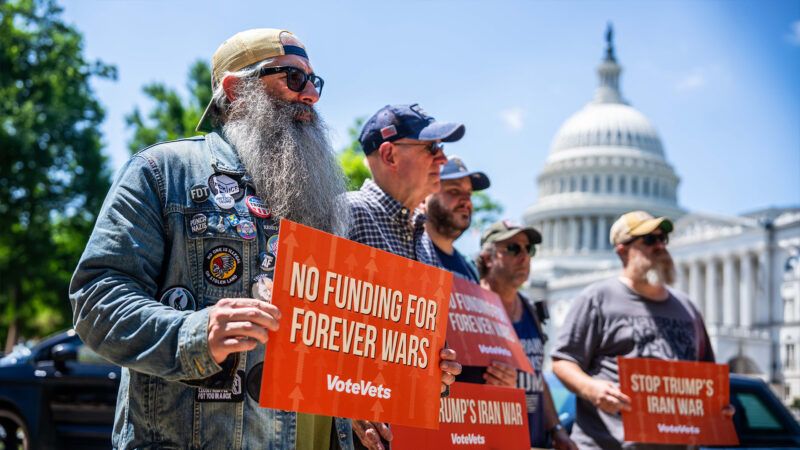
Republicans have been debating the causes of their midterm election losses last week, which gave Democrats a lead of at least a 36 seats in the House of Representatives. One faction of the Trump administration, led by Vice President J.D. Vance, argues that the decision to attack Iran was politically fatal. Another faction, led by Secretary of State Marco Rubio, is arguing that Republicans actually have a mandate to defeat Iran.
New data suggests that Vance is right. According to a poll conducted right before the election by YouGov on behalf of the Institute for Global Affairs, 44 percent of Americans said that they were less likely to vote for a candidate who supported the war, compared to only 13 percent who said they were more likely. And 53 percent said that Congress should have a final say over when the war ends, compared to 29 percent who chose the president. Iran may not be the only reason the Republicans did poorly, but it certainly seems to be a major one.
The poll adds to a growing body of evidence that the war was a major electoral loser. A majority of Americans opposed the war from the beginning, and an ABC News poll showed that 34 percent of voters considered the war "crucial" to their vote. While foreign policy has usually stayed out of sight and out of mind for American voters, the fighting in the Persian Gulf dramatically drove up fuel prices this year.
"The reason we lost is the war," Vance wrote in an essay the morning after the midterms. Citing an unnamed pollster, he claimed that disgruntled swing voters had four demands: "1) End the war 2) Focus on cost of living/inflation 3) Put America First 4) Change our relationship to Israel."
Rubio gave a thinly-veiled reply to Vance at the Conservative Political Action Conference on Saturday. "We cannot live in a world in which the most radical, terroristic regime on the planet possesses a weapon of mass destruction. And we've had president after president ignore it and allow it to linger, but this president wasn't elected to ignore it, and he wasn't elected to allow threats to linger," he said.
Others in his camp have argued that voters were punishing President Donald Trump for failing to fight Iran hard enough. Fox News hosts Mark Levin and Mark Thiessen blamed the June 2026 peace memorandum, which they both pinned on Vance, for prolonging the war. (That deal fell apart a month later.) "We should have taken care of it, ended it, armed the Iranian people, removed the regime," said Levin, who sits on the Homeland Security Advisory Council and whose stepson is a high-level State Department official.
But the polling was clear: Fifty-three percent of voters told YouGov that the U.S. government should prioritize lower prices even if its military goals in the Middle East are not met, compared to only 22 percent who preferred meeting those military goals even if prices stay high.
Part of the problem, of course, is that the Trump administration has never really been able to stick to one story about what those goals are.
"Trump and his aides still cannot agree on what they are trying to accomplish," The New York Times reported on Sunday. Vance—who publicly said during the 2024 election, "If you're going to punch the Iranians, you punch them hard"—consistently insists that the main U.S. interest is preventing Iran from building a nuclear weapon. Rubio has claimed that the goal was preventing an Iranian bomb and destroying Iran's "defense industrial base" so it cannot wage war. Levin wants the full overthrow of the Iranian government and possibly U.S. troops in Iran. Trump himself has bounced between all of these lines.
The U.S. Constitution was never designed for wars to be decided through this kind of factional palace intrigue. Article I, Section 8, gives Congress, not the president, the power to declare war. And the YouGov poll suggests that despite Congress' dismal 25 percent approval rating, Americans trust that institution more than the White House to make such decisions. The same week as the peace memorandum, Congress voted on bipartisan lines for a resolution calling on Trump to end the war.
The next Congress has a mandate to forcefully oppose the war. Rather than passing another war powers resolution, Sen. Chris Van Hollen (D–Md.) and Rep. Ro Khanna (D–Calif.) are threatening to simply strip away the funding for the Trump administration to continue the conflict. But as past experience shows, Congress may not have the willpower to actually fight the president over the military budget.
Of course, the same voters who gave Democrats a mandate could as easily take it away. In the YouGov poll, 76 percent of Democratic voters said they were less likely to vote for a candidate who supported the war. And in the primaries this year, establishment favorites such as Haley Stevens and Adriano Espaillat lost to insurgent candidates who made opposing the war a big part of their pitch.
"It would be a betrayal of the voters to be complicit in keeping the war going," Van Hollen told The Washington Sun.