
America Did Not Vote for Woke 2.0
Voters don't want far-left policies. They just really, really hate Republican ones.
Voters in North Carolina threw out at least five incumbent Republican members of Congress in this week's election—while also approving ballot measures to limit property tax increases and cut the state's highest income tax rate from 7 percent to 3.5 percent.
In Arizona (like in Colorado and Washington), voters passed new restrictions on transgender athletes' ability to participate in girls' and women's sports—even as Democrats appear to be on track to fully control the state government there for the first time since the 1960s.
And in California, the bluest of blue states during the bluest of blue waves, voters appear to be rejecting a proposed "wealth tax" and supporting an initiative to ban new taxes on personal property or retirement savings. (Neither has been officially called yet, but the leads are substantial in both cases.)
Making sense of these results requires stepping outside the partisan binary that dominates so much of American politics. Voters delivered a staggering, overwhelming victory for Democrats this week (even in places where Democrats simply aren't supposed to win), while simultaneously rejecting some of the most prominent left-wing policies and even elevating conservative ones, like tax cuts.
This election was not a victory for progressives. Instead, it was a thunderous rejection of the Republican Party and Donald Trump's presidency.
Indeed, Democrats feeling emboldened by Tuesday's results should check out the exit polls. When NBC News asked voters for their opinions of the two major parties, an outright majority said they have an unfavorable view of Democrats.
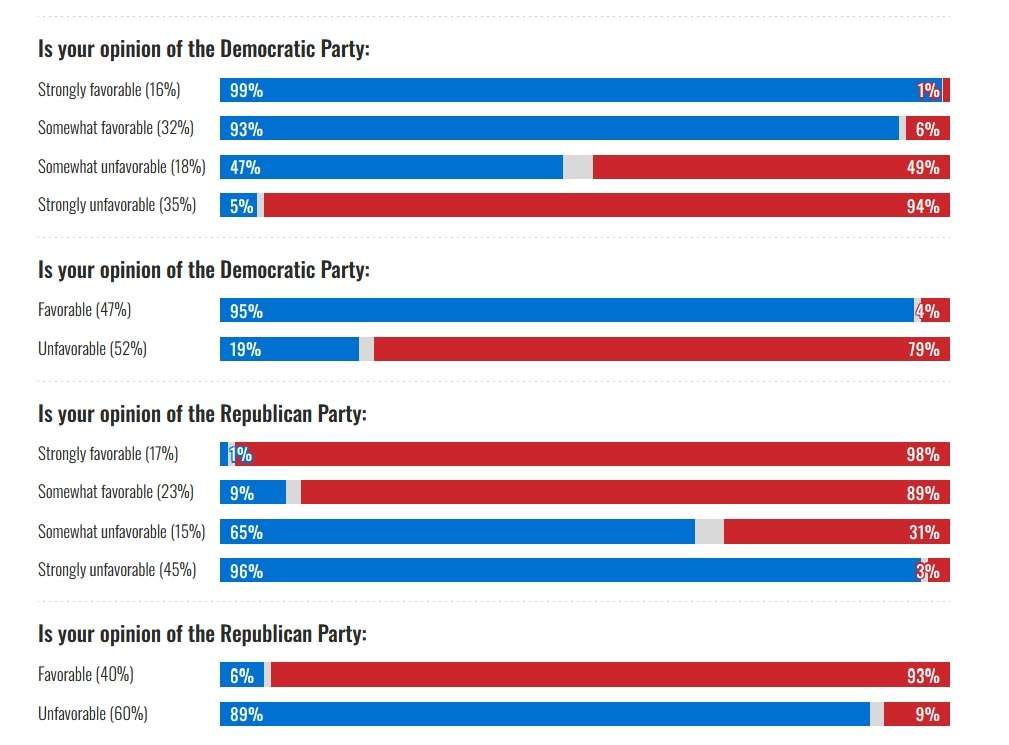
Of course, an even larger majority dislikes Republicans. And even larger majorities said Trump was doing a poor job as president—in the poll, 63 percent of voters disapproved of the job he has done and 62 percent said he has prioritized his personal interests over those of the country.
The extent of Tuesday's blue wave has triggered another landslide of memes and jokes about the coming "Woke 2.0"—put those pronouns back in your email signature and so on. Some of them are even pretty funny! (My colleagues Robby Soave and Christian Britschgi did a good bit about this on their podcast.)
Jokes aside, it would be a huge error for Democrats to misread this result as a nationwide embrace of their most radical and redistributionist agenda items. Or to misread a political outcome for a broader shift in the culture. The red congressional districts that voted for Democrats are still populated by the same people as they were last week. Kansas has its first Democratic senator since the 1930s, but it didn't transform into Brooklyn overnight.
The Democrats who shone the brightest this week are moderates. Adam Hamilton, who won that Senate seat in Kansas, was a registered Republican until earlier this year. Gina Hinojosa, who scored a huge upset in the Texas gubernatorial race, has urged Democrats to "shove it with your culture wars." In an ad that ran late in the campaign cycle, she said her pronouns are "mom, Texan, and soon-to-be governor." When Democrats are getting in on the joke about the excesses of the "woke" era, that's a good sign.
But what about all the far-left candidates who won, like Abdul El-Sayed in Michigan?
Yes, of course there are progressives who prevailed on Tuesday. That's because they won Democratic primaries earlier in the year. And in this environment, where any and all Democrats were seen as preferable to all Republicans, that was good enough for a large share of the electorate.
And even in that environment, progressive candidates underperformed relative to more moderate Democrats. Candidates endorsed by Sen. Bernie Sanders (I–Vt.) underperformed across the board, as Jeff Maurer detailed on his Substack. They still won in a lot of cases, of course, because Republicans have become utterly toxic in the Trump era. But that's not a mandate for progressive policies.
Go back to the NBC News exit poll once more: Just 18 percent of the midterm electorate said they self-identified as a "democratic socialist." That's fewer than the 24 percent who said they self-identified as "MAGA"—you know, the political coalition that was just dealt a historic wipeout.
This election was a revolution of independent and centrist voters, now the largest voting bloc in America, who turned their back on the Republican Party. And it was determined by "normal" Americans, as political commentator Noah Smith put it. That is most of the country (outside of the political echo chambers that exist on social media), thankfully.
To be clear, the fact that voters obviously aren't calling for "Woke 2.0" doesn't mean we won't end up there. It would hardly be the first time voters got the opposite of what they wanted—Trump won in 2024 with a"no new wars" promise, after all.
It's probably a safe bet that Democrats will learn some of the wrong lessons from this election—and that Republicans won't learn nearly enough of the right ones. Democrats might embark on a plan to spend trillions of dollars on socialized health care schemes that will worsen inflation. They might try to reignite culture wars or impose price controls or who knows what other kookery.
But I'm also skeptical about that. Trump is still president—and he says he will make aggressive use of the veto power (though he also wants to work with Sanders, so we'll see). The Supreme Court still has a conservative majority. Democratic attempts at wiping out the filibuster or packing the court will almost certainly backfire. When they overstep, the same voters who punished Republicans on Tuesday night will trudge to the polls to punish the Democrats.
For now, however, this much is clear. Voters in the 2026 midterms weren't rushing to embrace a lot of lefty, Democratic policies. They just really, really hated what Republicans have been doing.