
Outgoing Speaker Mike Johnson Once Decried the Surveillance State. Then He Became One of Its Top Defenders.
Fights over FISA are inevitably political. Will the next speaker learn from Mike Johnson’s 180?
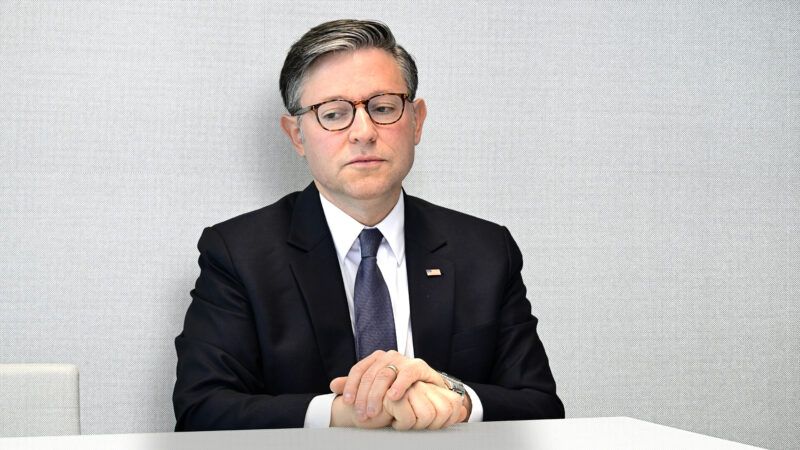
When the incoming Democratic Congress convenes in January, Rep. Mike Johnson will return to Capitol Hill as he started: a rank-and-file Republican representing Louisiana. But he can no longer claim to be the surveillance state critic he once was.
Dissecting Johnson's tenure as speaker of the House may seem inconsequential right now, as all eyes are on the Democrats after Tuesday's bluenami. But Johnson's dramatic 180 on surveillance serves as a valuable cautionary tale for ascendant politicians of either party.
Before becoming speaker, Johnson, whom The New York Times described as a "little-known social conservative from Louisiana," decried abuses of power by the security state. In 2022, Johnson co-signed a letter with Rep. Jim Jordan (R–Ohio) raising concerns about reports suggesting that the FBI had violated its privacy rules while conducting surveillance under Section 702 of the Foreign Intelligence Surveillance Act (FISA).
Section 702 of FISA allows national security agencies to collect foreign intelligence information without a warrant. But, as the Electronic Frontier Foundation notes, "the law gives the intelligence community the ability to target foreign intelligence in ways that inherently and intentionally sweep in Americans' communications," as Americans communicate with foreign nationals.
In a July 2023 interview on System Update with Glenn Greenwald, Johnson said the abuse of power by federal agencies was an issue that kept him and his colleagues "up at night." That same year, Johnson was chosen as House speaker after the ouster of former Rep. Kevin McCarthy (R–Calif.). Less than two months later, Section 702 of FISA was up for renewal. By bundling it with the annual defense bill, Congress extended the program until April 2024.
Days before the April deadline, Johnson not only voted against an amendment that would have required U.S. officials to get a warrant to search for Americans' communications, but he also pushed through a two-year FISA extension. Johnson's vote against the warrant amendment enraged some fellow Republicans, including Rep. Thomas Massie of Kentucky, who wrote on X, "This is how the Constitution dies."
So, what changed? According to The Hill, Johnson told reporters that he attended a confidential briefing after becoming speaker, which gave him a "different perspective" on FISA. Unfortunately, as members of the public, we may never know this top secret justification for why Americans should be spied upon without a warrant.
Johnson traveled to Mar-a-Lago the same day as the FISA votes and later told Fox News that President Donald Trump (who had claimed that FISA was used to spy on his campaign) was on board with the changes.
"What we did was we changed the bill to fit his requirements and ours, and that is that it would expire…two years from now, in the middle of his next administration, so he's the one that gets to determine if it's working well," Johnson said.
He added that the warrant requirement would impede intelligence analysts from acting quickly, and that "people we love and respect like Mike Pompeo and John Ratcliffe" have said that there cannot be a warrant requirement.
Then, predictably, this year, Trump and Johnson backed renewing Section 702. But after Trump named Bill Pulte the acting director of national intelligence in June, Democrats refused to renew Section 702 "over concerns that Pulte would weaponize FISA information," reported NPR. Although Congress let Section 702 expire, certified surveillance under 702 will effectively continue until March 2027.
Whatever is next for Section 702, its future will likely be determined by political calculus rather than genuine civil liberties concerns. Democrats have not yet formally chosen a House speaker, but if Rep. Hakeem Jeffries (D–N.Y.) fills the role, voters should not expect him, or most members of Congress, to have a consistent, privacy-focused position on surveillance. Jeffries voted against the warrant amendment and supported reauthorization in 2024. He then refused to extend the unreformed surveillance program once Pulte was installed.
Many of the surveillance state's biggest critics, including Massie and Rep. Andy Biggs (R–Ariz.), will no longer be in Congress in 2027. While more fringe members of a party, like Rep. Pramila Jayapal (D–Wash.), vocally oppose state spying, Americans should not expect the majority of representatives to prioritize privacy over power.
The security state is meant to keep Americans safe, but too often, it is used as a weapon against the state's domestic political adversaries. If Johnson, who was once a constitutional lawyer, abandoned his opposition to domestic spying, it is unlikely that privacy advocates will prevail over partisan, security state loyalists in a future FISA fight.