
Trump Enters His George W. Bush Era as Democrats Sweep House and Senate
It's 2006 all over again. The sooner the Republican Party jettisons an unpopular president and his failed policies, the sooner it will recover.
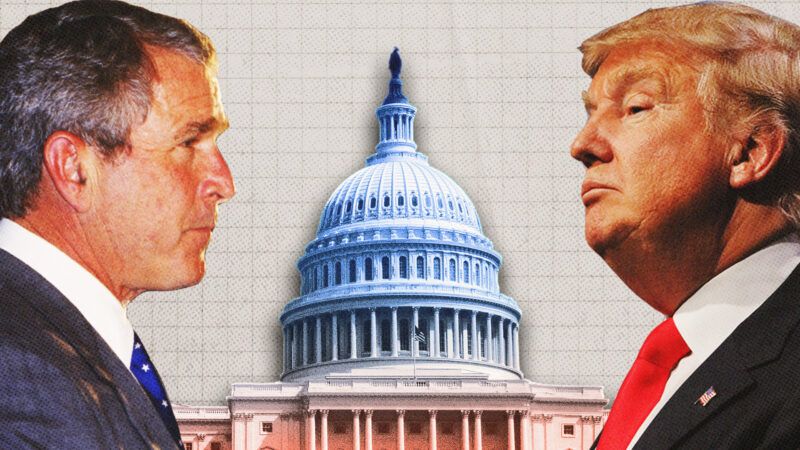
Stop me if you've heard this one before: An unpopular second-term Republican president who launched an unnecessary and poorly executed war in the Middle East was on the receiving end of an electoral rout, as Democrats took both chambers of Congress.
It happened 20 years ago, when Democrats flipped the majority in the House and the Senate on a single night. That "blue wave" election effectively ended the presidency of George W. Bush, just two years after he'd scored a narrow but decisive reelection. It ushered in a new era of Democratic politics—Nancy Pelosi became speaker of the House for the first time in January 2007—and laid the groundwork for Democrats' further gains in 2008, culminating in the passage of the Affordable Care Act.
Now it has happened again. Democrats have won a majority in both the House and the Senate. President Donald Trump, fresh off his own defiant second election victory, joins Bush as the only two Republican presidents to lose both chambers of Congress in a single midterm election since 1954.
Republicans never had much of a chance of holding their slim House majority, so the Senate results are the biggest story of this election. There were six states widely regarded as the "swing states"—Alaska, Iowa, Kansas, Maine, Michigan, and Texas—with four victories needed to swing control of the chamber.
Then, a surprise in South Carolina: Democrat Anne Andrews knocked off Darline Graham, the sister of the late Sen. Lindsey Graham. Andrews becomes the first Democrat to win a Senate election in South Carolina since 1998.
That was another result that had Trump's fingerprints all over it—he had personally elevated Darline Graham in a tightly contested primary election earlier this year. It was a bad choice. She was a terrible campaigner (who admitted at one point that she was "not that informed about national security"), and she was unable to coast to victory on the value of her last name alone.
The other dominoes were quick to fall. James Talarico routed Ken Paxton in Texas. Kansas elected a Democratic senator for the first time since 1932.
The tipping point for Democratic control of the Senate was Iowa, where state Rep. Josh Turek knocked off Rep. Ashley Hinson. It is the first time since 2008 that a Democrat won a Senate race in Iowa.
History doesn't always repeat itself, but it often rhymes. And there is something poetic about Trump, who launched his takeover of the Republican Party by dancing on Bush's political grave, arriving at this point.
Trump's presidency is not over yet, of course—after 2006, Bush still had two more disastrous years of wars and bailouts—but Trump is now firmly into his lame-duck era. His influence over American politics will only wane from here, and both his party and the country will likely be better off as a result.
If history is any guide, the next dominant faction in Republican politics will be led by someone who runs hard against Trump's legacy.
Florida Gov. Ron DeSantis, apparently sensing blood in the water on the eve of Election Day, went on Stephen A. Smith's podcast to call the Iran War a "big, big drag" on Republicans. (And that's a man who knows his drag.)
The extent of that 2006 beatdown might now be obscured by the mists of time, the haze of alcohol, or the fact that today's youngest voters were literally not even alive for it. (No, that's fine, I'm fine, stop asking.)
It was all one-way traffic. Democrats gained 30 seats in the House, while Republicans did not win a single House seat that they hadn't held before the election. In the Senate, Democrats picked up six seats while Republicans, again, failed to gain even one.
It's too soon to say whether 2026 will follow that same script, but Republicans will not win any new Senate seats. They may pick up a few House seats that remain uncalled, but the overall results have been a clear landslide.
It all, ultimately, comes back to Trump. He wasn't on the ballot this Election Day, but the voters have delivered a judgment of his administration's second term. His tariffs. His war. His thuggish and inhumane immigration enforcement schemes. His centralization of power—not just by asserting more federal power over the economy, but his use of executive orders to route around Congress and (when possible) the courts.
"This outcome has been crafted by Donald Trump," wrote National Review's Jeffrey Blehar on Election Day. "No other president could singlehandedly put their party so deep down in a hole that half the operatives I'm talking to consider the Texas, Kansas, and South Carolina Senate races to range from 'severely threatened' to 'gone.'"
Republicans will win back control of Congress at some point. It probably won't even take that long—remember, the predictions of a permanent Democratic majority after 2006 and 2008 were laughably wrong. Republicans won control of the House in 2010 and the Senate in 2014. By then, the party seemed to be turning against Bush's spendy, nation-building policies.
Let the GOP learn the same lesson again. The sooner Republicans jettison an unpopular president and his failed policies, the sooner their party will recover.