
Dems in Disarray?
Plus: Obamacare premiums spike, the next James Bond, and the looming GOP civil war.
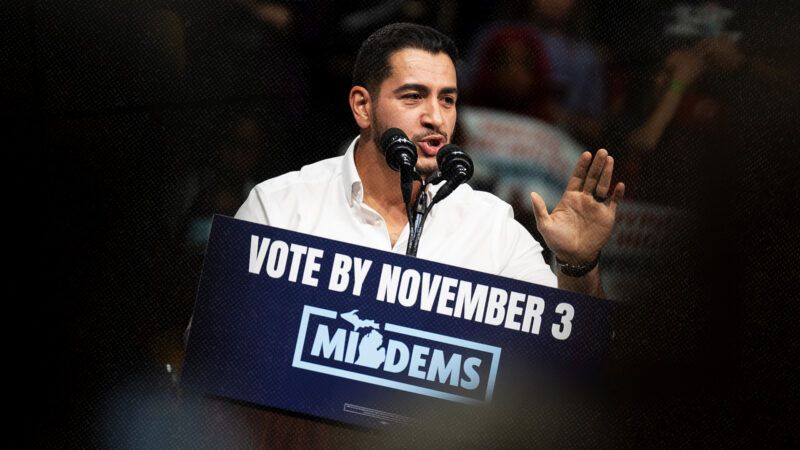
Civil war. Democrats look poised for victory in tomorrow's midterms, at least if the polls are right (a big if). But this weekend's intra-party clashes in Michigan show what's in store for the party after the voting is over.
The big story in Democratic politics this year has been the party's internal lurch to the left, including the rise of the Democratic Socialists of America (DSA) as a significant force. DSA candidates did well in places like New York's so-called "commie corridor," riding the tails of Mayor Zohran Mamdani. But could the party's progressive faction, broadly defined, win outside of deep-blue urban areas?
The Reason Roundup Newsletter by Liz Wolfe Liz and Reason help you make sense of the day's news every morning.
That question loomed largest in Michigan, where Abdul El-Sayed, a socialist in all but name who campaigned on Medicare for All and a more adversarial stance toward Israel, won a narrow and hotly contested primary against moderate rival Haley Stevens. El-Sayed's candidacy became a test case: If a left-wing candidate could win a Senate race in Michigan, such candidates could win anywhere. Or at least that was the theory.
Over the weekend, as Reason's Robby Soave noted yesterday, Stevens broke with El-Sayed and the party. El-Sayed and Stevens were supposed to campaign together on Sunday at a unity rally. But on Saturday, El-Sayed said he didn't want Stevens to join him at the event. On Sunday, Stevens appeared instead with El-Sayed's Republican rival, Mike Rogers, in the morning, and then went on to issue an endorsement of the GOP candidate.
This, to say the least, is…unusual.
Some reports suggest that Stevens had been telling party leaders as late as Saturday that she planned to vote for El-Sayed. The Washington Post reports that "Stevens had told multiple people close to her she had no plans to endorse Rogers." And yet.
As Politico's Lisa Kashinsky wrote before Stevens broke ranks: "Michigan's election results aren't going to solve Democrats' civil war. Instead, the conflict in the early primary state that's pivotal to the party's presidential ambitions is only intensifying."
The Michigan race is a preview of Democratic faction wars to come. Democrats will probably win big tomorrow. But then they'll have to fight each other.
Obamacare premiums spike. In September 2009, then-President Barack Obama delivered a major speech to a joint session of Congress touting the Affordable Care Act, a.k.a. Obamacare.
"The plan I'm announcing tonight," he said, "would meet three basic goals. It will provide more security and stability to those who have health insurance. It will provide insurance for those who don't. And it will slow the growth of health care costs for our families, our businesses, and our government."
That was 17 years ago. Next year, insurance plans sold through the health care exchanges erected under the law will increase by an average of 13 percent, according to the Kaiser Family Foundation. That's in line with, but a little higher than, the average increase for employer-sponsored plans, which The New York Times reports will rise by about 10 percent.
As Tyler Cowen notes, there is an inherent political/policy instability in Obamacare. Democrats rarely brag about the law: "It is striking to me how infrequently I hear Democrats boasting about Obamacare," Cowen writes. "They instead prefer to talk as if little or nothing has been done for America's uninsured." You hear a lot about Medicare for All these days, especially from left-leaning Democratic politicians like El-Sayed.
One reason for this year's big price increase? The unintended consequence of a law touted as saving patients from surprise medical bills. The law included a provision prohibiting out of network doctors from billing a patient directly. Instead, providers have the option to make a case to an arbitrator approved by the government; if the provider wins, the insurer must pay the bill.
As the Times reported earlier this year: "The law is successfully protecting patients against bills from doctors they never chose. But it has also generated an expensive unanticipated consequence: Doctors have flooded the arbitration system with millions of claims. Most are winning, often collecting fees hundreds of times higher than what they could negotiate with insurers directly or what they could have earned from patients before the law passed."
So: A law designed to protect people from the high cost of medical care has, instead, contributed to sharp jumps in the cost of medical care.
Perhaps this should be a lesson for those who support Medicare for All.
Scenes from Washington, D.C. Speaking of unintended consequences: So-called "inclusionary zoning" was supposed to increase the supply of affordable housing in the nation's capital. Instead, per Capital Commonsense, it has made it more expensive and more difficult to build housing of any kind, and contributed to making D.C. a troubled city for housing developers and investors.
QUICK HITS
-
- It's not just the Democrats. Steve Bannon predicts the GOP will erupt in a civil war after the midterms.
Steve Bannon: Republicans will erupt in 'civil war' after midterm elections https://t.co/4ZkBeRTPmU
— Financial Times (@FT) October 31, 2026
- Speaking of GOP civil wars: The midterm is tomorrow, but the 2028 presidential race is already waiting in the wings. The Washington Post reports on Vice President J.D. Vance's presidential ambitions.
- It's been clear for a while that Europe's public pension systems are unsustainable. But Europeans have not exactly been willing to hear this. They are now upset about reality.
- A federal judge nixed President Donald Trump's $10 billion suit against The Wall Street Journal over a report about a birthday message that the Journal said Trump sent to Jeffrey Epstein.
- Anthony Lane on the search for the next James Bond.
- I'm still reeling from the death of Patrick Stewart.
- It's not just the Democrats. Steve Bannon predicts the GOP will erupt in a civil war after the midterms.
Jean-Luc Picard remains the single most compelling vision of progressive politics I am familiar with — secular, rational, compassionate, egalitarian; a believer in progress & abundance but also duty, hard work, and a constant battle for self-improvement and improving the world. https://t.co/PQyh0qnouD
— Matthew Yglesias (@mattyglesias) October 30, 2026