
Rep. Steve Cohen Thinks the DEA Shouldn't Be Practicing Medicine
Cohen on Thursday introduced a proposed overhaul of the Controlled Substances Act, challenging decades of misguided assumptions.
For more than half a century, federal officials have classified drugs into legal categories that determine who can manufacture, prescribe, or study them, and who goes to prison for possessing or selling them. Those classifications carry enormous consequences. They also reflect decades of political pressure, moralization, myth, and stigma.
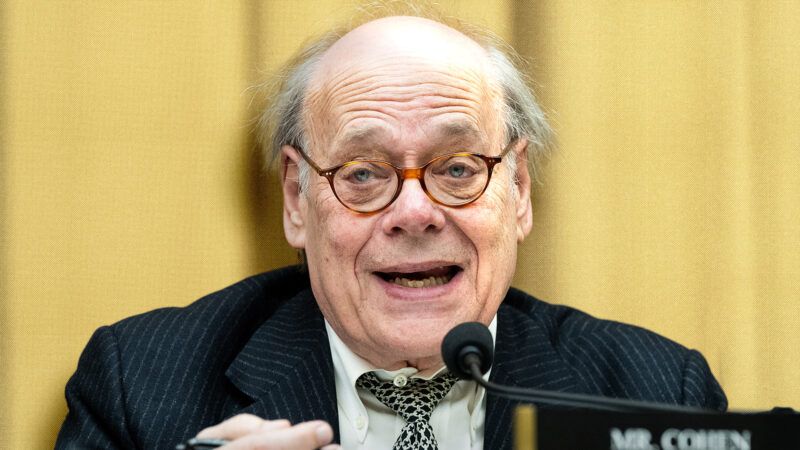
Rep. Steve Cohen (D–Tenn.) proposes to change that. His Public Health and Research Reforms in Controlled Substances Act of 2026 would substantially overhaul federal drug scheduling, shift key decisions from law enforcement to health officials, ease research restrictions, deschedule marijuana, and reduce mandatory prison penalties.
While the proposal preserves too much of the drug prohibition infrastructure, it represents a major step toward a more rational, evidence-based, and humane drug policy.
The Controlled Substances Act currently combines judgments about a drug's potential for abuse with judgments about its medical usefulness. Congress vested scheduling authority in the attorney general, who generally exercises it through the Drug Enforcement Administration (DEA). The Department of Health and Human Services (HHS) evaluates the scientific and medical evidence, but the DEA makes the ultimate legal determination of whether a drug has a "currently accepted medical use" for scheduling purposes, as the Justice Department explained in a 2024 legal opinion. Schedule I, the most restrictive category, includes substances deemed to have a high potential for abuse and no currently accepted medical use. These restrictions impede research, while officials cite insufficient evidence of medical usefulness to justify continued restrictions.
Cohen's bill would transfer authority to assess medical usefulness and drug-related risks—and to make scheduling decisions—from law enforcement to HHS, where those judgments more rationally belong. Under the new system, controlled substances would receive two classifications: a Roman numeral, I through IV, reflecting risks associated with misuse, substance use disorder, and threats to public health; and a letter, A through E, reflecting therapeutic value.
A substance could therefore be classified as high risk while still recognized for substantial medical benefits. That reflects an everyday reality of medical practice. Fentanyl, for example, can cause fatal respiratory depression and remains an indispensable anesthetic and analgesic. A drug's dangers do not erase its benefits.
The bill would also replace the vague "potential for abuse" standard for adding substances to the schedules with a standard based on the potential to develop a substance use disorder, expressly excluding isolated or occasional nontherapeutic use. Taking a substance for pleasure would no longer, by itself, satisfy that threshold.
Among the proposal's most consequential provisions is a requirement that officials consider whether scheduling a substance would itself threaten public health, including by encouraging people to substitute other drugs. They must also consider whether people use a substance to help control problematic use of another scheduled drug, as well as the harms associated with that other drug.
That would force federal officials to confront consequences that drug warriors routinely ignore. Banning a substance does not eliminate demand. Consumers may turn to underground suppliers, face uncertain potency and contamination, or switch to more dangerous products. Making a particular drug harder to obtain can leave its users worse off.
These requirements could be critical in disputes over kratom and its alkaloids, such as 7-hydroxymitragynine (7-OH), which some consumers report using for pain or to reduce their use of other opioids. Such reports should be part of an honest assessment of what consumers stand to lose when the government closes a legal supply channel.
An expert committee would evaluate each substance and publish its evidence and reasoning, making scheduling decisions more transparent and easier to challenge.
HHS would also assume from the DEA responsibility for registering researchers who study controlled substances. Qualifying researchers would gain an expedited registration pathway, with faster decisions for eligible small preclinical pilot studies. Federal officials currently demand evidence that these drugs have medical benefits while imposing restrictions that make it harder for researchers to obtain the drugs and conduct the studies needed to generate that evidence.
Cohen would require officials to reconsider existing classifications, setting a two-year deadline for 32 named substances and an eight-year deadline for most others. If officials miss those deadlines, statutory fallback classifications would apply.
The bill would also repeal the legal obligation of the director of the Office of National Drug Control Policy, the "drug czar," to oppose specified legalization efforts—a remarkable requirement for an office supposedly focused on evaluating drug policy.
Marijuana and tetrahydrocannabinols (THCs) would come off the controlled substance schedules altogether. The bill expressly makes that change retroactive, extending it to past offenses, pending cases, convictions, and juvenile adjudications.
Its sentencing reforms also merit praise. The proposal would remove the quantity-based trafficking provisions that impose five- and 10-year mandatory minimums and eliminate specified mandatory penalties when death or serious injury results. The bill would also limit certain repeat-offender sentencing enhancements to prior convictions that meet the narrower definition of a "serious drug felony." Among other requirements, the person must have served more than a year in prison and been released within 15 years of the new offense. Eligible prisoners could receive reduced sentences, and the Bureau of Prisons would be required to identify them, notify them, and file motions on their behalf.
These changes could spare people years of imprisonment. They deserve support even from those of us who would go much further.
The shortcomings remain significant.
First, the bill preserves criminal penalties for peaceful conduct involving drugs that remain controlled. It leaves the general federal simple-possession statute intact, including mandatory minimum jail terms for repeat offenses. Congress would continue to authorize imprisonment for possessing a substance without government permission.
Second, transferring power to HHS offers no guarantee against political interference. The secretary would appoint the expert committee in consultation with the drug czar. Its required membership emphasizes addiction medicine, toxicology, and substance-use services, without expressly reserving seats for pain patients, ordinary consumers, or civil liberties advocates.
The bill would allow emergency scheduling to bypass the new expert committee's review. It would also retain features of the current system: Temporary restrictions could last two years, with a possible one-year extension, and the statute would expressly exclude those orders from judicial review.
The bill would also transfer production quotas to HHS rather than abolish them. As I have argued before, presuming to know how much of each opioid more than 320 million Americans will need in the coming year exemplifies what economist Friedrich Hayek called the "fatal conceit." These quotas have contributed to shortages of injectable opioids in hospitals, jeopardizing care for surgical patients and those on ventilators. Transferring that power to a health agency does not solve the underlying knowledge problem. Congress should abolish the quotas.
The proposal substantially increases many maximum fines even as it reduces mandatory prison penalties. For an individual convicted of Schedule I or II trafficking without a qualifying prior conviction, the fine ceiling would rise from $1 million to $10 million. Congress should question this punitive expansion.
Finally, marijuana descheduling would leave Food and Drug Administration (FDA) authority intact. The bill expressly preserves the agency's powers under federal food and drug law, allowing it to regulate cannabis products that qualify as drugs, foods, or other products within its jurisdiction. It provides no explicit protection for a recreational cannabis market from FDA restrictions.
Those weaknesses warrant amendments. Scientific evidence can help people understand risks, but it cannot, by itself, justify depriving competent adults of the freedom to decide which risks they will accept. Autonomous adults should remain free to make informed choices about what they put into their bodies.
Cohen, who is retiring from Congress at the end of his term, is unlikely to see this sweeping reform pass during the brief post-election lame duck session. But his proposal can serve as a benchmark for reforming the Controlled Substances Act in the next Congress. Providing his successors with a framework that places greater weight on scientific evidence, recognizes the harms of prohibition, and reduces unjust punishment would leave Cohen with a substantial drug policy reform legacy.