
Israel Goes to the Polls
Plus: Financial woes for citydwellers in their 30s, Chinese stock meltdown, French protests, and more...
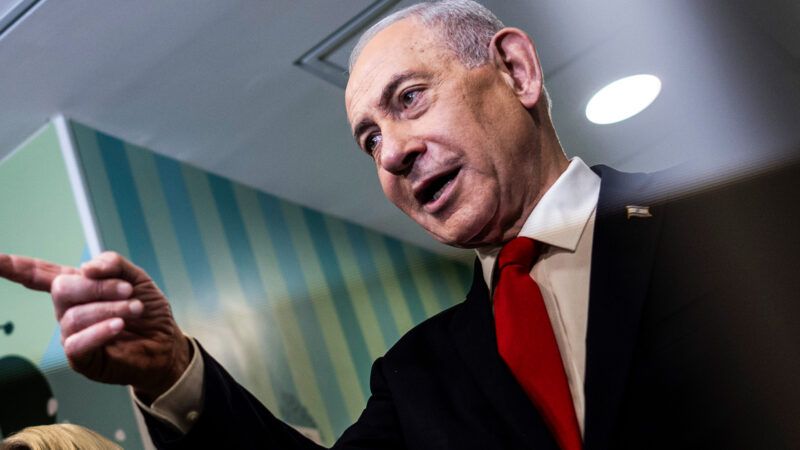
Will Bibi survive? Israelis head to the polls today for the first election since the October 7, 2023, attacks. The election is widely seen as a referendum on Benjamin Netanyahu's, or Bibi's, governance. Supporters say the last few years have been a success, as he "seized half of Gaza, dramatically expanded West Bank settlements, decimated Hezbollah in Lebanon and coaxed President Donald Trump into going to war against Iran," per The Washington Post—"all while offering a full-throated defense of Israel against accusations of war crimes and genocide."
The Reason Roundup Newsletter by Liz Wolfe Liz and Reason help you make sense of the day's news every morning.
But "many of those who seek change have rallied around the bloc led by Gadi Eisenkot, a centrist former military chief who, according to final polls this week, was running slightly ahead of Netanyahu," reports The Washington Post. "Heading a sprawling bloc that ranges from Naftali Bennett, a former prime minister who once managed a West Bank settlement council, to Yair Golan, a retired general known for his dovish views toward Palestinians, Eisenkot has pledged to investigate Netanyahu over his response to Oct. 7, to force the ultra-Orthodox to enlist and to rein in violent settlers in the West Bank." Eisenkot says the war against Hamas has been a failure, since the terrorist group is still in power. He is in opposition to some of the far-right alliances Netanyahu has made and broadly critical of Netanyahu's wartime leadership.
So far, turnout has been extremely high, the highest in 45 years—though the day isn't over yet; at publication time, it's about 3:30 p.m. in Israel. Polls close at 10 p.m. An estimated 70,000 Israelis have returned from overseas to cast their votes.
Here's how Israeli elections work, courtesy of The New York Times: "Every party creates a ranked list of its candidates, and voters choose a party or slate. The leader of the party with the most votes could become the country's next prime minister—though it is not automatic—if that candidate can form a government, but the parliamentary system is complicated and involves extensive negotiations.…No single party has ever won a majority of votes, which means parties must form factions and party leaders try to forge a governing coalition of at least 61 lawmakers. Within seven days of the official election results being announced, Israel's president, who plays a mostly symbolic role, meets with elected representatives of the parliamentary factions. Israel's president, Isaac Herzog, will assign a member of the Knesset—usually the leader of the party or faction that has won the most seats—to form a government." That person gets roughly a month to negotiate with potential allies and form a government; if they fail, another person gets picked to attempt the process.
"If a candidate who has been selected to form a government can propose one, along with a policy agenda," continues the Times, "and their proposal wins a plurality of votes in the Knesset, the government is formally invested, and that candidate becomes the prime minister."
"If neither Netanyahu nor Eisenkot can form a governing coalition in the 120-seat parliament," reports Reuters, "Netanyahu could stay on as caretaker until another election is held. His opponents have managed to wrest him from the premiership only once since 2009, and that took four inconclusive elections in two years. He was back 18 months later." So, Netanyahu seems unlikely to win outright, but likely to still be in charge at the end of all this—very much not a mandate, and something that would probably trigger elections again next year.
Kalshi and Polymarket betting markets seem fairly confident that Eisenkot will emerge victorious; polls are less optimistic.
Who's in charge in Israel, and how much of a mandate they believe themselves to have, matters an awful lot when it comes to American policy in the Middle East; tensions with Iran are still high, and though it's receded from view to some degree, shipping is still snarled in the Strait of Hormuz, with no resolution in sight. Given the complexities involved with forming a government, we're not going to get a clear answer for a while, but we will get some indications over the next few days as to how Israeli citizens are thinking about Netanyahu, his legacy, and the path forward.
Scenes from New York: "Many young professionals in their 30s have reached a breaking point in recent years and moved away in droves to raise families—contributing to an enrollment crisis in New York City's school system," reports The New York Times in an interesting reported piece on people in their 30s struggling to make ends meet and delaying milestones like getting married, having kids, and owning their own places. "Am I entitled to have what my parents had? I'm not sure," said one 31-year-old schoolteacher out in Queens. "But it's hard to know that I can't [have it]."
I don't think these people are totally off base; the tradeoffs are intense right now, with rental costs growing ever more wild. It's a shame most New Yorkers don't seem to understand the relationship between market-distorting policies (like rent control and stabilization) and housing costs getting so out of whack, and increasingly favor handouts (free daycare) to alleviate the strain they feel from the high cost of living.
QUICK HITS
- DoorDash is in talks to acquire Instacart; will someone please do a wellness check on Elizabeth Warren?
- "While global tech stocks teeter, in China they have already crashed as lofty valuations collapse under worries about AI demand and curbs on Chinese exports," reports Reuters. "The meltdown, tanking the mainland STAR50 index, of AI and semiconductor leaders by 40% in less than four months and vaporising some $480 billion in market value, is an ill omen for wobbly world markets and a dampener on China's efforts at encouraging its savers into stocks to fund the AI boom."
- "Most classrooms, most of the time, are nonideologically muddling along with a mix of lecture and activities—just like most classrooms, most of the time, are nonideologically muddling along with a mix of phonics and guess-and-bluff reading strategies," writes Kelsey Piper for The Argument on school curricula. "That means that fixing classrooms takes more than bold truth-telling about what works. It's going to take changing how we teach teachers, acquire curricular materials, and measure results."
- "Clashes erupted in Paris as a mass march drew to a close Saturday, with more than 400,000 people rallying across France over school funding and soaring living costs in a fresh challenge to President Emmanuel Macron," reports the Associated Press. "Police made nearly 1,000 arrests, the government said."
- Don't miss this week's Reason Roundtable!
- As for me and my house, we will cook up amazing hockey-themed parties and never let the AI overlords take this from us:
I cannot be replaced by A.I. became I come up with extremely niche and/or ridiculous themes. i.e. Fourth birthday party for my son was "Miracle on Ice, USA vs. Soviets 1980 Olympics at Lake Placid" (we painted the hockey players together, which is why they're, uh, imperfect) https://t.co/P4NvKaIPjy pic.twitter.com/JhwJCTDdYa
— Liz Wolfe (@LizWolfeReason) October 26, 2026