
The DEA Wants To Turn 7-OH Consumers Into Criminals
Where's the science?
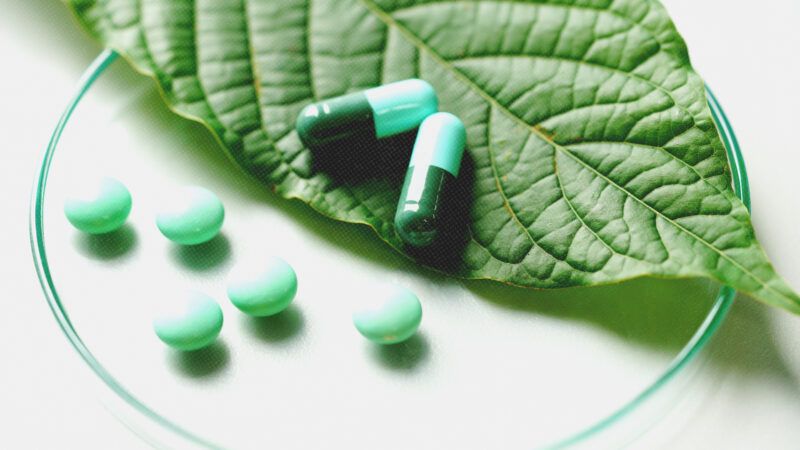
The federal drug police want to turn consumers of certain concentrated kratom-derived products into criminals while leaving traditional kratom leaf products outside the ban. Before exposing adults to arrest and prosecution, the feds owe them a scientific explanation for that distinction.
On October 14, the Drug Enforcement Administration (DEA) announced its intent to temporarily place 7-hydroxymitragynine (commonly called 7-OH) and mitragynine pseudoindoxyl—above specified thresholds—in Schedule I. Schedule I is the category for drugs that the agency thinks have "no currently accepted medical use" and "a high potential for abuse." A scheduling order could be issued on or after November 13.
The DEA already classifies mitragynine pseudoindoxyl as a Schedule I substance regardless of concentration. The proposal would ease that restriction by introducing thresholds—while imposing new Schedule I restrictions on 7-OH under the same criteria.
The Food and Drug Administration (FDA) and the Department of Health and Human Services (HHS) have supported the DEA's move, and HHS supplied the proposed thresholds. Under the temporary scheduling provision of the Controlled Substances Act, the DEA must consider HHS's comments but need not follow its recommendations. Congress gave a law-enforcement agency the authority to decide which drugs individuals may consume.
The ordinary scheduling process gives health officials more authority: HHS's scientific and medical findings bind the DEA, and its recommendation against control prevents the agency from proceeding. But temporary scheduling lets the DEA bypass those requirements when it determines a substance poses an imminent hazard to public safety.
Congress should never have given federal drug police that power. Having done so, it should at least demand compelling evidence before they exercise it.
Kratom comes from a Southeast Asian plant whose principal alkaloid is mitragynine. Its leaves contain trace amounts of 7-OH. Manufacturers also sell concentrated 7-OH products and products containing the related compound, mitragynine pseudoindoxyl.
Millions of Americans use kratom or kratom-derived products. A 2022 review cited an estimate of 2.1 million U.S. users in 2020. In a survey of 2,798 users, 91 percent reported using it for pain and 41 percent said they use it to reduce or stop opioid use. In a letter to HHS, nine military veterans described using 7-OH to manage pain and symptoms of post-traumatic stress disorder and to move away from other opioids and from alcohol. They warned that banning it could drive them back to more dangerous drugs.
These reports describe benefits that warrant further study and needs that will persist after a ban.
Concentrated 7-OH products deliver a potent alkaloid without requiring consumers to ingest large amounts of kratom leaf. 7-OH is significantly more potent than mitragynine in activating the opioid receptors involved in pain relief. Researchers still need to determine how its benefits and risks compare across different human doses.
The DEA's proposed criminal controls hinge on concentration and composition. The concentration threshold is 1 milligram per gram of solid material or 1 milligram per milliliter of liquid, calculated for the two covered substances combined. Products would also trigger controls if the mitragynine-to-covered-substances ratio fell below 100 to 1.
Consider a tablet containing 15 milligrams of 7-OH, a strength advertised by some sellers. If the tablet weighs one gram, its concentration exceeds the limit fifteenfold. Diluting the same 15 milligrams into a product weighing 15 grams brings it to the concentration limit. Consuming the entire product still delivers the same dose. It would also need at least 1,500 milligrams of mitragynine to avoid the separate ratio restriction.
Adding bulk changes the concentration but does not change the amount of 7-OH consumed. These calculations tell us nothing about whether that dose is effective or safe.
The DEA acknowledges that controlled trials have not established safe consumption limits or standardized dosing for concentrated 7-OH products. Neither DEA nor HHS has determined that below-threshold products are safe.
In a public comment submitted to HHS in July, I urged officials to obtain the human evidence needed to justify a threshold before setting one. Animal studies can reveal hazards, including dependence and respiratory depression, but they cannot, by themselves, identify a scientifically defensible cutoff for human consumption.
Officials may intend these thresholds to distinguish traditional kratom from concentrated products. What evidence shows that crossing that boundary justifies criminal penalties?
The DEA also owes consumers an accounting of what prohibition could do to them. People seeking relief from pain or withdrawal will still need it after a ban. Some may abandon these products, while others may turn to illicit sellers or switch to other opioids. Criminalizing those choices could make them more dangerous.
Misleading labels, contamination, dependence, and drug interactions warrant attention. Accurate labeling, independent testing, age restrictions, and enforcement against fraud can address several of these concerns. Before resorting to criminal penalties, the DEA should explain why those measures would be inadequate.
We already know how difficult it is to verify a drug's identity, strength, and purity in an illicit market. Creating another prohibited product will give that market another opportunity.
Autonomous adults should be free to decide which substances they consume and which risks they accept. The DEA proposes taking that choice away even as it acknowledges major gaps in the medical evidence. Before the drug police turn more consumers into criminals, they should at least demonstrate how doing so will make those consumers safer.