
Trump Says He Wants Drones and Snipers in 250-Foot Triumphal Arch, Complicating His Controversial Proposal
The arch has yet to receive final approval—and Trump’s newly announced military use was not part of the original federal review.
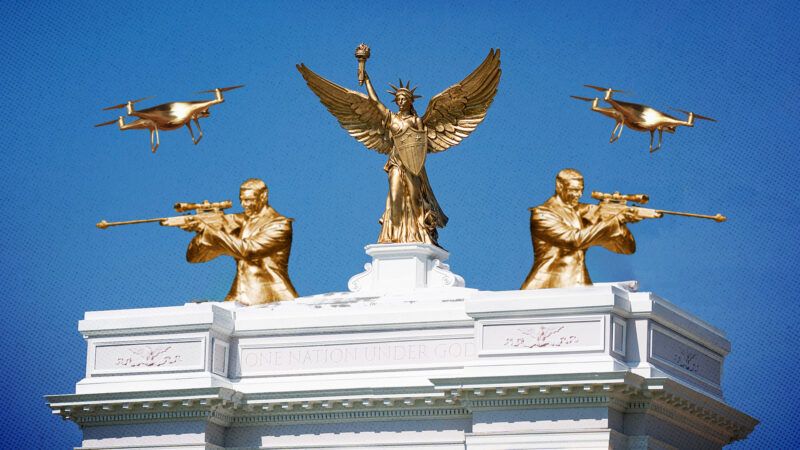
Since last year, President Donald Trump has been wanting a 250-foot triumphal arch built in Washington, D.C.. On Sunday, he said that the arch would, in fact, be a "Military Complex" with "large numbers of drones, plus Snipers."
"At the strong request of the United States Military, and for National Security purposes, I have agreed to convert the magnificent Triumphal Arch… into a top grade Military Complex/Triumphal Arch," Trump wrote on Truth Social. "Out of the 59 top cities and Capitals, Washington, D.C., IS THE ONLY ONE IN THE WORLD THAT DOES NOT HAVE A TRIUMPHAL ARCH, but it will now and, by far, the greatest of them all!"
The idea for a triumphal arch situated in Memorial Circle, located by the entryway into D.C. from Virginia, was first publicly suggested in 2024 by Catesby Leigh, a former research fellow at the National Civic Art Society (NCAS). He argued that although a temporary arch may be more feasible to complete prior to America's 250th anniversary, a "handsome permanent arch" would "be the happiest outcome of all." The idea was presented to Trump in 2025 by Justin Shubow, president of the NCAS. It was intended to be a temporary construction to commemorate America's 250th anniversary, but at the end of last year, officials were reported to be considering a permanent arch. D.C.-based architect Nicolas Leo Charbonneau, who is working on the project for the White House, teased images on his social media of what the permanent structure could look like.
"I don't think an arch that large belongs there," Leigh, who contemplated a more modest arch in his 2024 essay, told The Washington Post earlier this year. Indeed, if the White House (70 feet) and the Lincoln Memorial (99 feet) were stacked one on top of each other, they would still be shorter than Trump's proposed 250-foot arch.
While there is not a publicly displayed final price tag, reports suggest that it could cost as much as $100 million. Trump initially floated paying for it with leftover private donations from his White House ballroom project, but taxpayer cash is already being slated for the arch. The National Endowment for the Humanities has already set aside $15 million for the arch. Separately, the agency has awarded $30,000 to the NCAS to develop "architectural plans, renderings, and models" of "the Independence Arch" and examine "how form, scale, and symbolism can convey historical meaning in public space." Meanwhile, the National Park Service awarded Portland-based engineering firm OTAK a $500,601 contract to conduct environmental assessment and compliance work for the Memorial Circle arch.
The arch has run into various legal barriers. In February 2026, a group including Vietnam veterans and an architectural historian sued the administration, asking the court to block construction unless Congress authorizes the arch and the administration completes the required statutory review processes. Indeed, under the Commemorative Works Act, new commemorative works within "Area I" (which the Memorial Circle falls under) generally require congressional approval.
The Trump administration argues that Congress provided authorization in 1925, when it approved plans associated with Arlington Memorial Bridge that considered two monumental columns at roughly the same location. Of course, this was for two columns, not a 250-foot triumphal arch.
The legal troubles continued earlier this month, when U.S. District Judge Tanya Chutkan ordered the Trump administration to give 48 hours' notice before undertaking work at the site. The project also awaits final approval from the National Capital Planning Commission for an exemption to Washington's 130-foot building height limit.
The location's proximity to Reagan National Airport has also raised aviation safety concerns. The structure would sit roughly 3,000 feet from the airport and within an approach and departure corridor. The Federal Aviation Administration recently determined that the arch itself would not pose a hazard to aircraft but would be required to have an "eternal flame" on top. However, Trump's new plans to operate "large numbers of drones" from the site raise a separate set of questions that were not part of the earlier proposal.
Trump's announcement is a significant departure from the project federal agencies have spent months reviewing. Until Sunday, the arch was presented as a commemorative tourist attraction. Turning it into an operational military facility, capable of storing ammunition and deploying drones and snipers, would require an enormous amount of additional security infrastructure.
It could also complicate the project's authorization and funding. As a commemorative work on federal land, the arch is subject to the Commemorative Works Act, while construction associated with an operational military facility could implicate a separate body of military construction law. Federal law generally provides that military construction projects must be "authorized by law," though the Pentagon has narrower authorities for certain smaller projects. It remains unclear what authority or funding source the administration would use for the newly proposed military functions.
Just 21 percent of Americans supported the president's plans for a commemorative arch in April, with 41 percent saying they strongly opposed it, according to a Washington Post-ABC News-Ipsos poll. Of course, residents may feel more strongly about passing a "Military Complex" on their morning commute.
If the president gets his way, military drones and snipers may become a permanent fixture on the capital city's border.