
Can a New Weight Loss Treatment Escape the Legal and Regulatory Thicket?
It’s Eli Lilly vs. RFK Jr. in a battle over the rules around retatrutide.
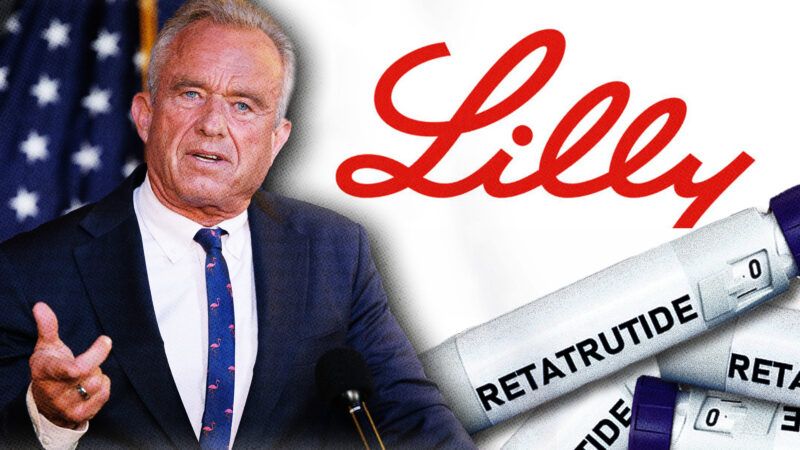
On September 24, Eli Lilly and the Food and Drug Administration (FDA) will begin oral arguments before the 7th Circuit Court of Appeals in Eli Lilly and Company v. Robert F. Kennedy, Jr. Officially, the case is about a narrow technical question: Is Eli Lilly's experimental weight loss treatment retatrutide a biologic product or a conventional drug?
But it's actually about the legal and bureaucratic gymnastics Lilly is performing to protect its upcoming peptide from molecular copycats and how affordability will likely suffer if it succeeds.
Retatrutide is one of the most exciting new medicines to come to market in years. It's a metabolic blockbuster in waiting. In clinical trials, it produced an average weight loss of 28.3 percent in 80 weeks, roughly matching the most effective forms of bariatric surgery. Lilly plans to submit it to the FDA for approval in early 2027.
Peptides are all over the news, including the July start of Medicare's pilot program for weight loss GLP-1s and RFK Jr.'s efforts to move some experimental peptides off of the FDA's 503A Category 2 list of banned substances. Yet this new medicine has become entangled in a regulatory and legal mess involving FDA classification rules, the intricacies of administrative law, and competing claims about who gets to decide what it even means to be a drug.
Everyone loves to hate big pharma, but Lilly isn't really the villain of this tale. The system that is supposedly designed to promote safety, affordability, and availability of the latest medicines is making it harder to develop them, harder to bring them to market, and harder for patients to get them.
How Did We Get Here?
Retatrutide is a GLP-1/GIP/Glucagon triple receptor agonist, the next generation of the hugely successful class of drugs known as GLP-1s, a group of medications that includes the peptides semaglutide and tirzepatide, such as Wegovy and Zepbound. Eli Lilly has spent the last decade developing retatrutide. But now Lilly has a problem.
Right now, patients can obtain GLP-1s through several channels. In addition to patent holders, compounding pharmacies and "research-use only" (RUO) providers are also selling the weight loss medications. These pathways are good news for customers anxious to try the new generation of weight loss drugs, who would otherwise be stymied by price or availability, but bad news for manufacturers.
FDA regulations allow compounding pharmacies to create customized medications for individual patients. They can fill prescriptions based on FDA-approved drugs when a patient has a documented need for an alternative dose or formulation, even if the drug is still under patent. Compounding usually occurs during shortages or on a limited, case-by-case basis.
But the massive demand for GLP-1s has turned that exception into something much larger. Compounding has continued at scale even after shortages were resolved in early 2025. The popularity of compound GLP-1s has been propelled by their affordability, with current offerings around $150 to 200 a month, compared with self-pay options of $299 to $449 for the highest doses of brand-name products. Novo Nordisk's CEO recently estimated 1.5 million patients are currently obtaining Lilly's tirzepatide and Novo Nordisk's semaglutide through compounders, and the real number may be even larger. Lilly would very much like to prevent that from happening with retatrutide.
On August 12, Lilly announced six lawsuits against organizations selling or advertising "research-use only" retatrutide and said it had referred over 200 entities and individuals to regulatory and law enforcement agencies.
This campaign is understandable from Lilly's perspective. Developing a new drug is extraordinarily expensive—thanks in large part to the slow and expensive approval process—and Lilly wants legal protections that will allow it to recoup those costs.
But the government's attempt to provide those protections has created another set of problems.
What Is a Protein?
One of the most consequential distinctions in pharmaceutical regulation is between a conventional drug and a biologic.
One way Lilly can shield retatrutide from compounding is to secure FDA designation as a biologic product rather than a drug, because biologics are not eligible for compounding.
Biologics receive 12 years of statutory exclusivity, compared with five for new drugs. Their biosimilar competitors face a more demanding approval process than conventional generics as well. When those protections are combined with patent thickets, biologics can be shielded from biosimilar competition well beyond the original patent or 12-year exclusivity period. That makes the classification extremely valuable.
All of this hinges on the question of what counts as a protein.
The FDA defines a protein as "any alpha amino acid polymer with a specific defined sequence that is greater than 40 amino acids in size." Lilly argued that retatrutide meets those requirements because it has 39 alpha amino acids in its backbone, with another chain of two additional amino acids covalently bonded to the main backbone, giving them a total of 41 amino acids. In March 2024, the FDA disagreed, saying that the word alpha modified all of the amino acids in the definition, meaning that the molecule doesn't qualify.
Then it gets even more complicated. Federal law doesn't actually limit biologics to products that satisfy this very specific definition of a protein. It also covers products that are "analogous." Lilly argued that retatrutide didn't have to meet the FDA's requirements to be a protein. It could qualify by being analogous to one.
In September 2024, Lilly sued to challenge the FDA's decision, arguing that its refusal to designate retatrutide as a protein or analogous to a protein was arbitrary, capricious, and contrary to its own regulations.
In 2025, Judge Tanya Walton Pratt split the baby. She agreed with the FDA that retatrutide did not meet the strict definition of a protein. But she also ruled that the FDA acted capriciously in deciding what is "analogous" to a protein: applying identical standards to "protein" and "analogous to a protein" gave "analogous" no meaning.
That sent the matter back to the FDA. And there it sat.
The Appeal
Next comes a disputed statutory deadline.
Federal law says the FDA has 60 days to classify a product after receiving a designation request. If it misses the deadline, the product is classified as originally requested.
Lilly argues that when the district court vacated the FDA's original decision and sent the matter back to the agency, that 90-day clock started again. On February 17, 2026, Lilly appealed to the 7th Circuit, saying the clock had run out and retatrutide should therefore receive a biologic designation.
As you would expect, the FDA disagreed. It argued that the lower court was correct in ruling that retatrutide was not a protein, but maintained that the 60-day limit applies only to the designation request, "not when a court vacates a designation decision." The Outsourcing Facilities Association (OFA), a trade association of compounding facilities, backed the FDA's arguments and lambasted Lilly's appeal as a "money grab." Most importantly, it argued that the appeal is not "properly before the Court."
To review: The agency says the court should defer to the agency's interpretation. The company says the agency missed a statutory deadline. The court says the agency must reconsider. The agency stalls. The company goes back to the court to argue that the failure to act has triggered another statutory provision.
Meanwhile, patients wait in limbo.
A medicine that may produce extraordinary weight loss is being forced through a byzantine system in which two amino acids can make or break its profitability and availability. A 60-day deadline intended to establish clarity and promote regulatory promptness may itself become the subject of a monthslong or yearslong court case. What a mess.
What Do Consumers Want?
Lilly wants a monopoly and to recoup its costs. The FDA wants to follow the law. Compounding pharmacies want to serve customers at lower prices. The court wants agencies to follow statutory requirements.
All those positions are defensible.
A biologic designation could protect Lilly from compounding competition and provide longer exclusivity. That will mean less price competition and higher prices for consumers for longer.
But the opposite outcome creates different problems. If companies spend billions only to discover the statutory protections they expected don't exist or are time-consuming and costly to defend, they'll have less reason to make large bets in the future. The costs behind bringing a drug to market are massive. Deloitte recently estimated that development and launch of a new drug costs $2.671 billion. FDA requirements also make Phase 3 obesity trials unusually long and costly: While a statin or antidepressant may need one six-to-12-week Phase 3 trial, anti-obesity medications require at least two trials lasting more than a year each. Retatrutide's lasted 80 weeks apiece.
A Call for Clarity
Congress writes overlapping and confusing statutes. Agencies twist themselves into knots to interpret them and layer on their own agendas. Companies hire lawyers to navigate the thicket. Upstarts find loopholes in the rules. And then the courts are asked to sort it all out.
But it's not really the job of the court to rectify this issue. It's the job of the legislature to appropriately balance incentives and protections for both consumers and producers. The current system isn't working for companies or consumers or even the regulators themselves.
In 2004, Milton Friedman gave an interview to Tech Central Station's James Glassman. He said: "The FDA in the United States has followed policy, which means that it costs roughly $800 million to bring a single new drug entity to the market. And the question is where is that $800 million [now $2.7 billion] going to come from? The answer that we have given…is that it's going to come by giving the producer of the drug a patent, a monopoly privilege to sell that drug, to exclude others from the sale of that drug."
What the market needs is appropriate and reliable protection for both manufacturers and consumers. Manufacturers need reliable protections to recoup their development costs on approved medications and to invest in future efforts, but patients need the other side of the patent deal as well: reliable limits on the monopoly so that patients get the reduced pricing and improved access that was part of the original bargain.