
I Celebrate Labor—Just Not Organized Labor
Unions do protect the jobs of existing workers and sometimes get them raises. But that protection kills jobs later.
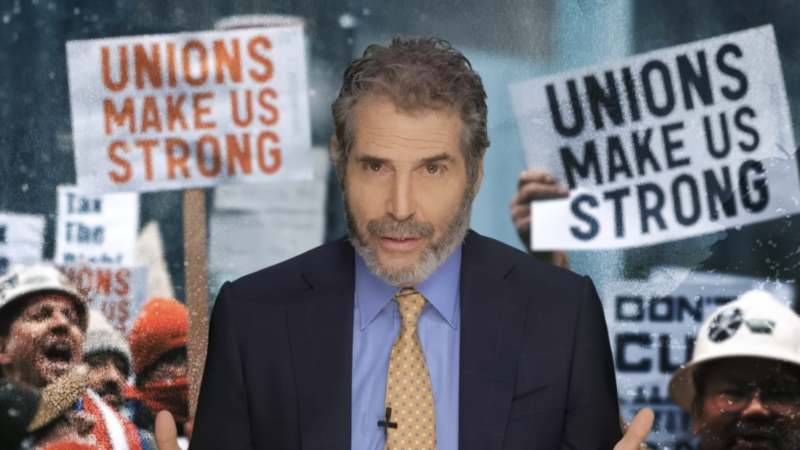
Did you celebrate labor last Monday, Labor Day?
I did.
But not organized labor.
At least I get to choose.
Organized labor isn't a fan of choice.
Joining CBS in NYC, I was told: "You must join—and pay dues to—SAG-AFTRA (Screen Actors Guild-American Federation of TV and Radio Artists)."
Why? I didn't want to. "I'm not an actor!" I complained.
"Too bad," they replied. "This is a union shop."
Today, outside New York, some things have changed for the better. Twenty-six states now have "right to work" laws that say unions may not force workers to join.
This is a good thing, because many union leaders reward themselves more than their members.
Some pad expense accounts using members' dues. Some fund lavish lifestyles.
Maryland union boss Kimberly Goodwin stole nearly $1,000,000 from members and spent it on things like a $7,400 massage chair.
Kye Carbone, a United Federation of College Teachers boss, just grabbed $290,000 for personal use.
Unions do protect the jobs of existing workers and sometimes get them raises. But that protection kills jobs later.
Yet the most recent Gallup poll found 71 percent of Americans (even most Republicans) approve of labor unions! A record 47 percent want unions to have more influence!
Why?
My reporting leads me to think that unions destroy more than they protect.
When I was young, the Midwest was known as the "Steel Belt." Now we call it the "Rust Belt." Why?
Media blame free trade, but trade didn't create the rust—organized labor did. Unions frequently went on strike.
Company leaders aren't stupid. They said, "We'll expand elsewhere." Many moved to America's South or overseas.
Union contracts are obstacles to success in a competitive world. Innovation requires constant change. Managers working with union shops must wade through a bureaucracy of rules and union lawyers. So they are slow to innovate.
The union company stagnates. They create fewer jobs and less opportunity.
Micromanagement in one-size-fits-all union contracts isn't great for workers, either.
If your union says everyone must work an eight-hour day, you can't make your own deal to work longer for higher pay. You and your manager might be OK with it, but your union will brand you a troublemaker for "putting pressure" on everyone else.
Union contracts also lock in destructive work rules.
The Longshoremen's union boss complains that his members' jobs are dangerous: "We've had 17 people killed!"
But he had his union strike to demand a ban on new automated cranes—machines that would have made his members' jobs safer. So American ports remain dangerous, less productive, and more expensive.
Yellow Corporation was one of America's largest freight carriers.
Teamsters demanded faster benefit payments. Teamsters boss Sean O'Brien threatened a strike.
Yellow agreed to the union's demands. But just days later, Yellow shut down for good. Thirty thousand people lost their jobs.
And so on.
Unions were once needed. Companies sometimes colluded with government to abuse workers.
In 1914, Colorado Fuel and Iron Co. got the National Guard to send men with machine guns into strikers' tents. They killed 25 people.
Thankfully, today, workers have choices: If you don't like your employer, the internet will tell you about others that are desperate for workers. Employees are often in better bargaining positions than bosses.
It's why most workers don't join unions anymore. When I started, union membership was 30 percent of the workforce. Now its 10 percent. And that 10 percent would be lower were it not for the 32 percent of government workers in unions. They can continue to waste money, because governments are monopolies.
On Labor Day, I celebrate labor. But not organized labor.
All people should be free to negotiate whatever contract they want.
COPYRIGHT 2026 BY JFS PRODUCTIONS INC.