
Maryland Synagogue Challenges Restrictive Gun Law
Montgomery County officials want to prevent houses of worship from making security decisions.
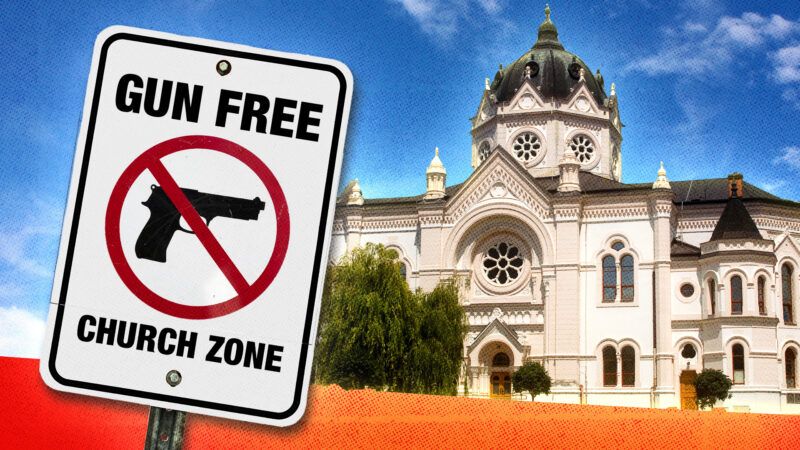
Houses of worship are often targeted by people with murder on their minds. That's especially true of synagogues, which were disproportionately attacked even before October 7 and have since been on the receiving end of the "antizionist" reframing of hatred of Jews. But in Montgomery County, Maryland, officials recently renewed efforts to forbid the carrying of firearms within 100 yards of "places of public assembly," including churches and synagogues. Now, some security volunteers are defying the intrusive law as they await the outcome of courtroom pushback against the restrictions.
You are reading The Rattler from J.D. Tuccille and Reason. Get more of J.D.'s commentary on government overreach and threats to everyday liberty.
Violating the First, Second, and Fourteenth Amendments
"Today, the Justice Department filed suit against Montgomery County, Maryland (County). The complaint alleges that the County's newly enacted Bill 23-26 violates the Second Amendment by prohibiting law-abiding citizens from possessing firearms in daily life," the U.S. Department of Justice announced on August 3. "Bill 23-26 prohibits carrying firearms at thousands of locations, and also creates an arbitrary 100-yard exclusion zone around each location. The law applies even if the person carrying a firearm is duly licensed and has the express consent of the property owner."
Separately, on behalf of the Silver Spring Jewish Center and along with Rabbi J. Menashe Shapiro, the New Civil Liberties Alliance is suing Montgomery County. That lawsuit contends the law "violates the First Amendment right to free exercise of religion by prohibiting synagogue members from acting according to their beliefs. It also violates the First Amendment's Establishment Clause by making decisions in place of religious leaders. The law denies the Second Amendment right to keep and bear arms, and deprives the Jewish community and others of equal protection under the law by discriminating on the basis of religion, a Fourteenth Amendment violation."
The lawsuits against Montgomery County come after the July passage of Expedited Bill 23-26. In a press release, county officials boasted, "the legislation maintains the County's prohibition on carrying firearms within 100 yards of many sensitive public places, including schools, parks, libraries, polling places, houses of worship, and legislative assemblies, while removing or modifying provisions that the Court determined the State must regulate."
Primarily sponsored by Democratic Councilmember Dawn Luedtke, Bill 23-26 restates, in revised form, a 2022 ban on carrying firearms near public places. That ban was subject to an injunction after it was challenged and then found overbroad by the Maryland Supreme Court. The new law was a response to the court ruling.
Keeping 'Guns Out of Sensitive Community Spaces' No Matter What People Want
By email, I asked Luedtke about "any thought given to consulting with places of public assembly, including houses of worship, to learn if they prefer to make their own rules regarding the carrying of firearms rather than have them set by the county?"
The councilmember responded that "the ban on firearms in houses of worship was in place before County Bill 23-26E" and that her legislation "was simply to conform the County's law with the Supreme Court of Maryland's decision earlier this year."
It's true that, as mentioned above, the ban on carrying firearms in and near "places of public assembly" was in place as of 2022. But Luedtke and her colleagues were under no obligation to restate the ban after it was overruled by the courts, nor to—as she did in the press release—tout her efforts to "keep guns out of sensitive community spaces" without letting managers of those spaces decide for themselves.
A Congregation That Defends Itself by Necessity and by Choice
According to the Silver Spring Jewish Center lawsuit, the synagogue has always permitted congregants to carry personal weapons but implemented a security plan based on trained volunteers after antisemitic incidents became more common in the wake of Hamas' October 7 terrorist attack on Israel. The law makes it impossible "to continue to implement its security plan and to use its volunteer Security Team, as the Ban forbids even members who are licensed to carry a firearm from doing so in the synagogue," the lawsuit claims. It further points out that while the law makes exceptions for licensed security guards, it would be "prohibitively expensive" for the synagogue to hire armed guards. The synagogue also prefers to rely on community volunteers as prescribed by the congregation's faith: "Talmudic and later religious sources command Jews to proactively provide their own security and the security of other Jews."
Montgomery County lawmakers may prefer that it be illegal to carry guns near houses of worship. But at least some clergy members and congregants think they would be much better off if allowed to make their own decisions about armed self-defense. (Note that I volunteer as an armed synagogue security guard.)
The challenge to Montgomery County's restrictive gun laws comes as antisemitic incidents have surged in a county where 9.3 percent of the population is Jewish (the comparable percentage for the whole country is 2.3 percent). All "places of public assembly" face security concerns, but that's especially true for houses of worship, and particularly for Jewish groups.
Citing Montgomery County police statistics on hate crimes, a June 2026 letter to county officials from the Washington, D.C., Maryland, and Virginia chapter of EndJewHatred.com pointed out that "incidents against Jews—even a year before the Gaza war—were No. 1, and have steadily increased."
That has many Jewish groups are on high alert. Importantly, a May attack on Temple Israel in West Bloomfield, Michigan, was thwarted by the synagogue's security team.
Government Preferences vs. Private Choice
In response to my questions, Councilmember Luedtke told me: "We are working to protect synagogues and Jewish members of our community from rising antisemitism and hate. In addition to our local laws, the County has a Nonprofit Security Grant Program, which has awarded more than $6.5 million over the last five years to enhance security measures for houses of worship and nonprofit organizations."
That may be helpful to some places of public assembly. But it won't do much for those who believe it wiser and even religiously necessary to provide for their own defense rather than rely on the authorities. J. Menashe Shapiro, the center's rabbi, "holds the sincere religious belief that Jewish law requires him to carry a firearm for personal, family, and communal protection," according to a court filing.
For now, some congregants say they're ignoring the law and continuing to bring weapons to services. "We are still carrying," said a Jewish security volunteer in Silver Spring. "That remains true, despite Montgomery County's best efforts."
Montgomery County residents defying the restrictive gun law choose a course of action that seems sensible to them. Everybody should be able to make their own decisions about the means of self-defense—whether to forbid it in spaces they run or to encourage its presence—and they should be able to do so without worrying about the preferences of government officials.