
Socialist Hugo Chávez Destroyed Venezuela's Power Grid. Now the Regime Hopes Private Capital Will Rebuild It.
The regime is paying lip service to undoing a policy that caused incalculable human suffering but is hesitant to relinquish control.
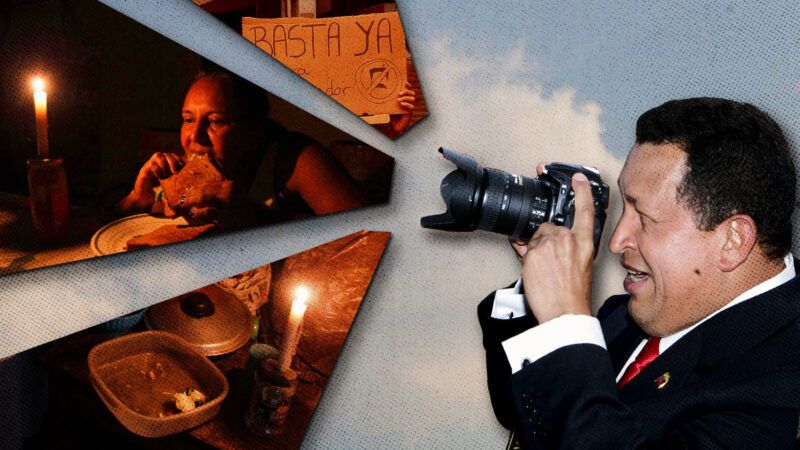
Venezuela's electric grid was once the envy of Latin America. The Guri Dam, completed in 1986, was one of the world's largest hydroelectric plants, and the nation's grid reached 96 percent of households by the early 2000s. Today, after more than two decades of socialist rule, hours-long outages are routine in Venezuela. Blackouts disable water pumps, cellular service, electronic payments, and hospital equipment. The independent National Hospital Survey reported 233 deaths from 2019 through 2021 attributable to electrical failures, including patients who lost mechanical ventilation or could not reach operating rooms because elevators stopped. In March 2019, a nationwide blackout lasted roughly a week, provoking widespread looting and property destruction. By 2025, just 10 percent of households reported having no routine electricity interruptions.
The Venezuelan regime is now reversing the 19-year-old decision to nationalize the industry, which caused the system's rapid breakdown. The regime-controlled National Assembly has given initial approval to a bill that would open the electricity sector to private investment. The reform would allow private capital to participate in generation, transmission, distribution, and commercialization. However, the Energy Ministry would grant concessions, set rates, supervise operators, and retain broad intervention powers. Licenses could last up to 25 years, with a possible 15-year extension given to public-private companies. The bill's text is contradictory about what would happen to private investment capital once a license expires. The bill doesn't guarantee currency conversion, profit repatriation, state payment security, neutral arbitration, or an independent regulator, and it's unclear whether foreign investors will be willing to risk their capital to repair the nation's broken grid and power plants.
The destruction of Venezuela's power grid traces back to 2002, when President Hugo Chávez froze utility companies' rates. The regime historically cast the freeze as a social good, or the "democratization of access to electricity." Its officials would defend the policy for years: Rates were "absolutely subsidized" and had been "kept well below any limit of what should be charged," as Chávez's vice president Elías Jaua later put it.
Through rampant money printing, Chávez caused runaway hyperinflation. Prices spiraled, but electricity rates stayed frozen. Within a few years, electricity for the average Venezuelan cost next to nothing. Real billing revenue collapsed 83 percent from 1999 to 2015. The country's 14 regional power companies (a mix of private and public firms) were starved of the revenue they needed for routine maintenance. Electricity was virtually free, so bitcoin mining became a thriving industry in Venezuela.
Political meddling prevented experienced engineers from maintaining the grid. Miguel Lara, a former manager of OPSIS, Venezuela's once-independent grid planning and dispatch office, said the executive branch curtailed its authority in November 2001. Lara later said electricity-sector officials had warned the government in writing that year that the country would face a supply deficit in the following years.
In 2007, Chávez nationalized the electricity industry, creating Corporación Eléctrica Nacional S.A., or Corpoelec. "All of that which was privatized, let it be nationalized," he declared. PDVSA, the state oil company, bought the largest private company in the sector for about $739 million. Chávez folded all 14 utility companies into one vertically integrated state monopoly, Corpoelec, and replaced technical managers with political and military appointees.
"The government started bringing in people ideologically aligned but lacking in managerial skills," Lara recalls. "Abuses and mistreatment of personnel became rampant." The company was thoroughly politicized. "Anyone who wouldn't subjugate themselves, go on marches, wear a red shirt, or appear on Chávez's TV show, Aló Presidente, was fired," according to Lara.
By 2009, the grid had exhausted its operating reserve and entered permanent rationing. An El Niño drought reduced water flows into hydroelectric reservoirs and strained urban water supplies. Chávez blamed the weather and called for conservation. During a televised cabinet meeting, he urged Venezuelans to stop singing in the shower and wash in three minutes. "I've counted, three minutes, and I don't stink," he said. Jacuzzis, he joked with his ministers, were incompatible with communism.
As rationing became the norm, government offices closed at lunchtime, stores reduced lighting and refrigeration, restaurants lost food, and factories slowed or shut down. Chávez called rationing an "electricity diet" and predicted that Jesus would make it rain because he was a believer in the socialist movement. In February, Chávez declared a national electricity emergency. Later that year, the National Assembly enacted a new law reserving generation, transmission, distribution, electricity sales, and grid management to the state.
The emergency spending delivered far less electricity than promised. A 2017 investigation reported that Venezuela had spent over $39 billion on roughly 14,000 megawatts of thermal capacity, yet only about 4,000 megawatts were operational. The nonprofit watchdog group Transparencia Venezuela reviewed 40 generation projects initiated or contracted from 2000 through 2014. The group estimated that only 4,361 of the promised 17,513 megawatts became effective and that reported costs exceeded government planning benchmarks by $23 billion.
Several projects became symbols of the spending spree. Derwick Associates, founded by politically connected young businessmen, received emergency generation contracts and faced allegations of bribery and inflated pricing in investigations and civil litigation. The 2,160-megawatt Tocoma hydroelectric project, estimated to cost about $3.05 billion in 2006, and originally promised for 2012, missed successive completion dates and never generated commercial electricity. Available public records don't reflect how much was ultimately spent.
The regime has never offered a persuasive explanation for the grid's breakdown. Official accounts shifted from blaming the drought and El Niño in the 2010s to accusations of opposition sabotage backed by the CIA, claims that rats and iguanas were eating cables, and a U.S. cyberattack and electromagnetic attack directed from Houston and Chicago on Pentagon orders. Corpoelec lost roughly half of its workforce, including 14,700 engineers and technicians.
Today, Venezuela can't generate enough electricity to meet demand. Its power plants have a combined capacity of roughly 36,000 megawatts on paper, but fewer than 13,000 megawatts were available in May.
While Venezuela is racing to expand oil production under pressure from the Trump administration, extraction requires a steady supply of electricity. The electric grid is nowhere near up to the task. In April, a grid failure knocked out all 827 of Chevron's wells in the country, according to an internal document reported by Bloomberg.
Venezuela desperately needs private investment, but the regime doesn't want to surrender control, and it isn't offering any credible protection from future property seizures. Many of the very same people in power today have defrauded investors in the past.
At least the regime is paying lip service to reversing a socialist initiative that caused incalculable human suffering. Policymakers charged with unwinding Chávez's disastrous "Socialism for the 21st Century" continue to find it a lot harder to put things back together than it was to tear them apart in the first place.