
The 2026 World Cup Is Over. Here's How To Make It Even Better Next Time.
Plus: nine books for your soccer summer reading list, and a problem with professional golf
Hello and welcome to another edition of Free Agent! Time to invest in aluminum companies.
The World Cup may be over, but our quest to fix soccer goes on. Last week readers sounded off in our "how to fix soccer" survey, so let's go through the results this week. After that, we've got some book recommendations for your post–World Cup reading list, and thoughts on this year's golf major champions.
Don't miss sports coverage from Jason Russell and Reason.
Locker Room Links
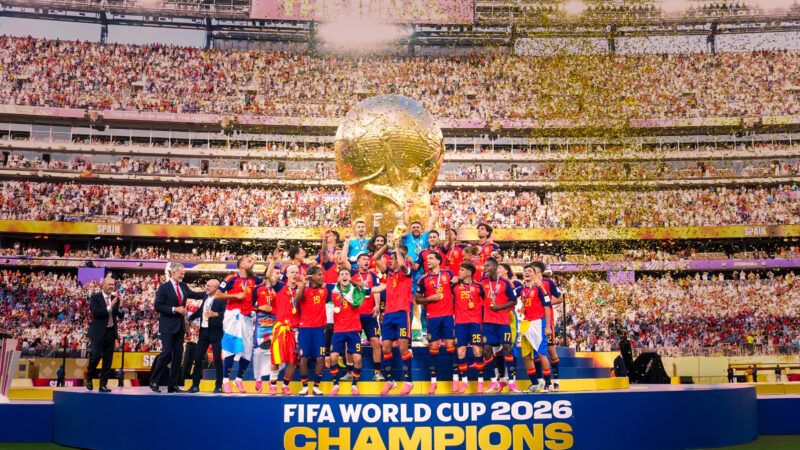
- Watch here: President Donald Trump very predictably tried to stay in the picture as Spain lifted the World Cup trophy. (He looked positively Joe Biden-esque, except it was on purpose instead of confusion.) Trump also had thoughts on England's tactics.
- Bryson DeChambeau reportedly threatened to call Trump during a dispute over his two-stroke penalty at the Open Championship.
- New Jersey is spending $5 million of taxpayer money on Rutgers athletes through NIL.
- "The Mets spent hundreds of thousands on AI. Then MLB stepped in."
- The latest on MLB's labor dispute, ahead of the likely lockout after the season.
- International college athletes may be limited to just four years in school, and may be restricted from transferring, under a new Department of Homeland Security policy.
- Must be nice! Vice President J.D. Vance reportedly wanted a military helicopter to take his son to a golf lesson—after it was reported, they instead planned to have Secret Service agents drive instead.
- Elsewhere in Reason: "Baseball Is Being Watched More Than Ever. But Fewer People Are Falling in Love With It."
- Sigh.
Government-imposed limits on how many members a private college sports conference can include?
Government-imposed five-year waiting periods for a college to join another conference?
The era of Big Government is back! https://t.co/l7648WXHIr
— Michael McCann (@McCannSportsLaw) July 20, 2026
Let's Fix Soccer
Far be it from us to try and fix the most popular sport in the world, but last week I asked readers to submit their ideas for improving soccer, and you guys came out in force. We got more survey results for this than when we did the same exercise with the Olympics, NFL, college football, and baseball. As with those, these are not the changes I'd make in a perfect world—we're trying to balance what fans, players, club owners, and all the various governing bodies (domestic leagues, continental confederations, and FIFA) want. I wrote last week that FIFA did a good job cracking down on flopping and time-wasting at the World Cup, but I still think we can do better.
World Cup: A lot of people had strong opinions about the size of the tournament—one person even suggested expanding the group stage to 128 teams. Others want it to go back to 32 teams. But expanding to 64 teams solves a lot of problems: FIFA gets more TV money (more participating countries and more games), there's more drama because third-place teams won't get to the knockout stage, and also more total ticket revenue while average get-in ticket prices might fall because of the increase in supply. FIFA should not be afraid to schedule back-to-back or overlapping matches, like the first two days of March Madness.
I used to be a 32-team stalwart, but I think this tournament showed the best teams rose to the top even with the expanded format. Purists hate the hydration breaks—broadcasters love them, the competitions selling TV rights will love them, and honestly, no matter where I was watching from, I didn't mind having a preset time to get out of my seat. Also, as we said during the Folarin Balogun situation, no more automatic suspensions for a red card or a certain number of yellow cards: Just have an independent authority decide what actions, on or off the field during the World Cup, are worthy of a suspension.
Also, no one suggested it, but FIFA should bring back the Confederations Cup the year before the World Cup. The champions of the continental tournaments got to play in this, creating higher stakes. (The women's game is especially in need of this.)
On-field Rules: The lack of scoring is part of what makes soccer great, but I've long wished soccer had twice as many goals (basically as much scoring as hockey). Soccer's rulemakers should seek to marginally increase scoring, starting with more trials for the great Arsene Wenger's "daylight offside" rule, where an attacker is only offside if his entire body is offside, instead of a single toe or ear. (Some people proposed a shot clock or an over-and-back rule, but I think the unintended consequence is just more people booting it aimlessly toward goal from near the halfway line). I'm also intrigued by someone's idea to move corner kicks a couple yards closer.
What should we do about penalty kicks and overtime? They're fun to watch, but everyone wants to change them. I had not heard of the Attacker, Defender, Goalkeeper (ADG) proposal. I'm sympathetic, but I think it has a fatal flaw: attackers get a penalty kick if they're fouled, so they'll try to draw a foul every time, and we end up scrutinizing the referee's decisions over and over again in this high-leverage situation. Instead, play normal soccer, but with fewer players: the first overtime is 10 minutes (two five-minute halves) played with 10 players for each team, the second overtime has 9 players, so on and so forth. Newcomers hate the never-stopping clock—I say keep it the same for the purists (and the people who want the game to end in two hours) but pause it in extra time for major stoppages (injuries, goals, etc.) so people don't have to guess when the game will end, but it should still end at the referee's discretion. Lastly, people seem to really hate the players' annoying behavior—refs should just give out more yellow cards (and they probably deserve two or five minutes in the penalty box or "sin bin" for that).
Club Soccer: Lots of strong opinions here, especially on MLS. "The cartel model of MLS isn't working," as one person said. I do love that we have the United Soccer League and its promotion-relegation model competing with the MLS. The MLS owners will almost certainly not give in to promotion and relegation like everyone wants, but they should certainly get rid of the salary cap (and all the kabuki rules around designated players). Why do so many foreign games get better TV ratings in America than MLS? Because Americans like to watch the best players. If MLS wants to compete with the Premier League for the biggest American soccer fans, then let owners invest more money into their team's wages.
A lot of you also took this question in the direction of youth soccer: Pretty much everyone agrees that youth soccer is broken—too expensive, too much time, too much travel, overly stringent. Some of that is on the leagues, some of it is on parents for partaking. My thought is that kids should participate as long as they're having fun—and if it's not fun anymore, either quit or find a more casual league or team to play on. (Also, teams should focus more on developing skills in practice and only play matches once a week.)
Video Assistant Referee (VAR): Soccer purists tend to hate VAR, so I was very surprised by this survey result: 83 percent of you want to keep it and slammed the "VAR is good, actually" button. Let's quibble around the edges, though. For example, I agree with this person: "Doesn't make sense to be able to take away a corner, but not award one." I don't think soccer's use of VAR gives deference to the call on the field, or to the idea that it's only overturning a clear error, or that its measurements have a margin of error—adding all of these to the decision making process would be helpful, I think, because it helps remind viewers these are judgment calls.
People are still mad about the Egypt goal against Argentina that was erased. To me, it didn't look like a foul. But if it was a foul, it was right to call the goal off because the foul led directly to the attacking move that scored the goal—if Egypt had "reset" by passing the ball around the back a bit, then the foul shouldn't have mattered.
Miscellaneous: I'm not going to lie, this is just a place to put your funniest responses. "The USA team should go with USA Soccer instead of an acronym that only disappoints us when Mutant Ninja Turtles don't show up on the field." "Lifetime ban for floppers." "End the awful haircuts. Those Euro-mullets look like the barber started with the wrong clipper, shaved too high, then ran out the back door." "Every [World Cup] game needs an anime intro that plays on the field." "Players should have to wear steel toed shoes so there aren't so many time wasting owies." "VAR complaints are stupid, VAR prevents cheaters like [Trump] from corrupting the game." (And yes, I noticed the person who just suggested turning soccer into hockey.)
Your Post-World Cup Soccer Reading List Is Here
If you're new to soccer and looking for more, I've got the reading list for you. (If you're not interested, skip ahead for some thoughts on golf and the Open Championship.)
Most of my summers in college were spent reading books about soccer. Here's a quick rundown of what I recommend you read.
How Soccer Explains the World, by Franklin Foer: If you feel like you're 20 years behind your soccer friends, this is a short, digestible, and relatable introduction to soccer around the world. If you've ever wondered if hooligans are still a thing, why Celtic and Rangers hate each other so much, or what it's like as a female soccer fan in Iran, Foer's 2004 book will tell you, all while showing the many ways soccer intersects and influences the economic and political forces in society.
Soccernomics (2026 World Cup Edition) by Simon Kuper and Stefan Szymanski: I read the original 2009 edition multiple times, and I've read some of the updated versions too. I don't endorse everything it says (soccer's transfer system gives athletes incredible individual agency, contrary to the authors calling it "evil" and comparing it to human trafficking), but it's always been very informative. It's one part Freakonomics-style look at soccer's misconceptions, as well as a deep dive on which countries do best, and why.
World Cup Fever by Simon Kuper: This is basically a quick jaunt through World Cup history, with a focus on World Cups since 1990 (every one of which the author has attended) after an educational history lesson on Jules Rimet, who was president of FIFA when the World Cup began and started to grow. This is not the World Cup through an American's eyes, so don't expect to see a riveting retelling of Landon Donovan's 2010 winning goal against Algeria. But you'll relive the biggest moments through the world's eyes and the author's eyes, with enough supplemental information to form your own opinion on FIFA, the World Cup, and various hosts. The exclusive interview with Sepp Blatter is unexpected and fantastic.
Fever Pitch by Nick Hornby: Have you read all of that and you're ready to start watching a club soccer team weekly? Great, you should root for Arsenal. Hornby's 1992 book won't necessarily tell you why, but you'll feel pulled in by the passion—even if his own passion grew into excessive obsession. It's a seminal work in the soccer memoir genre, even if Soccernomics explains to you why Hornby's obsession is not the norm. You'll follow Hornby, and Arsenal, from childhood to adulthood through all the troubles and glories.
A Bigger Field Awaits Us by Andrew Beaujon: If you're looking for a more narrow history that will stick with you, A Bigger Field Awaits Us tells the story of Heart of Midlothian Football Club in Edinburgh, Scotland, as the team, city, and country navigate the Great War. Sixteen players from the club, and 500 fans, joined a battalion that was sent to the trenches. You can probably imagine how the Battle of the Somme went for them, but the book will tell the story in heartbreaking detail. (Plus, you'll pick up a Scottish team to root for: Hearts very nearly upset the Celtic-Rangers stranglehold on the Scottish Premier League last season.)
The Club by Joshua Robinson and Jonathan Clegg: For those looking for something on the business side of soccer—I shouldn't recommend a book I haven't read, but if the same authors' treatment of Formula 1 is any indication, The Club is probably fantastic as well. It will tell you everything you wanted to know about how the Premier League came to be founded in 1992, and it will be easy to read with plenty of character-driven details. You'll probably spend weeks thinking about whether the same kind of disruptive league could happen in American sports.
The Mixer by Michael Cox: While Soccernomics looks at what makes a club or country good at soccer, The Mixer looks at what teams are actually doing on the field to win. What made Wenger, Alex Ferguson, and Jose Mourinho such good managers? How did tiny Leicester City win the Premier League? It's a tactical and managerial history of the Premier League. (Those who want a wider historical and global look at tactics would like Jonathan Wilson's Inverting the Pyramid.)
Net Gains by Ryan O'Hanlon: If you watched World Cup matches and enjoyed seeing the expected goals stats and those weird momentum graphs, or wanted to learn where those stats came from, then you're in soccer's analytics camp. Welcome! No one who's not here wants to hear about it. If you want to read Moneyball but for soccer, Net Gains will tell you more about how the numbers and stat-heads are upending the game.
The National Team by Caitlin Murray: If you forgot the Women's World Cup is next year, followed by the Olympics the year after that, then shame on you. Thankfully, The National Team is here to tell you everything you want to know about the history of the U.S. Women's National Team. Murray's thoroughly sourced book goes from the team's creation to the record-setting fourth World Cup title in 2019. (Hopefully we get a 2027 update that covers the 2022 equal pay agreement and the 2024 Olympic gold.)
A Problem With Pro Golf
With apologies to Ryan Fox of New Zealand (who showed amazing stones to knock in a birdie putt on 18 to win), most sports fans probably saw the notification on their phone announcing his Open Championship victory and said "Who?"
While tennis was excessively dominated by the same three guys winning almost every major for 20 years, golf this year has had the opposite problem: Too many tournaments won by random guys the average sports fan has never heard of. If the point of a major is that it's a big deal and everyone wants to win and whoever wins goes down in history, then the person who wins should probably be one of the best golfers in the world and not just a guy who played golf very well for four days.
Before he won, Fox was 56th in the Official World Golf Rankings with two minor PGA Tour wins to his name. Before Wyndham Clark won this year's U.S. Open, he was 37th (granted, he's won that tournament once before and has played in a Ryder Cup and a Presidents Cup). And before he won the PGA Championship in May, Aaron Rai was ranked 44th with one PGA Tour win. Meanwhile, some guy named Rory McIlroy won the Masters in April by battling some of the best in the world—everyone else who finished in the top 10 at the Masters was ranked in the top 35 in the world before the tournament, most of them in the top 10 (except for Max Homa—who was ranked 163rd but has six PGA Tour wins).
Maybe I'm just yelling at a cloud here about some statistical noise this year, because there aren't really any great solutions to this. Golf purists, and probably golfers themselves, don't want majors to have five rounds even though it might help separate the best from the pretty good (though five rounds would probably make tournaments, sponsors, broadcasters, and thus, golfers, more money). Smaller fields would cause an even bigger uproar—although the Masters has a smaller field (with 90–100 golfers as opposed to 156 for the other majors) and it's the most popular major.
The problem here isn't just legitimacy of the winners, it's marketing. Even though I've been watching golf pretty closely over the last couple years, I hadn't heard of Fox or Rai beyond seeing their names as I scrolled through leaderboards. There's only so many names, backstories, and rooting interests a sports fan can hold in their head at one time. If you want to sell someone on watching the final day of a major, you should be able to sell them on a bunch of household names being in contention.
Replay of the Week
Is there anything more satisfying to score than a World Cup–winning goal that's a rocket into the back of the net? I'll never know, but Ferran Torres will. (Full credit to Nico Williams—he could have tried futilely to head the ball in himself, but wisely heads it back to his teammate for the finish.)
Another look at Ferran Torres' potential FIFA World Cup Final game-winning goal 🔥
Nico Williams with a special assist as Spain look to hold on 🇪🇸 pic.twitter.com/4VTp3wRfJG
— ClutchPoints (@ClutchPoints) July 19, 2026
That's all for this week. Enjoy watching the real event of the weekend, the Big League Wiffle Ball playoffs, on Sunday evening.