Few American institutions illustrate the dynamics of creative destruction quite so vividly as baseball in the 21st century. Television empires have emerged and then been destroyed; streaming platforms have filled the void. New rules have been implemented, games have gotten shorter, and computers call balls and strikes. Attendance has stabilized after years of hand wringing about the game dying.
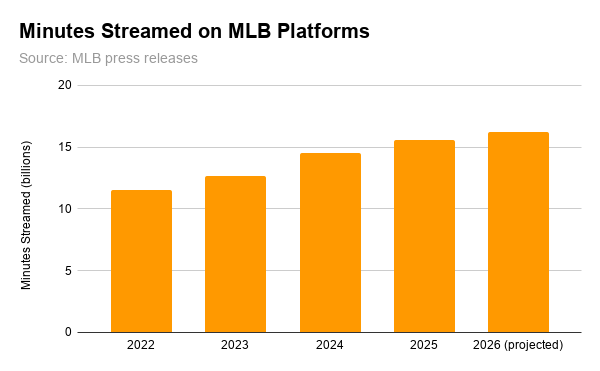
Baseball is being seen by more people, in more ways, than ever before. The catastrophic collapse of the regional sports network model has paradoxically opened the sport to a broader audience. Rule changes have made games crisper and faster. Streaming minutes on MLB platforms have grown by more than 50 percent in just four years. Platforms like Netflix get exclusive rights to show marquee events like the Home Run Derby.
But there is a hidden ball trick: Mass audiences can't actually watch the games, at least not in the way they did for the past 75 years. For decades, families saw games and developed lifelong loyalties, usually at home but often by going to the ballpark. They were fans of a baseball team. Today, much of the increase in viewership has come from people who are not fans but who have an intense interest in one game, not a team. They place bets, highly specific and often arcane bets, and they watch to see if they won the bet, rather than if their team won the game.
The result is that more people are watching baseball, but fewer are falling in love with it.
How Boxing Lost Its Mass Audience to Pay-Per-View
There was a time when boxing was the most-watched sport in America. The 1978 heavyweight championship between Leon Spinks and Muhammad Ali drew an estimated 90 million television viewers, with roughly 47 percent of all TVs in the United States tuned to the same fight on the same night. Not just a sport, boxing was a shared national event.
Then came the pivot to pay-per-view. The Floyd Mayweather Jr. vs. Manny Pacquiao "Fight of the Century" in 2015 reached approximately 4.6 million households—less than 4 percent of the audience that had watched Spinks and Ali. Viewers paid around $140 in today's dollars, and the revenue was considerable. But boxing sacrificed its mass appeal, along with something harder to quantify: the cultural presence that makes a sport matter to people who are not already devoted fans.
Boxing appeared to be dying. Then came the November 2024 Jake Paul vs. Mike Tyson fight—or farce. That event generated 65 million concurrent streams on Netflix alone, the most-watched single streaming event in history at the time. But many viewers were tuning in to check on prop bets—How long will the national anthem run? Will the fight start late? How many rounds? How many knockdowns?—rather than out of any love for the sport.
Baseball is not boxing. But the structural pressures are similar, and the trajectory bears watching.
The Superstation Era: How Cable Created Baseball Fans by Accident
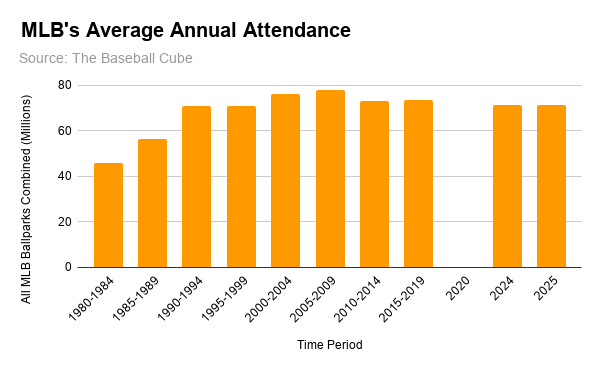
For much of the 20th century, baseball's relationship with TV was uncomplicated and mutually beneficial. When games first appeared on broadcast television, the sport's leadership worried that free access would cannibalize ballpark attendance. The opposite happened: Attendance climbed steadily from 1980 through 2007, when total MLB attendance at all ballparks combined peaked at nearly 80 million fans.
Two institutions were especially responsible. WGN in Chicago began broadcasting Cubs games locally in the 1940s, then distributed its signal across the country via cable. Millions of Americans acquired a second team almost by accident, tuning in on summer afternoons simply because the Cubs were there. Ted Turner's TBS did the same for the Atlanta Braves. These so-called superstations created an underappreciated value: casual fans who watched baseball because it was available and pleasant. Many of them became devoted fans, and the sport grew organically.
Michael Munger
Now attendance appears to have stabilized in the low-to-mid 70 millions, and the rule changes introduced in 2023—a pitch clock, limits on defensive shifts, larger bases—shortened games and revived offense.
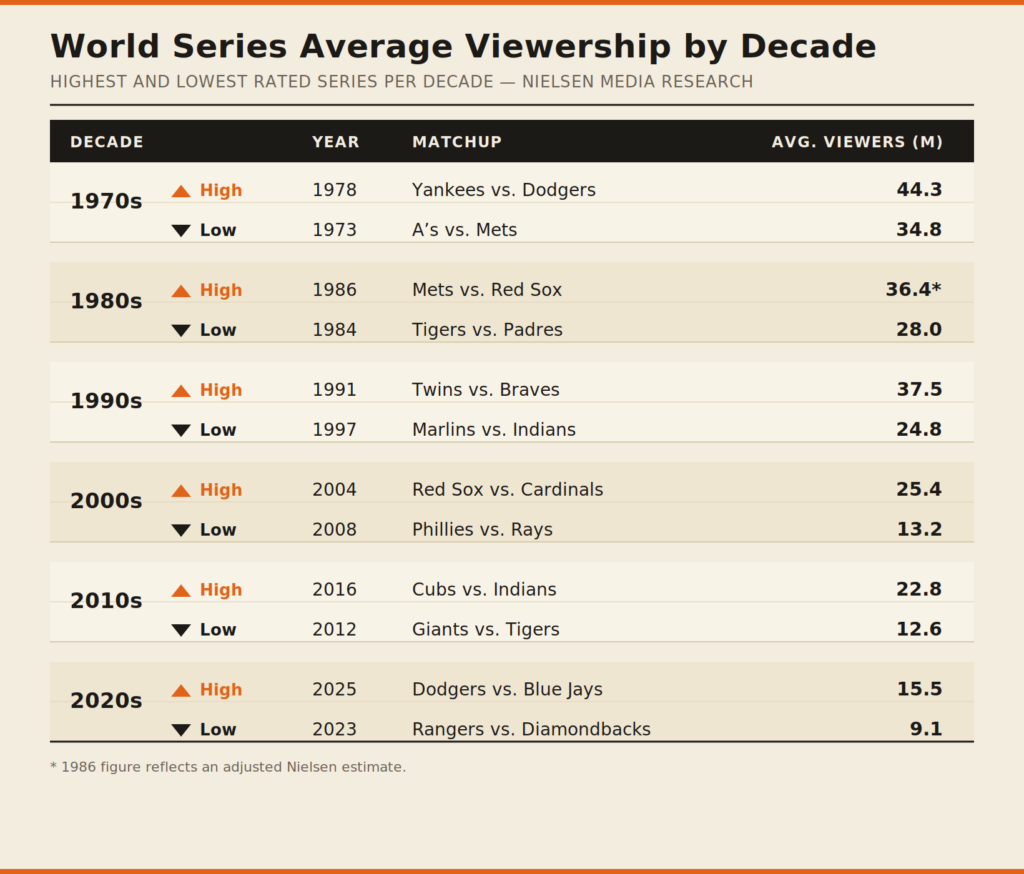
But wait: Broadcast television viewership of the World Series tells a different story.
Michael MungerSource: Wikipedia / Nielsen Media Research/Baseball Almanac. Averages are per-game series averages. *The 1986 series average (36.4 million) is for the broadcast series; Game 7 alone is separately estimated at 55 million to 60 million viewers—the most-watched game ever. The 1978 series (44.3million avg) remains the all-time most-watched series overall. The 1994 series was canceled due to the MLB strike.
These numbers fed a narrative of decline: America's pastime is past its prime (although the 2025 World Series, with 15.5 million viewers for each game, may mark a turning point). But those measures address only legacy media—a distribution channel shrinking across every genre, not just sports. People are actually watching more, not less; it's just that more of them are streaming the games.
How the Regional Sports Network Model Collapsed
When Disney acquired 21st Century Fox in 2019, regulators forced the divestment of Fox's regional sports networks. Sinclair Broadcast Group, through its subsidiary Diamond Sports Group (DSG), used massive debt to buy those 21 networks for $9.6 billion. The deal covered exclusive local rights to 42 professional teams across baseball, basketball, and hockey.
Sinclair bet that Americans would keep a cable subscription package just so they could still watch sports. It seemed plausible. Each team is a local monopoly for its fan base. A Cardinals fan in St. Louis paid for Fox Sports Midwest; he didn't care about other games.
In an unintentionally meaningful name change after bankruptcy, the "Fox Sports" networks became Bally Sports. (Bally's runs in-person casinos. Hold that thought.) Then, to dispel all doubt, a new naming rights deal transformed everything into FanDuel Sports Network. The new value proposition was now fully transparent.
And the old value proposition was destroyed. After emerging from bankruptcy, DSG missed a rights payment to the St. Louis Cardinals. All nine MLB teams under contract ended the deal. What Sinclair paid nearly 10 billion dollars for in 2019 was worth less than nothing. It is one of the most catastrophic misreadings of media industry momentum in American business history.
Why More MLB Viewers Doesn't Mean More Baseball Fans
Nonetheless, total views are up.
A 40 percent increase in streaming minutes over four years is not nothing. National games have migrated to Apple TV, Peacock, and ESPN+. Netflix even got Opening Night, the Home Run Derby, and the upcoming "Field of Dreams" game this season. Game 7 of the 2025 World Series, meanwhile, was the most-watched baseball game worldwide since 1991. Rule changes have brought younger viewers back to a sport that had genuinely become slow and difficult to schedule around a modern attention span.
Michael Munger
But there are now two distinct audiences consuming baseball. The first are traditional fans—people with genuine long-term attachments to teams, people who watch because they care about the Cardinals or the Dodgers or the Tigers. Many attend games in person. Most of these viewers were born in the superstation era, and they are not being replaced.
The second group comprises fantasy sports participants and sports bettors, and it is growing rapidly. Someone who has placed a parlay on a pitcher's strikeout total and on the catcher to hit a home run is watching baseball, but their attention is instrumental rather than affectionate. It's like the way someone watches a horse race: for the outcome, not for love of the animal. When many states legalized sports betting after the Supreme Court's 2018 decision in Murphy v. NCAA, it created a substantial new class of viewers. These viewers watch obscure games or stay tuned through blowouts because they are interested in bets, not baseball.
Declining Youth Participation and What It Means for Baseball's Future
None of this dooms baseball. A sport can survive online with an audience composed primarily of bettors, fantasy players, and fair-weather fans. Boxing is still very much alive, as those 65 million Netflix streams demonstrated.
But boxing no longer manufactures new fans. It survives on spectacle, nostalgia, and occasional events large enough to pull in a mass audience that does not normally follow the sport. It has no pipeline of young people who grew up watching it, arguing about it, and building part of their sense of self around allegiance to a particular fighter. That pipeline was cut when the mass audience was surrendered to pay-per-view, and it has never been restored.
This is the question that MLB's streaming metrics cannot answer: Are the new viewers becoming fans? Are children watching baseball—all nine innings, over a full season—and forming the kind of attachments that sustain a sport across generations? Or are they catching the last three innings because a player on their fantasy roster is batting in the eighth?
The evidence is mixed. Youth participation in baseball has declined. The average age of the broadcast television baseball audience, and of those who attend games, has been rising for years. The sport's social media presence is robust, but engagement metrics measure attention rather than devotion. MLB has invested in youth programs, and teams freed from regional sports network contracts now stream on MLB.TV without blackout restrictions—a genuine improvement over the old model.
But accessibility is not the same as cultivation. The superstation era created casual fans accidentally, through ubiquity: Baseball was there, every day, all summer. The contemporary streaming environment requires active subscription choices and competes for attention against an essentially unlimited array of alternatives. A child who does not already have a reason to seek out baseball won't stumble across the next Harry Caray singing "Take Me Out to the Ballgame."
The creative destruction playing out in baseball media is real, and in some respects it is genuinely liberating. The regional sports network model was, at its core, a rent-extracting system that forced fans to pay for a whole bundle of channels they rarely watched in order to follow the team they loved. Its collapse has made baseball more accessible to cord-cutters than at any point in decades. A fan in Denver can now follow the Tampa Bay Rays with a clarity and convenience that was simply impossible 15 years ago.
But the process that Joseph Schumpeter described long ago—an economy "incessantly destroying the old one, incessantly creating a new one"—really does destroy as well as create. What has been destroyed in baseball's media transition is harder to rebuild than a cable network: the ambient, low-commitment exposure that helped turn ordinary Americans into baseball fans across several generations. The sport is now watched more than ever, but differently: with more purpose, less serendipity, and a growing share of viewers whose interest is financial rather than emotional.
If that trend continues, baseball will become like boxing: durable, occasionally spectacular, profitable for those who manage it well, and slowly detached from the broad cultural presence that once made it America's pastime. The views will keep going up. But the fans—the real ones, who teach their children the infield fly rule and argue about the designated hitter and remember where they were when their team won the World Series—may be a shrinking share of that growing audience.
A 3-Part Plan To Save Baseball's Next Generation of Fans
What should baseball, and those of us who love it, do about all of this? Government subsidies are likely to make things worse. In a couple of years, Yankee Stadium would look like Seville Cathedral in Spain: enormous, beautiful, and almost always empty. Major League Baseball deserves a better fate than that.
It is possible to foster committed fans while retaining the new viewership that streaming and sports betting have delivered. But it will require three things.
The first is ubiquity—something like the superstation effect for the streaming age. Baseball needs to be findable by people who are not looking for it. That means aggressive free-to-air distribution: not just on subscription platforms, but on free, ad-supported streaming services, on social media in full-game or half-game form, and in public spaces. A teenager who stumbles across a pennant race on a phone or a sports bar television is a potential fan. A teenager who would have to subscribe to three different services to find a game is not. MLB's blackout restrictions and fragmented rights packages remain the single greatest structural obstacle to organic fan growth, and eliminating them should be the priority.
The second element is a genuine youth strategy, built not around Little League participation statistics but around spectatorship. Baseball grew its 20th-century fanbase through radio and then television—technologies of passive absorption that allowed children to absorb the rhythms and rituals of baseball without any active effort. The equivalent today is short-form video: the moment Shohei Ohtani hits a ball into the upper deck, or a pitcher strikes out the side on nine pitches, that clip needs to be everywhere within minutes, without paywalls or friction. MLB Advanced Media has the technical infrastructure for this; the question is whether the league's rights structure will permit it. Allowing social virality of highlight moments—even at the cost of some licensing revenue—is an investment in the next generation of fans. But if anything MLB may be going in the other direction: by pushing big games and major events behind a streaming paywall.
The third element is storytelling. The bettors and fantasy players who now constitute so much of baseball's viewing audience are an opportunity. People who have spent a season watching a particular pitcher because of a fantasy investment have, almost despite themselves, developed a relationship with that player. The sport needs to meet them there, telling the human stories behind the statistics, making the game emotionally legible to people who arrived through a spreadsheet. The pitch clock and the rule changes have made baseball faster and more watchable. What remains is making it more lovable—helping casual viewers find their way into the narratives, rivalries, and characters that emerge from baseball's essential drama: one person using all his strength and guile to throw a ball past another man using all his power to hit that ball past other people who are intentionally positioned to make him fail.
A baseball that achieves all three—a sport that is ubiquitous, youth-oriented, and emotionally resonant—is one that can absorb the betting audience without becoming dependent on it, grow viewership without mortgaging the future, and pass itself on to a generation that did not grow up with Harry Caray. Schumpeter's creative destruction does not have to end in a cautionary tale.