
America's Founding Drinkers: Washington and His Men Knew How To Party
America was founded by drinkers, distillers, and maltmen whose consumption would be labeled problematic by today's public health authorities.
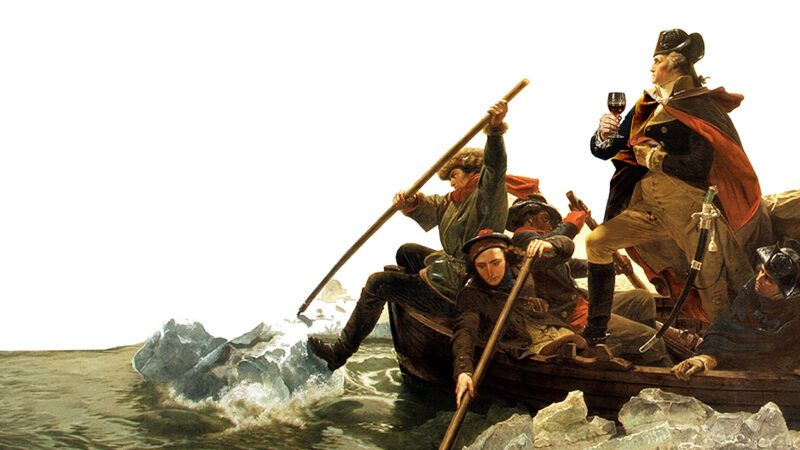
In a special America 250 issue, Reason takes a look back at our country's founding people and ideas. Read more here.

There are a lot of words you could use to describe America's Founding Fathers: geniuses, visionaries, ideologues, perhaps even bros.
Here's another word you could use to describe them: drunks.
America was founded by drinkers, distillers, and maltmen whose consumption would be labeled problematic or worse by today's public health authorities. In a recent Supreme Court argument about marijuana and gun rights, Justice Neil Gorsuch noted the Founders' penchant for heavy boozing. "John Adams took a tankard of hard cider with his breakfast every day," he said. "James Madison reportedly drank a pint of whiskey every day. Thomas Jefferson said he wasn't much of a user of alcohol—he only had three or four glasses of wine a night."
Gorsuch's point was that drinking norms were different, and so were standards for excess. "The American Temperance Society, back in the day, said eight shots of whiskey a day only made you an occasional drunkard." To be a habitual drunkard in the old days, he noted, one had to double that.
Certainly, by today's doctor-approved standards, the Founders' drinking would have called for treatment or intervention. So were the Founders habitual drunkards?
Whatever your answer to that question, it's clear they knew how to party.
On September 14, 1787, George Washington stepped into the City Tavern in Philadelphia with his pals and began a night of drinking that would make today's wildest frat parties look like afternoon tea. It was a Friday night, and the Constitutional Convention that would produce America's foundational document was all but concluded; the signing would take place just three days later. So Washington, then in his mid-50s, and his companions did what the moment called for. They got rip-roaring drunk.
Washington and a party consisting of "55 gentlemans" consumed 45 gallons of booze that night. The beverages served included seven bowls of punch, eight bottles of cider, a dozen bottles of unspecified beer, 22 bottles of porter, 60 bottles of claret, 54 bottles of the fortified wine Madeira, and eight bottles of whiskey, according to an itemized receipt that was reconstructed and later published in The Washington Post in 2018. It was, as the Post put it, a "bender that began America."
Washington went on to become a spirits entrepreneur, opening a distillery at his home in Mount Vernon, a revitalized version of which is open today. His distillery made whiskey and apple brandy, an aged, whiskeylike spirit distilled directly from apples. By the end of the 1700s, he was reportedly selling nearly 11,000 gallons annually. His customers consisted mostly of his local circle—neighbors, traveling merchants, family, and staff from the estate, according to the Mount Vernon library website. Much of the whiskey was sold for cash, but he sometimes traded it directly for services from his family physician, James Craik, meaning he literally kept his doctor in good spirits.
Drinking was a way of life for Washington, who mixed politics and spirits long before he got into the business himself. In 1758, before the American Revolution, he was elected to the Virginia House of Burgesses as a representative from Frederick County. His campaign plied voters with booze, according to Mount Vernon, distributing 28 gallons of rum, 50 gallons of rum punch, and 82 gallons of wine, beer, and cider to Virginia's thirsty colonial ballot casters.
Not all of America's Founders were fans of whiskey. Jefferson was well-known for his opposition to the spirit. In an 1818 letter, he complained that whiskey was "destroying" the middle and lower ranks of American society and "ruining their families."
But Jefferson wasn't an anti-alcohol crusader. He was another familiar type: a wine snob.
In that same letter, Jefferson complained about the era's tariff on wines, which he called "a tax on the health of our citizens" and "a legislative declaration that none but the richest of them shall be permitted to drink wine." Tariffs, Jefferson understood, were functionally taxes that raised the price of goods, with predictable economic consequences. A tax on wine meant that more Americans were consigned to what he called the "poison of whisky."
John Adams was a fan of good wine as well, and his surviving diary entries are dotted with descriptions of booze. In September 1774, he described a party featuring the "most excellent and admirable" wines. "I drank Madeira at a great Rate," he wrote, "and found no Inconvenience in it."
Samuel Adams, the namesake of one of America's great craft beers, may or may not have brewed the stuff himself. But according to a 1751 advertisement in the Boston Evening-Post, he sold it, offering "strong beer, or malt for those who incline to brew it themselves; to be sold by Samuel Adams, at a very reasonable rate."
Reasonable is not a word that today's health authorities would have used to describe the Founders' relationship with alcohol. In recent years, the consensus among the global public health community has shifted toward abstention. The latest guidelines from the World Health Organization, Canada, and the United Kingdom say no amount of alcohol is safe for consumption.
That recommendation contrasts with the updated federal dietary guidelines released early this year in the United States. The new guidelines say you should "consume less alcohol for better health." But they omit a longstanding recommended limit of two drinks a day for men and one for women, leaving it for individuals to decide. Truly, it's the American way.
Yes, consuming less alcohol might be good for your liver and your longevity. But for America's founding drinkers, consuming more was the path to a nation that, after 250 years, is still in good health.