
Supreme Court Slams the Door on Asylum Seekers at the Border
Justice Samuel Alito compared asylum seekers who haven't made it across the border to a running back being tackled on the 1-yard line.
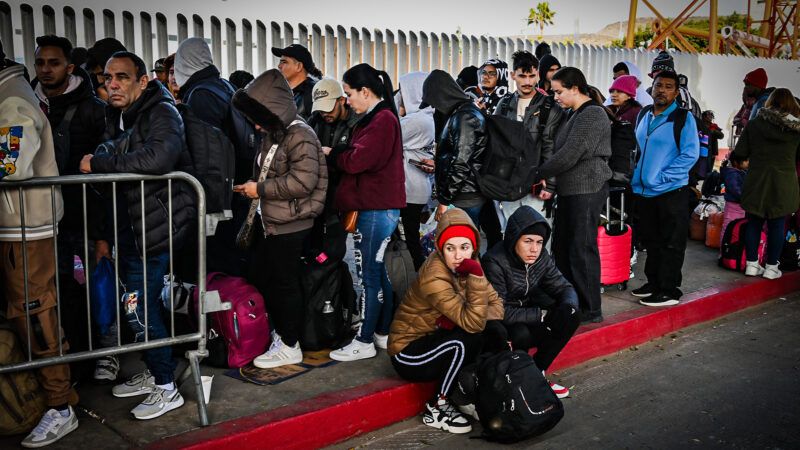
A 6–3 conservative majority of the Supreme Court ruled Thursday that the U.S. government can turn away asylum seekers who arrive at the border without processing their claims.
The case, Mullin v. Al Otro Lado, was one of the closely watched immigration cases of the current Supreme Court term. It concerned whether an alien who is stopped on the Mexican side of the U.S.–Mexico border "arrives in the United States" under the meaning of the Immigration and Nationality Act (INA), which states that an alien "who arrives in the United States …may apply for asylum" and be inspected.
The decision reverses and remands a ruling last year by the U.S. Court of Appeals for the 9th Circuit, which held that the law "encompasses those who encounter officials at the border, whichever side of the border they are standing on."
However, writing for the majority, Justice Samuel Alito wrote that the ordinary, commonly understood definition of "arrives in" meant that Customs and Border Protection (CBP) had no obligation to inspect asylum seekers until they set foot in the country.
"The running back does not arrive in the end zone (and six points do not go up on the scoreboard) when he is tackled at the 1-yard line by the defense," Alito wrote. "The guest does not arrive in the house when the homeowner locks the door right before the guest tries to open it. The army does not arrive in the city when the city's defenders repel the attack outside city limits. And the letter does not arrive in the mailbox when a dog assaults the carrier a step away from the mailbox. A person arrives in a destination only when he enters it, and that conclusion does not change because someone or something blocks entry. A person arrives in the United States, then, only when he enters it."
In a dissenting opinion, Justice Sonia Sotomayor, joined by the Court's other two liberal Justices, Elena Kagan and Ketanji Brown Jackson, wrote that the majority's "fixation" on the word "in" had led it to ignore the legislative history and context that suggested that the INA was clearly intended to include noncitizens in the process of arriving. To hold otherwise would give the government free license to avoid its statutory obligations altogether.
"It does not make sense to say an asylum seeker's arrival depends on whether she has taken a step across the border or her foot has not yet landed, or whether her hand is outstretched across the threshold or is still by her side; she is arriving in the United States for purposes of seeking admission," Sotomayor wrote.
The case was precipitated by the surge in asylum seekers in 2016. In response to the wave, the U.S. government began a policy of "metering" how many asylum seekers it would process at a time, allowing agents to turn some back at the border.
In 2017, the immigrant rights organization Al Otro Lado and 13 asylum seekers sued the U.S. government, claiming that the INA requires CBP to process asylum applications and inspect aliens who reach the Mexican side of the U.S.–Mexico border. In addition, Al Otro Lado alleged that the "metering" was not based on actual capacity problems; the government turned away asylum seekers even at uncrowded ports of entry.
The Biden administration rescinded the turnback policy. The Trump administration has not restarted it, but argued it should have the power to do so if necessary. The Trump administration argued in its briefs to the Supreme Court that the ordinary meaning of "arrives in" should guide the Court.
"An alien on the Mexican side of the border may be 'close to the United States,'" the government argued in its brief seeking review, "and may even have 'arrived at the United States border,' but he has not 'arrived in the United States.'"
The case attracted a wide range of amicus briefs in support of Al Otro Lado's position from civil and human rights groups, as well as the U.S. Conference of Catholic Bishops (USCCB), all of which argued that reversal would inflict life-threatening harm on vulnerable asylum seekers fleeing persecution.
The USSCB wrote that the turnback policy "was devastating to asylum seekers while it was in place, and giving the government free rein to implement it again would be catastrophic."
"USCCB writes to underscore that the flaws in the turnback policy run much deeper than plain text," the bishops wrote. "The policy violates the obligation to care for refugees—a fundamental legal and moral principle that runs through nearly two millennia of Catholic faith, an international humanitarian consensus, and this Nation's history."