
Darializa Avila Chevalier Will Be This Congress' First Campus Radical
A democratic socialist who favors the eradication of Western civilization just won her primary.
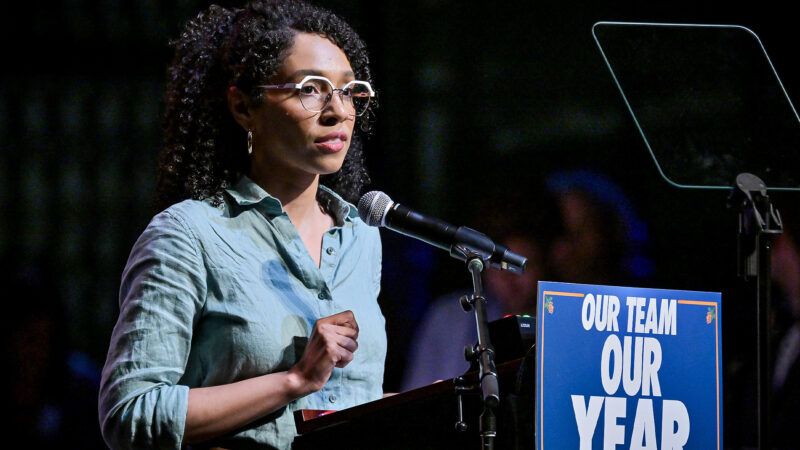
You have probably heard the news: The Democratic primary elections in New York City went very well for the Democratic Socialists of America (DSA). Mayor Zohran Mamdani, a democratic socialist, leveraged his popularity and star power to propel three of his best friends to victory over more establishment figures, two of them incumbents. The winners are all but guaranteed to advance to Congress: Brad Ladner—whose ouster of incumbent Rep. Daniel Goldman (D–N.Y.) was a proxy battle over the Israel issue—Claire Valdez, and Darializa Avila Chevalier.
Avila Chevalier, the most overtly radical of the three, is an interesting figure because she represents a stunning triumph for modern campus progressive activism; she will be the first person elected to Congress who comes directly from that world. Rep. Alexandria Ocasio-Cortez (D–N.Y.) is a democratic socialist and a progressive activist, but she was not a central figure in those movements until well after she graduated from Boston University. Avila Chevalier, on the other hand, was a prominent far-left activist at Columbia University throughout the 2010s and remained involved with the pro-Palestinian campus protests there in 2023 following Israel's attacks on Hamas in Gaza.
She co-founded Columbia University Apartheid and Divest (CUAD), an organization that did not merely oppose the state of Israel but also celebrated terrorism outright. After the death of Yahya Sinwar, CUAD's Substack published a glowing eulogy of the Hamas terrorist who masterminded the October 7 attack on Israelis. CUAD hailed him as a "hero of the revolution" guided by "pragmatic optimism." The group called on its followers to "reflect on how we can make ourselves more like him."
Avila Chevalier was also involved with the related group Students for Justice in Palestine (SJP), which explicitly celebrated the October 7th terrorist attack as a "historic win."
It's characteristic of these activists that they do not see the Israel/Palestine issue as distinct from any other issue they may care about, but rather part of a broad and interconnected battle with the United States. Intersectionality is a key facet of this tradition, and so it is not enough to merely express concern for the plight of the innocent Palestinians; to be in good standing with the movement requires fervent denunciations of every other -ism known to man. In fact, one of the defining features of modern campus radicals is that their own mundane feuds with university administrators are cast as manifestations of a global struggle against colonialism, capitalism, and U.S.-led imperialism. In 2024, Columbia protesters demanded the right to occupy administrative buildings, and also to receive food and water from the administration so that their occupation could continue.
So it should come as no surprise that Avila Chevalier is not merely furious about the state of Israel. She is part of an activist movement that favors "the total eradication of Western civilization," a goal that—somehow—is not viewed as in tension with the movement's stated desire to prevent genocide. (One wonders how Avila Chevalier plans to make Western civilization go extinct without anybody getting hurt.) In keeping with her stated desire to eliminate the U.S.-led West, Avila Chevalier has previously commented in favor of Russia's invasion of Ukraine; i.e., she is not merely opposed to American involvement in the conflict (a defensible position) but affirmatively on the side of the attackers.
Indeed, Avila Chevalier's past statements on X—Twitter at the time—are a veritable gold mine of 2010-era radicalism. For instance: She wants to abolish not just the police but the very concept of policing entirely. For good measure, she views interracial relationships with suspicion, thought COVID-19 originated in France, and thinks white people are not hygienic.
In an interview with The New York Editorial Board from earlier this month, Avila Chevalier declined to walk back her most controversial statements. She refused to say, for instance, that murderers belong in prison.
In 2019, when I published my first book, Panic Attack: Young Radicals in the Age of Trump, I predicted that the era's campus protesters would not shed their radicalism when they graduated college and moved out into the so-called real world—rather, they would force the world to conform to their quixotic expectations. This would be particularly felt in the areas of American life most susceptible to their influence: education, media, entertainment, and eventually, politics.
Now that day has finally arrived. Welcome, congresswoman.